- 176 pages
- English
- ePUB (mobile friendly)
- Available on iOS & Android
eBook - ePub
About this book
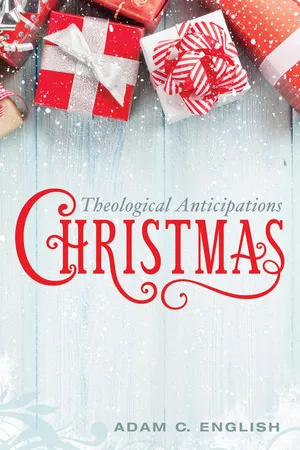
Christmas cheers the birth of Christ with a fresh look at the festive season. English engages the rich theological and biblical themes of Advent as well as family traditions, popular carols, and legends of the holidays. Topics range from a theology of the incarnation of the Word, the role of Mary, the historical origin of December 25, the significance of Bethlehem and the star, the plight of the holy family in a hostile world, and the place of American pop icons like Frosty the Snowman, Santa Claus, and Buddy the Elf. Christmas brims with anticipation.
Information
Topic
Theology & ReligionSubtopic
ReligionOn This Day
We have inherited four Gospels in the New Testament, not just one. Isn’t it curious that the early church did not choose one to be the official version and get rid of the others? What if they had felt especially creative and decided to harmonize the four accounts into one mega-Gospel? Thankfully, they didn’t. The preservation of four Gospels has significant implications for our study of the infancy of Jesus because each Gospel begins the story of Jesus at a different point in time. Each of those beginnings illuminates something important about the incarnation and birth of our Lord.
When Jesus makes his first appearance in the New Testament’s earliest Gospel, the Gospel of Mark, he steps out as a fully grown man just arrived from Nazareth of Galilee (Mark 1:9). Mark never mentions the details surrounding Mary’s miraculous conception or the dramatic birth in Bethlehem. If the New Testament had preserved this Gospel alone as the single witness to the life of Jesus, we might be left with the impression that God chose Jesus unexpectedly from the crowd of people gathered by the waters of the Jordan to be adopted as the honorary son of God. Mark simply relates that Jesus came from Nazareth in Galilee and was put under water by John who was baptizing many individuals at the time. When he came up for air “he saw the heavens torn apart and the Spirit descending like a dove on him” (Mark 1:10). He heard a voice from heaven—“You are my Son, the Beloved; with you I am well pleased.” Jesus went into the wilderness for a period, after which he began his ministry of teaching, preaching, and healing. From Mark we learn nothing of Jesus’ birth or upbringing.
If, on the other hand, we possessed only John’s gospel we would come away with a radically different impression. We might believe that God transmitted his Son to the world in the manner of the first man, Adam. John, like Mark, says nothing about swaddling clothes and cradles. Instead, he declares that the eternal and almighty Word of God “became flesh and lived among us” (John 1:14). Jesus emerges as a radiant figure in full possession of his divine aura. Similar to Mark’s narrative, the Gospel of John introduces Jesus through the eyes of John the Baptizer. The baptizer looks up, sees the outline of Jesus on approach and shouts, “Here is the Lamb of God who takes away the sin of the world!” (John 1:29).
Matthew and Luke, by contrast, provide the greatest amount of information about the nativity. We could spend pages sifting through the details of their accounts. Indeed, the eminent New Testament scholar Raymond Brown managed to produce a mammoth 594-page study of Matthew and Luke’s infancy narratives in the late 1970s: The Birth of the Messiah. We will attempt nothing as bold or laborious, but simply highlight some of the major points.96
Matthew’s gospel opens with “the genealogy of Jesus the Messiah, the son of David, the son of Abraham” (Matt 1:1), a list of descendants organized in three groups of fourteen generations. The scrupulous record of names begins with Abraham and ends with Jesus, “who is called the Messiah,” emphasizing along the way names connected to the kingly, royal lineage of David and Solomon. Although many sound foreign and downright unpronounceable to us, we must remember that the names conjured up heroic tales and mighty deeds in the minds of Matthew’s readers. These were stories they knew and names they recognized. Matthew could imagine no better way to grab readers’ attention than to lay out an epic roll call of names from Israel’s proud history.
Matthew then relates the angelic words to Joseph given in a dream concerning the child growing in the womb of the girl to whom he is betrothed, reassuring him that Mary is indeed a virgin and that the child is from the Lord, a fulfillment of prophecy (Isa 7:14). Joseph makes Mary his wife and names the child born to her Jesus. Wise men from the east come looking for the newborn and are directed to Bethlehem where they pay homage to the child on bended knee. An angel warns Joseph in a dream to flee to Egypt and escape Herod, who has ordered the massacre of the infants under two years of age in and around Bethlehem. Matthew cites the words of the prophets for all these happenings.
Luke gives the most detailed account of events surrounding the birth of Jesus, and for this reason Luke’s version is the one usually read in homes on Christmas Eve. Luke begins with the story of Zechariah and Elizabeth. In dramatic fashion, Zechariah learns that his wife Elizabeth will soon be with child, even though “Elizabeth was barren, and both were getting on in years” (Luke 1:7).97 Then, in the sixth month of Elizabeth’s pregnancy, the young Mary receives a visit from the angel Gabriel in a town in Galilee called Nazareth. We are also told that she is engaged to a man named Joseph, a descendent of David. Mary sets out in haste to visit her relative Elizabeth in the hill country of Judea and together they share in the wonder of God’s work.
Luke records a beautiful song of praise sung by Mary, known by its Latin title, the Magnificat. In it we listen to Mary’s fine-spun testimony of praise, “My soul magnifies the Lord,” and her salty proclamation of justice, “he has filled the hungry with good things, and sent the rich away empty” (Luke 1:46, 53). Three more months pass and Elizabeth gives birth to a boy. Zechariah names him John as the Lord has instructed and then sings his own prophetic song of praise. When the narrative returns to Mary, we find her and Joseph traveling from Nazareth to Bethlehem to be registered in accordance with the decree of Caesar Augustus. Mary goes into labor. The couple must stay the night in a shelter for animals and lay the child in a feeding trough, or as it is identified today, a little niche in the wall with a stone manger.98 Nevertheless, the heavenly host announces the long-awaited birth in a ringing song of praise overheard by night watch shepherds.
On the eighth day the child is circumcised and given the name Jesus. Forty days after the birth, “when the time came for their purification according to the law of Moses,” the family travels to the Temple in Jerusalem to present the child and to offer the requisite sacrifice of purification for Mary (Luke 2:22–4). In the Temple, the prophet Simeon picks up the child and prophesies concerning his future. Then, as if in an aside, he says to Mary that the child is destined for the falling and the rising of many in Israel and that even her soul will be pierced (Luke 2:34–5). The old prophetess Anna offers her own words of foresight and praise. Having completed the requirements of the Law, the holy family returns to Galilee and to their own town of Nazareth (Luke 2:39).
Later in chapter three, Luke gives his own version of the genealogical record (Luke 3:23–38). Unlike Matthew, who begins with Abraham, the founding father of the Hebrew people, Luke begins with Jesus and ends with Adam, the first man. The names in his list vary significantly from Matthew’s, causing scholars to speculate that Luke means to emphasize the priestly heritage in Jesus’ family line, whereas Matthew emphasizes the royal, Davidic heritage. It may also be that Matthew is recording the family line through Joseph while Luke takes the family line through Mary.99 That fits the narrative. Matthew consistently sees events through the eyes of Joseph—it is Joseph who has dreams and Joseph who acts for the family, whereas Luke sees the same events through Mary’s eyes—Mary’s relatives, Zechariah and Elizabeth, Mary’s encounter with the angel Gabriel, and Mary’s reactions to events (for example, Luke 2:19; 2:51). Indeed, Luke most likely spent time with Mary and interviewed her at Ephesus for his account of the Gospel.100 He records details and insights that only Mary could have supplied.
There is so much to mull over in these infancy narratives—historically, spiritually, and theologically. But we are getting ahead of ourselves. Let’s start with the facts, beginning with the most basic piece of information: the date. When was he born? What year? What day? I want to spend some time with these often overlooked questions because I think we will find they contain som...
Table of contents
- Title Page
- Acknowledgments
- Santa Claus in Bethlehem
- Instigating Word
- The Breath of Heaven
- On This Day
- The Rule of Bedlam
- Charting Stars
- Jesus the Migrant
- Saints of the Season
- Works Cited
Trusted by 375,005 students
Access to over 1.5 million titles for a fair monthly price.
Study more efficiently using our study tools.
Frequently asked questions
Yes, you can cancel anytime from the Subscription tab in your account settings on the Perlego website. Your subscription will stay active until the end of your current billing period. Learn how to cancel your subscription
No, books cannot be downloaded as external files, such as PDFs, for use outside of Perlego. However, you can download books within the Perlego app for offline reading on mobile or tablet. Learn how to download books offline
Perlego offers two plans: Essential and Complete
- Essential is ideal for learners and professionals who enjoy exploring a wide range of subjects. Access the Essential Library with 800,000+ trusted titles and best-sellers across business, personal growth, and the humanities. Includes unlimited reading time and Standard Read Aloud voice.
- Complete: Perfect for advanced learners and researchers needing full, unrestricted access. Unlock 1.5M+ books across hundreds of subjects, including academic and specialized titles. The Complete Plan also includes advanced features like Premium Read Aloud and Research Assistant.
We are an online textbook subscription service, where you can get access to an entire online library for less than the price of a single book per month. With over 1.5 million books across 990+ topics, we’ve got you covered! Learn about our mission
Look out for the read-aloud symbol on your next book to see if you can listen to it. The read-aloud tool reads text aloud for you, highlighting the text as it is being read. You can pause it, speed it up and slow it down. Learn more about Read Aloud
Yes! You can use the Perlego app on both iOS and Android devices to read anytime, anywhere — even offline. Perfect for commutes or when you’re on the go.
Please note we cannot support devices running on iOS 13 and Android 7 or earlier. Learn more about using the app
Please note we cannot support devices running on iOS 13 and Android 7 or earlier. Learn more about using the app
Yes, you can access Christmas by Adam C. English in PDF and/or ePUB format, as well as other popular books in Theology & Religion & Religion. We have over 1.5 million books available in our catalogue for you to explore.