eBook - ePub
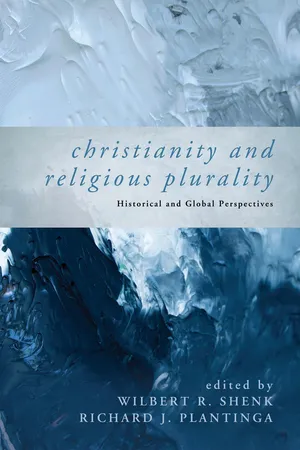
Christianity and Religious Plurality
Historical and Global Perspectives
- 326 pages
- English
- ePUB (mobile friendly)
- Available on iOS & Android
eBook - ePub
Christianity and Religious Plurality
Historical and Global Perspectives
About this book
Over the past two centuries the Christian faith has spread to all continents. Although more global than ever, Christians are religious minorities in most societies. Religious freedom is hardly universal.
In the past fifty years, millions of people have been uprooted from their traditional homelands in Asia, Africa, and Latin America. Some have emigrated to Western Europe and North America. The West has become the scene of cultural, linguistic, and religious variety on a scale unimagined in 1900. Today, the full range of faiths and religious practices from all continents are present in Europe and North America. Christians are challenged to come to terms with this changed situation. These developments have intensified religious plurality. Christians all over the world are being urged to understand and engage with this new situation.
This volume highlights this new reality and specifies some sources for engagement, not least among them the Judeo-Christian scriptures--fundamental to all "Christianities"--that emerged out of religious plural contexts. On the basis of their faith in the Triune God disclosed in this text, all followers of Jesus Christ must interact with these opportunities in today's radically context-sensitive world.
Information
Topic
Theology & ReligionSubtopic
Christian TheologyPart 1
Biblical and Patristics Perspectives
Chapter 1
“Yhwh Our God Yhwh One”
Religious Plurality and the Old Testament11
What attitude does the Old Testament suggest regarding religious plurality? In the first part of this essay I consider varying perspectives on this question that emerge from different parts of the Old Testament. The Old Testament as a whole offers two overarching insights. One is that it is possible to recognize foreign religions as reflecting truth about God from which Israel itself may even be able to learn; but at the same time, the Old Testament sees these religions as always in need of the illumination that can come only from knowing what Yhwh has done with Israel. So the Old Testament does not suggest that one should take a radically exclusivist attitude to other religions, as if they were simply misguided, simply the fruits of human sin, or inspired by demonic spirits. Yet one cannot simply affirm them as if they are just as valid as the Old Testament faith of Israel itself.
The closing sections of the essay suggest why this is so. The narrative nature of Old Testament faith is key to understanding its attitude to this question. The Old Testament is not simply a collection of religious traditions parallel to those of other peoples, although that is one aspect of its significance. In the story of Israel that led to the story of Jesus Christ, God was doing something of decisive importance for all humanity. The Old Testament’s religious tradition is therefore of unique and decisive importance to all peoples because it is part of the Christian story.
Perspectives from Creation: Humanity’s Awareness of God and Distance from God
Genesis 1–11 assumes that human beings are created in God’s image and aware of God. Their disobedience and expulsion from God’s garden did not remove the image or the awareness; this is presupposed by their religious observances in act and word (e.g., Gen 4:1, 3, 26). The God they refer to in connection with these observances is identified as Yhwh, though on the usual understanding of Exodus 6 this identification is a theological interpretation of their practice rather than an indication of the name for God they would themselves have used. They acknowledge God as creator, giver of blessing, judge, and protector, and respond to God in offering, plea, and proclamation. The chapters imply an understanding of the religious awareness of human beings in general that corresponds to the understanding of the ethical awareness of human beings expressed in Amos 1–2. They imply a universal lordship and involvement of Yhwh among all peoples that corresponds to that stated in Amos 9:7.
This understanding also bears comparison with that of Proverbs, Ecclesiastes, Job, and the Song of Songs. These works have particularly clear parallels with others from ancient Mesopotamia and Egypt. Sometimes the relationship with these involves direct dependence, as is the case with the “Thirty Sayings” in Proverbs 22–24. Sometimes the parallels are matters of theme, form, emphasis, and mode of treatment, which as such apply also to features of proverbial, skeptical, philosophical, dramatic, and erotic literature from other times and areas. In either case, non-Israelite insight is set in a new context within the religion of Yhwh (cf. Prov 1:7), but the implication of such parallels is that pagan thought has its own insight. The Old Testament pictures God’s wisdom involved and reflected in creation (Prov 3:19–20; 8:22–31), and God’s breath infused into human beings by virtue of their creation (e.g., Job 32:8). Both ideas suggest a theological rationale for expecting that the nature of the created world and the experience, thought, culture, and religion of the human creation will reflect something of God’s truth. The Wisdom literature is thus evidence of the ability of Yahwistic faith to incorporate the insights of other cultures, recognizing its human value while removing from it idolatrous or polytheistic elements. We might thus reflect on the significance of the Wisdom tradition as a starting point for cross-cultural communication of biblical faith and interreligious dialogue.12
The picture of all humanity as made in God’s image might seem to point in the same direction, though the Old Testament itself does not develop this idea. This lack of reference back to the motif in Genesis 1—as to other aspects of Genesis 1–3—can puzzle Christians for whom these chapters are of key theological significance. Exegetically, the meaning of “the image of God” is much disputed.13 Further, despite the universal form of the expression, originally its point may have been to reassure Israelites of their human significance as much as directly to make a comment on humanity as a whole. So we may say that the Old Testament indeed presupposes that all humanity was made by God and has some insight into the significance of human life, but it does not use the idea of being made in God’s image to express the point.
From the time of Noah, human beings in general are seen as being in a form of covenant relationship with God (Gen 6:18; 9:8–17; cf. the kinship covenant of Amos 1:9). This Noahic covenant undergirds the providential preservation of life on earth. The fundamental idea of “covenant” in Hebrew, as in English, is that of a formalized commitment in relationship; the commitment may be one-sided or more mutual. It would not have raised our eyebrows if the relationship between God and humanity in Genesis 1–2 had been described as covenantal, and it has often been interpreted as implicitly so. The absence of the actual term “covenant” in Genesis 1–2 perhaps suggests that a covenanted relationship is by definition one that needs special protection or undergirding because of known pressures on commitment, such as the human shortcomings that come to expression in Genesis 3–6. It is only when sin has become a reality that commitments need to be the subject of a covenant. It is in any case striking that God enters into such a committed relationship with humanity after the flood on the basis of their shortcomings that had clearly emerged (cf. the explicit argument of Gen 8:21—obscured by NIV).
This is not, however, the kind of special redemptive covenant relationship that Israel later enjoys, with its more explicit committed mutual relationship, which itself turned out to be insufficient to solve the problems unveiled in Genesis 1–11. The human beings in the covenant relationship initiated with Noah are not readmitted to God’s garden, and they tend toward resistance of the fulfillment of their human destiny. Indeed, the events that follow the covenant-making in Genesis 9 underline the moral and religious shortcomings of Noah’s descendants and give Genesis 1–11, as a whole, a rather gloomy cast. The chapters are a background to the necessary story of restoration that follows.
Both sides to Genesis 1–11 have implications for attitudes toward the religions of our own day. On the one hand, the religions reflect humanity’s being made in God’s image and being in a form of covenant relationship with God. Books such as Proverbs further reveal an attitude toward other cultures—of which their religions are a significant part—that looks at them as sources of insight and not merely as expressions of lost-ness. On the other hand, Genesis 1–11 suggests that the religions, like all human activity, belong in the context of a world that needs restoration to the destiny and the relationship with God that were intended for them, which God purposed to bring about through the covenant with Israel that culminated in the mission and accomplishment of Jesus. Similarly, books such as Proverbs, Job, Ecclesiastes, and the Song of Songs illustrate the limitations of what can be said on the basis of human experience outside of Yhwh’s special involvement with Israel.
The religions can thus be viewed both positively and negatively in relation to the faith of Israel. They are not inherently demonic or merely sinful human attempts to reach God. We can learn from them. Yet they are not equally valid insights into the truth about God. They may provide a starting point and certain areas of common ground but not a finishing point. All human religion is not only inevitably tainted by our fallen life in this earth, but i...
Table of contents
- Title Page
- Contributors
- Acknowledgments
- Introduction
- Part One: Biblical and Patristics Perspectives
- Part Two: The Consequences of Christendom before 1800
- Part Three: Contemporary and Global Perspectives
Trusted by 375,005 students
Access to over 1.5 million titles for a fair monthly price.
Study more efficiently using our study tools.
Frequently asked questions
Yes, you can cancel anytime from the Subscription tab in your account settings on the Perlego website. Your subscription will stay active until the end of your current billing period. Learn how to cancel your subscription
No, books cannot be downloaded as external files, such as PDFs, for use outside of Perlego. However, you can download books within the Perlego app for offline reading on mobile or tablet. Learn how to download books offline
Perlego offers two plans: Essential and Complete
- Essential is ideal for learners and professionals who enjoy exploring a wide range of subjects. Access the Essential Library with 800,000+ trusted titles and best-sellers across business, personal growth, and the humanities. Includes unlimited reading time and Standard Read Aloud voice.
- Complete: Perfect for advanced learners and researchers needing full, unrestricted access. Unlock 1.5M+ books across hundreds of subjects, including academic and specialized titles. The Complete Plan also includes advanced features like Premium Read Aloud and Research Assistant.
We are an online textbook subscription service, where you can get access to an entire online library for less than the price of a single book per month. With over 1.5 million books across 990+ topics, we’ve got you covered! Learn about our mission
Look out for the read-aloud symbol on your next book to see if you can listen to it. The read-aloud tool reads text aloud for you, highlighting the text as it is being read. You can pause it, speed it up and slow it down. Learn more about Read Aloud
Yes! You can use the Perlego app on both iOS and Android devices to read anytime, anywhere — even offline. Perfect for commutes or when you’re on the go.
Please note we cannot support devices running on iOS 13 and Android 7 or earlier. Learn more about using the app
Please note we cannot support devices running on iOS 13 and Android 7 or earlier. Learn more about using the app
Yes, you can access Christianity and Religious Plurality by Wilbert R. Shenk, Richard J. Plantinga, Wilbert R. Shenk,Richard J. Plantinga, Shenk, Plantinga in PDF and/or ePUB format, as well as other popular books in Theology & Religion & Christian Theology. We have over 1.5 million books available in our catalogue for you to explore.