- 212 pages
- English
- ePUB (mobile friendly)
- Available on iOS & Android
eBook - ePub
About this book
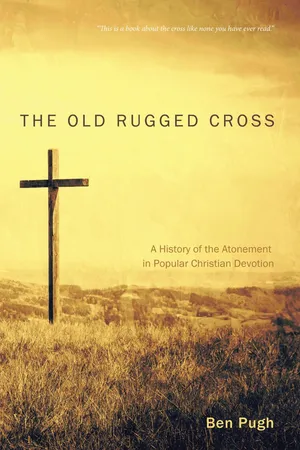
A lot has been said about the atonement theology of the theologians, but what of ordinary believers and their church leaders? What, if anything, have they done with "penal substitution" or with "Christus Victor"? How, if at all, have these doctrinal approaches helped ordinary Christians to live more devoted lives or lead good church services?
Ben Pugh takes the temperature of the church at various points in its history right up to the present day, noting particular emphases that can be detected in various expressions of personal and corporate faith--whether these be hymns, sermons, magazines, or devotional texts. The book aims not only to describe what the implied atonement theologies of the church have in reality been but also to explore why these have taken the forms that they have. This exploration will shed some fresh light on current debates, building on the findings of the author's earlier work, Atonement Theories: A Way through the Maze.
Information
Topic
Theology & ReligionSubtopic
Christian TheologyChapter 1
Crucicentrism
The Search for a Beginning Point
Introduction
So, where does it all come from? When and why did Christianity adopt the cross as its central symbol? And at what point does it start to venerate the blood that flowed upon it? We will begin our search within that relatively murky world that is second- and third-century Christianity.1 It is the part between the death of the last of the apostles at the end of the first century and the emergence of a Christian Europe under Constantine following the Edict of Milan in AD 313. We leave that first world, the New Testament world, anticipating perhaps that the resurrection is destined to become the great centerpiece of Christian proclamation and worship, or that the mystical union with Christ will be the center. We enter the Constantinian era with two things that would ensure that it would be the death of Christ that would occupy an increasingly important central place within the Christianity of Christendom. These two things, in roughly chronological order, are the elevation of the Eucharist in the churches and the veneration of the cross as the main visual symbol of the faith.
The Eucharist
The Story of the Eucharist in the Early Church
The trend in scholarship, since the discovery of a number of new manuscripts, has, until very recently, been towards less and less certainty as to the true origins of the Eucharist. As with similar scholarly problems such as the quests for the historical Jesus (to which the quest for the historical Eucharist is not unrelated), the desire to answer the un-answerable generates very large volumes of literature. The nature of this literature tends to become more and more detailed, less and less meaningful, and more and more filled with assertions that “certainty is impossible,” accompanied by lists of obstacles to that certainty. The reasons for the caution, however, are well stated by McGowan: “The standard account is teleological—an ‘intelligent design’ theory of liturgical history, reading back to produce a picture amenable to the conclusions assumed.”2 Dearly held confessional standpoints have, ever since the days of Gregory Dix brushing aside the Didache, tended to result in fingers in ears and loud singing while evidence has steadily emerged of almost no uniformity or clear chronology in early Eucharistic practice.
In current scholarship,3 the point of widest agreement is that the Eucharist as we know it today is not the Eucharist that Jesus instituted as such. The assumed direct link between the Last Supper and the Lord’s Supper is, unless some new evidence comes to light, undiscoverable, and quite possibly non-existent.4 This may sound shocking and writers try to lessen the shock of that by emphasizing that the Holy Spirit was at work as much in the postbiblical formation of liturgy as he was in the inspiration of Scripture5—something many within the Protestant traditions would doubtless find unconvincing. Be that as it may, what we in fact have are a number of different sources of influence that are largely up-for-grabs since there is no fail-safe way of placing these different Eucharists into a big story: first this, then that, as Chilton attempts.6 Indeed, a lot of scholars are content to say that throughout the second and third centuries a variety of Eucharists existed.7 However, I have been bold enough to arrange Eucharistic origins into two chronological phases, more or less following McGowan, and then further divided the discussion into first one of practice and then one of theology, which follows O’Loughlin.8 And it is hopefully going to be this theological discussion that will be especially suggestive to us of answers to our quest for the origins of crucicentrism.
Mediterranean Banqueting Habits: Jewish and Greco-Roman
Greco-Roman Strands
McGowan9 points out how ubiquitous was the banquet to all forms of voluntary association in the first century. People gathered for all sorts of reasons, drawn together by family and by profession, and by religious and charitable ties.10 Indeed, it is inconceivable that the early church would not have met together in precisely this form: the banquet or symposium,11 and Christians had an even stronger reason for doing so: the precedent set by Jesus in his practice of table fellowship. So, gathering around a meal would have happened regularly even if there had been no tradition of an institution saying and a last supper. Probably some churches were aware of this Last Supper tradition, and others not.
Two ubiquitous elements of these feasts would have been bread and wine. Wine, though varying in quality was not a bourgeois drink, but universal to all such suppers.12 Similarly, it was customary for each guest to bring their own loaf (perhaps resembling the modern Western custom of guests bringing a bottle). The key difference in Christian feasts, if the Corinthians are anything to go by, was the use of one shared loaf rather than everyone bringing their own. The one shared loaf broken and distributed to all was clearly laden with symbolic significance for the early Christians. Another difference would have been with the god that was invited. Paul spoke of how, though idols invited to pagan feasts were “nothing” or “no-gods” yet there was a demonic power behind them activated by the “participation” in them. Such spiritual participation was implied by the fact of eating with the supposed god. It was even customary to pour a bowl of wine for the god to drink. In the Christian love feast, the deity invited was Jesus and he would set the tone for the evening. Such a meal is a participation in the body and blood of Christ, a re...
Table of contents
- Acknowledgements
- Preface
- Chapter 1: Crucicentrism
- Chapter 2: Passion Mysticism in the Middle Ages
- Chapter 3: Zinzendorf, the Moravians, and the Wesleys
- Chapter 4: The Holiness Movements
- Chapter 5: Black Religion and the Origins of Pentecostalism
- Chapter 6: Getting Up to Date
- Bibliography
Trusted by 375,005 students
Access to over 1.5 million titles for a fair monthly price.
Study more efficiently using our study tools.
Frequently asked questions
Yes, you can cancel anytime from the Subscription tab in your account settings on the Perlego website. Your subscription will stay active until the end of your current billing period. Learn how to cancel your subscription
No, books cannot be downloaded as external files, such as PDFs, for use outside of Perlego. However, you can download books within the Perlego app for offline reading on mobile or tablet. Learn how to download books offline
Perlego offers two plans: Essential and Complete
- Essential is ideal for learners and professionals who enjoy exploring a wide range of subjects. Access the Essential Library with 800,000+ trusted titles and best-sellers across business, personal growth, and the humanities. Includes unlimited reading time and Standard Read Aloud voice.
- Complete: Perfect for advanced learners and researchers needing full, unrestricted access. Unlock 1.5M+ books across hundreds of subjects, including academic and specialized titles. The Complete Plan also includes advanced features like Premium Read Aloud and Research Assistant.
We are an online textbook subscription service, where you can get access to an entire online library for less than the price of a single book per month. With over 1.5 million books across 990+ topics, we’ve got you covered! Learn about our mission
Look out for the read-aloud symbol on your next book to see if you can listen to it. The read-aloud tool reads text aloud for you, highlighting the text as it is being read. You can pause it, speed it up and slow it down. Learn more about Read Aloud
Yes! You can use the Perlego app on both iOS and Android devices to read anytime, anywhere — even offline. Perfect for commutes or when you’re on the go.
Please note we cannot support devices running on iOS 13 and Android 7 or earlier. Learn more about using the app
Please note we cannot support devices running on iOS 13 and Android 7 or earlier. Learn more about using the app
Yes, you can access The Old Rugged Cross by Ben Pugh in PDF and/or ePUB format, as well as other popular books in Theology & Religion & Christian Theology. We have over 1.5 million books available in our catalogue for you to explore.