- 104 pages
- English
- ePUB (mobile friendly)
- Available on iOS & Android
eBook - ePub
About this book
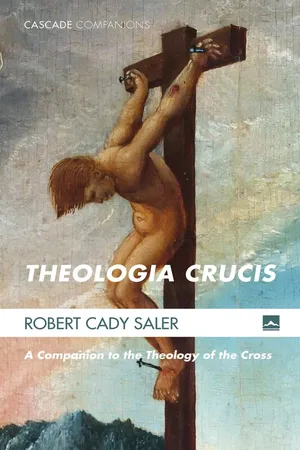
Recovery of Paul and Luther's theology of the cross has been an enduring legacy of twentieth-century theology, and in our own day the topic has continued to expand as more and more global voices join the conversation. The array of literature produced on the cross and its theological significance can be overwhelming. In this readable and concise introduction, Robert Saler provides an overview of the key motifs present in theologians seeking to understand how the cross of Jesus Christ informs the work of theology, ministry, and activism on behalf of victims of injustice today. He also demonstrates how theology of the cross can be a lens through which to understand crucial questions of our time related to the nature of beauty, God's redemption, and the forces which seek to overwhelm both. Ranging from Luther and Bonhoeffer to James Cone and feminist theologians, Saler makes this literature accessible to all who wish to understand how the cross shapes Christian claims about God and God's work on behalf of the world.
Information
Topic
Theology & ReligionSubtopic
Christian Theology1
Luther’s Cross
Whenever most theologians think of “theology of the cross” today, the name of Martin Luther generally arises first. Theologia crucis is a signature motif both within Luther’s theology itself and its subsequent legacy upon theology, philosophy, and the church. But it is also heavily contested ground. Luther himself understood the cross to have implications for both religion and politics. And the fact that he weaves both religion and politics together leads to some of the most powerful insights on both of his era.
The interest that Luther’s own theologia crucis generates in contemporary theologians has kept the power of Luther’s theological critiques of human pretension and politically oppressive theology alive. As we will see below, many theologians have used Luther’s insights and inspiration to form a theology of the cross that speaks to their contexts. This seems natural: Luther wrote his theology because he was frustrated both with what he took to be the arrogance of theology of his day (which he thought forced God’s word into overly systematized and domesticated philosophical categories, derived mostly from Aristotle and Aristotle’s Christian heir Thomas Aquinas) and with the power of the church to impose the implications of this theology with unchecked authority. One definition of power is the ability to impose one’s fictions on someone else; Luther thought that the power of the church was to impose a fictitious, demanding God upon the people, and benefitting institutionally as a result.
That said, theologia crucis for Luther is a not a free-floating theme applicable to any given theological or political project; rather, it is best thought of as a specific theological orientation that allows the ordinary Christian as well as the theologian to live into the fullness of the Christian life in a manner that frees her to engage church tradition, ecclesial structures, and God’s word while maintaining the primacy upon God’s revelation of grace precisely in the brokenness and dejection of the cross. Luther was not anti-church or anti-government. But for Christians, he thinks that protest is needed when the church replaces the cross with a lust for power.
Likewise, we need to remember the medieval setting of Luther’s views on good and evil. Luther’s apocalyptic discourse concerning the beleaguered true church and its theology of the cross in opposition to the theology of glory that upholds the false testimony of God’s enemies is neither metaphorical nor a stand-in for some more “natural” reality. In the battle between the truth of the cross and the lies of the cross’s enemies, Luther understood nothing less than eternal salvation to be at stake, and the stakes remained high for him throughout his life. Whether or not contemporary theologians wish to operate in such dualistic terms, one cannot read Luther without remembering that, for him, perceiving the cross rightly truly is a matter of life and death.
Theology of the Cross vs. Delusions of Glory
This setting within the cosmic drama of judgment, damnation, and salvation helps us to understand the fact that Luther’s tendency was to talk less about a given “theology of the cross” and more about a particular kind of stance towards theology as a whole. In Luther’s main discussion of the theology of the cross specifically, the 1518 Heidelberg Disputation (written less than a year after the famous posting of the Ninety-five Theses that began Luther’s rebellion against his church’s selling of indulgences), it is in fact the theologian and not theology itself is what Luther is really interested in. The author herself, as much as the texts authored, are at the center of the discussion. This is why the famed theses 19 and 20 of the Heidelberg Disputation discuss, not “theology of the cross” per se, but rather the framework within which the theologian of the cross engages both the world and God’s revelation. Here are the key theses along with their elaboration:
(19) That person does not deserve to be called a theologian who looks upon the invisible things of God as though they were clearly perceptible in those which have actually happened [Rom. 1:20]. . . . (20) He deserves to be called a theologian, however, who comprehends the visible and manifest things of God seen through suffering and the cross. . . . Now it is not sufficient for anyone, and it does him no good to recognize God in his glory and majesty, unless he recognizes him in the humility and shame of the cross . . . (21) A theologian of glory calls evil good and good evil. A theologian of the cross calls a thing what it actually is. . . . (22) That wisdom which sees the invisible things of God in works as perceived by man is completely puffed up, blinded, and hardened. . . . Because men do not know the cross and hate it, they necessarily love the opposite, namely, wisdom, glory, power, and so on. Therefore the become increasingly blinded and hardened by such love, for desire cannot be satisfied by the acquisition of those things which it desires. . . . Thus also the desire for knowledge is not satisfied by the acquisition of wisdom but is stimulated that much more. (24) Yet that wisdom is not of itself evil, nor is the law to be evaded; but without the theology of the cross man misuses the best in the worst manner.11
What does all this mean?
Notice, again, the emphasis is on the person thinking and not the thoughts that are thought. Luther is concerned first and foremost, not with what the theologian says, but with how the theologian’s perspective on God and the world is formed. This focus upon the person of the theologian and the optics by which she engages the things of God and the things of the world, as opposed to series of propositions that might be said to make up a “theology of the cross,” supports the idea that for Luther the theologia crucis is a kind of interpretive lens by which in the tasks of exegesis, theology, and proclamation—and doing so with the goal of chastening the speculative impulse inherent in all these activities.
Chastened by what? By the epistemological and existential limits imposed by the fact that God chooses to be known to the world under the realities of pain, brokenness, and weakness. In other words, for Luther, there is no one set of tenets of propositions that makes up theologia crucis; it is more a kind of methodological bearing centered on the theologian’s positioning vis-à-vis the scandal of God’s choosing to reveal saving truth in the form of brokenness and scandal. The cross gives us lenses to see God that are very different from what is on display in theologies of “glory,” those that can only associate God with what is pure, good, and holy.
To be sure, the medieval church in which Luther carried on his work was saturated at both the popular and theological levels with crucifixion imagery. However, Luther’s great contribution was to flesh out with unparalleled vigor the notion that the cross must be a formative influence not only upon the content but also the form of thinking about God, and to apply this stricture with rigor and creativity to all aspects of the Christian life. In other words, Luther made the cross a cornerstone of Christian existence in the here and now. As a number of historians have pointed out, the actual term “theology of the cross” comes up often in Luther’s early writings, but less in his later work. However, Luther retained and even expanded the substance of the term throughout the remainder of his life and writing career. In fact, careful reading demonstrates that the cross touches everything in Luther’s theology—and for Luther, at least, theology touches everything.
As regards Luther’s understanding of the cross’s role in salvation, his model conforms broadly to what the Christian tradition terms “substitutionary atonement:” in Christ, God takes on the sin of humanity in such a way that those in Christ need no longer bear the punishment that the sin entails. Luther was fond of describing this as a kind of “happy exchange” of the sin of humanity with Christ’s perfection—humanity gets the benefit of Christ’s perfection even as Christ takes humanity’s sins upon himself. However, what has been most influential in Luther’s theology of the cross has not been the mechanics of how the cross saves, but rather the critical edge that the cross brings to theological projects that seek to minimize or distort the gospel of God’s free gift of grace. That is, for Luther, theologizing about the cross is just as much about deconstructing bad theology as it is about paving the way for better theology.
Theologia Crucis and the Formation of the Theologian
The centrality of the cross was present as a theme even in Luther’s thinking prior to the Reformation; his sermons between June 1516 and February 1517, immediately prior to the posting of the Theses, contain exhortations to “Preach one thing: the wisdom of the cross!”12 Later, his “Explanations of the Ninety-Five Theses” (completed in February 1518, amidst Luther’s preparation for the debate at which the aforementioned Heidelberg Disputation was presented) makes it clear that the contrast between theologia crucis and theologia gloriae was not a one-off. It deeply informs how Luther thinks of theology’s role in the church:
Yet in the meantime [the theologians] have opened the floodgates of heaven and flooded the treasury of indulgences and the merits of Christ so that by this deluge almost the whole Christian world is ruined. . . . A theologian of glory does not recognize, along with the Apostle, the crucifi...
Table of contents
- Title Page
- Introduction
- Chapter 1: Luther’s Cross
- Chapter 2: God Will Never Be the Same
- Chapter 3: Glory and Reality
- Chapter 4: The Community of Fidelity to the Crucified
- Conclusion
- Bibliography
Trusted by 375,005 students
Access to over 1.5 million titles for a fair monthly price.
Study more efficiently using our study tools.
Frequently asked questions
Yes, you can cancel anytime from the Subscription tab in your account settings on the Perlego website. Your subscription will stay active until the end of your current billing period. Learn how to cancel your subscription
No, books cannot be downloaded as external files, such as PDFs, for use outside of Perlego. However, you can download books within the Perlego app for offline reading on mobile or tablet. Learn how to download books offline
Perlego offers two plans: Essential and Complete
- Essential is ideal for learners and professionals who enjoy exploring a wide range of subjects. Access the Essential Library with 800,000+ trusted titles and best-sellers across business, personal growth, and the humanities. Includes unlimited reading time and Standard Read Aloud voice.
- Complete: Perfect for advanced learners and researchers needing full, unrestricted access. Unlock 1.5M+ books across hundreds of subjects, including academic and specialized titles. The Complete Plan also includes advanced features like Premium Read Aloud and Research Assistant.
We are an online textbook subscription service, where you can get access to an entire online library for less than the price of a single book per month. With over 1.5 million books across 990+ topics, we’ve got you covered! Learn about our mission
Look out for the read-aloud symbol on your next book to see if you can listen to it. The read-aloud tool reads text aloud for you, highlighting the text as it is being read. You can pause it, speed it up and slow it down. Learn more about Read Aloud
Yes! You can use the Perlego app on both iOS and Android devices to read anytime, anywhere — even offline. Perfect for commutes or when you’re on the go.
Please note we cannot support devices running on iOS 13 and Android 7 or earlier. Learn more about using the app
Please note we cannot support devices running on iOS 13 and Android 7 or earlier. Learn more about using the app
Yes, you can access Theologia Crucis by Robert Cady Saler in PDF and/or ePUB format, as well as other popular books in Theology & Religion & Christian Theology. We have over 1.5 million books available in our catalogue for you to explore.