- 254 pages
- English
- ePUB (mobile friendly)
- Available on iOS & Android
eBook - ePub
About this book
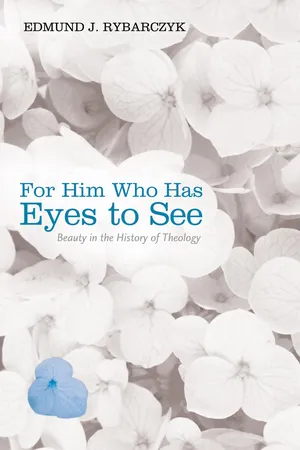
Too many Christians are afraid of beauty. This fear disconnects these Christians from their larger culture, a culture that is increasingly visual, increasingly aware of the presence and power of images, and more commonly fascinated by the power of beauty and form. This historical-theological overview presents the thought of ten theologians and one philosopher in an attempt to give Christians helpful vocabulary concerning beauty and aesthetics. It is time to use beauty and aesthetics for the mission of Christ! And yet rather than simply parrot the larger post-Christian culture, Christians and churches need to employ beauty and aesthetics in a manner that echoes God's own revelation: creation and redemption through Jesus Christ. We need to develop a sensitivity that can perceive beauties ignored. We need theological framing that both respects the glory of God's handiwork and keeps it from becoming idolatrous. We need to live with wonder for the bounty that routinely surrounds us. In short, we need eyes to see.
Information
Topic
Theology & ReligionSubtopic
Christian Theology1
Introduction
The Evangelical Problem with Beauty
Our vocabulary is often powerful. In many ways, we become the words we use. With our words we taste the recipe of reality. Using words, we sample together life’s peace, play, delight, humor, irony, toil, frustration, alienation, and wounding. And the words we use to process all those qualities actually shape the flavor of each. Or, to use another analogy, words are like automobiles: they take us places. Just like an automobile enables us to go and see things beyond our own neighborhood—the ocean, a mountain, a redwood forest, or an old college friend—words enable us to see more crisply life’s experiences.
With only that bit of setup at hand, here’s my premise: Evangelicals1 have failed to employ the word beauty in our daily vocabulary. And that means we have failed to incorporate beauty variously into our everyday conversations, how we treat others, the way we navigate daily life, and our own lives in Christ. Frighteningly, it might mean we ourselves are not purposefully beautiful.
Oh, we like beauty. Some Evangelicals, owing to family proclivities or a personal sense of space, know how to decorate their homes with beauty. Regularly we enjoy the beauty of a well-crafted piece of furniture or jewelry. But when it comes to our faith, presumably that value above all others in our lives, we bar beauty. We don’t know how to include her. When we do think about including her our thoughts are clunky and jumbled. If that seems overstated, just think of the Evangelical church buildings you have attended. They are consistently clean but bare. Designed for utility, they enable crowds of Christians to sing, pray, and chiefly listen together. Some of those buildings might intrigue us with their sheer size or their reputation, but beauty is rarely one of their celebrated features. Frequently built on shoestring budgets, they are functional—lights, heating, sometimes comfortable seating, and visually clear lines of sight are consistently present—but aesthetically they are boring. They rarely have an intentionally beautiful aspect to them. They are too often merely gathering spaces, auditoriums, or worse, theaters for a kind of Christian show. Nobody thinks to go to an Evangelical auditorium just to be there, to pray or to contemplate God there, or to seek personal solace inside the walls. Yet it is just not natural to have worship spaces that are functional but aesthetically stark. Excepting Islam, which consistently forbids any aesthetic design other than two-dimensional painted geometric designs, all of the world’s religions intentionally employ beautifully designed sacred space to shape the experience of the religious concelebrant. More, the sacred space of those religions is consistently a mirror of ultimate and true reality (however understood) itself; sacred space design thus exemplifies something important about the world view, of the metaphysic, and of the ultimately valuable for those who spend time inside the walls.
The point here is, our very worship spaces—the very places we assemble to disciple, shape, renew, and enliven ourselves as we worship and glorify the triune God—betray the Evangelical inability to incorporate beauty into our way of being.
Concerning beauty and aesthetics we Evangelicals have an imaginative and theological vacuum. Vacuums do not cause anything. Rather, vacuums are empty spaces that are quickly filled with other things. Not surprisingly then we Evangelicals sate that hunger-for-beauty vacuum, that our attention must go toward something dynamic in church with substitutes: pastors as heroes, or worship bands as superstars. Outside of churchly space, we fill our beauty vacuums with items from pop culture, historical artifacts, antique furniture, trophies from our travels, the latest fashion fads, or even national symbols. Personally, I’m not against the collection of display of any of those things. (Please, Christians need not only have or collect “Christian” art!) It’s just that we do not think of or appreciate or speak together about the beauty in our lives either as a blessing from God himself or as a way to bless God and others.
Concerning beauty, we have a stunted theological vocabulary. Beauty is not a regular feature of our daily conversation. Beauty is not woven into the lyrics of our churchly music. Beauty is not integrated into our life and thought and prayer as Christians. My argument here, again, is that we Evangelicals do not know how to talk, think, or live for beauty in the affirmative. We do not have a vocabulary that roots beauty in and through our daily lives as Christians.
Our vocabularic stuntedness is one thing, but our prejudicial attitude is another. Evangelicals seemingly have a theological bias against beauty.2 We are afraid beauty will distract from God’s word, preached or written; as will be shown in our chapter on the Reformation, that fear has historic, if unevenly understood, roots. We worry that beauty will become an idol; as our chapter on Gregory of Nyssa will reveal, that worry has ancient Christian historic roots. We shudder to think that beauty—merely a matter of “personal preference” as we believe it is, something addressed in our chapter on Immanuel Kant—might deter people from the more important matters of life: preaching the gospel, developing Christian character, ethics, justice, and communal responsibility. I am going to suggest, both implicitly and explicitly through the theologians surveyed herein, that all of those “weighty” matters are even more important, more truly themselves, more accurately understood, and more deeply loved and thus eagerly embraced, when beauty is folded into their mixture. Beauty is indeed a spice of life; beauty makes absolutely everything better. Yet, beauty is more than mere spice.
Beauty stems indirectly but purposefully from the very being of God. Yes, God is truth and light and life and love. But God himself is beautiful. Beauty exists because God exists. Beauty is an oversplash of God’s glory and love. As such beauty whispers to us something about God. It reminds us that God loves to share. Beauty, spilling onto the simplest of creatures, tells us that God is not a glory hog. Truly, God enjoys our enjoyment of his beautiful creation. If Genesis is correct, God made the entire cosmos for us! God exuberantly surrounds us with beauty almost every single day, if only we will train our eyes, or our mind’s eye, to see it and celebrate it. Beauty is God’s way of saying, “There is so much more. This life is sometimes wonderful, but in me there is always more.” Beauty is regularly present, but only for him who has eyes to see.
And that, too, is part of the Evangelical problem: we have not trained our eyes to see beauty. In truth, as William James once argued, our eyes require more than mere seeing.3 We need to know how to look, and for what to look. Our seeing itself is pre-shaped by our outlook on life, and some outlooks are more prone to recognizing and appreciating beauty than others. For instance, frequently beauty is subtle; we can travel right past it every day and miss its tender greeting. Beauty is unusual to our Western, rational souls precisely because the human perception of it is innate. We often feel it before we know how to articulate its presence. Yes, for some personality types, apparently trained from birth to be sensitive toward it, beauty gives deep joy. But for many Evangelical Christians beauty is not on our horizon precisely because it is less rational, or what I prefer to call a-rational: that quality which is decidedly indifferent to whether something makes sense. The a-rational in life is not predisposed against reason. The a-rational is not in a fight with reason! Yet, the a-rational elements of life just are not bothered to make immediate sense. Here are just a few things that don’t make immediate logical sense about Christianity:
• God is both three and one
• the eternal God became finite in Jesus
• the fountain-of-life God died in and as Christ Jesus
• each of us gains eternal life by dying to our former selves
• we are asked to cast our future and our entire identity on a God we cannot see
• God the Holy Spirit prays through us to God
• we can pray to God by speaking in unknown tongues
Each of those truths are resolutely biblical, but they only make sense after we give ourselves to the “theo-logic,” to quote Balthasar, the logic which ultimately transcends and frequently defies human logic, the logic of biblical revelation, or simultaneously of that which stems from God’s own being. The same is true with how we view beauty: we need some theo-logic.
And yet beauty doesn’t seem to concern herself with making logical sense. Frankly, sometimes her appearance at odd times is nonsensical! True, we can touch upon beauty with our words; I mean to do that in this study. Yet, beauty smiles without any defensive challenge toward her friend reason. Reason too is a God-given gift but beauty delights in not being imprisoned by reason. Beauty—that a-rational, elusive, peaceful, delightful, mysteriously oversplashing quality present in so many things, people, and places around us—is frequently free from reason, even though she has no war with reason.
The human nervous system structured the way it is, we often feel things profoundly faster than we can think about them. My contention is that we feel or intuit beauty before we know how to process or explain it. Beauty, because it is usually perceived before understood, can leap into our souls faster than we can reason or reflect upon it.4 Rationalists may not like beauty for that very cause: it is more felt than analyzed. Rationalists, God bless us, want to understand. Contrastingly, beauty frequently defies logic. Consistently, beauty eludes analytic certitude. Myself, I am a Pentecostal. Raised to be mindful of the presence and leading of the Holy Spirit, Pentecostals value intuition. We know the Holy Spirit can communicate with our souls in a-rational ways: he can speak to our hearts, give us dreams and visions, and even emotively motivate us to do good works. Nevertheless, for all that intuitive awareness, we Pentecostals too are sadly stunted when it comes to our vocabulary and sensitivity to the presence of beauty.
Oriented to words—itself a marvelous proclivity that has grown from the Reformation’s emphasis on reading the Bible and listening to sermons—our Evangelical souls are rather icy toward the warm embrace of beauty. We don’t understand it, or don’t want to understand it, so for generations on end we have taught ourselves that beauty is unimportant. We are like horses with blinders on; we have excellent direct-ahead foveal vision, but no peripheral vision. The problem is that beauty frequently comes to us from the peripheries, from the fringes of our awareness, so to speak. With foveal vision we look directly and narrowly forward to see the details of life. Foveal vision enables us to read books and think in reasoned ways. Less direct than foveal vision, peripheral vision makes us sensitive to the more nuanced matters of life. Beauty often comes to us from the edges, the less-direct places in life. But if we haven’t trained our peripheral vision, or perhaps more accurately if we have not trained our intuition, we will only be able to perceive what’s directly ahead.
Beauty invites. She never forces herself upon the human will. Praise God for truth and goodness, beauty’s two other ancient sisters! But both goodness (ethics, morals, behavior) and truth (philosophy, science, engineering, accordance with life) can be very coercive, very overpowering. For example, good deeds can win over people’s hearts and attitudes even when performed by ill-motivated government officials. Or to offer a personal example, when I was an eleven-year-old boy, the thrown softball that hit me square in the temple both knocked me onto the outfield grass and stung whether or not I had previously believed the truth that it would do so! Truth can hurt. Goodness and truth constantly have an either-or effect to their presence. The good can shape us even when we are not aware of it. Truth naturally pierces and divides even though many assume that truth is always beneficial. Beauty is a different kind of gift. Beauty, even though she can be overwhelming and even euphoric, consistently comes in peace.
And so, for me, beauty is a cause of both wonder and gratitude. How can something so profound be so peaceful? How can something that so marvelously fills me with hope have been so freely offered? How can something so transfixing daily surround me?
We do not perceive life from either nowhere or everywhere. All people “do” life from somewhere, from some time-bound, geographically situated, acculturated, linguistically informed, and world view-anchored vista. Christians, or so this historical theologian believes, ought to perceive life from, in, and through the God of their salvation. Still more carefully put, following Jesus Christ is not just a means to an end. God did not simply give us his Son so that when we die we can go to heaven (thank you, Father, for the hope of heaven!...
Table of contents
- Title Page
- Dedication
- Chapter 1: Introduction
- Chapter 2: Gregory of Nyssa (c. 330–395)
- Chapter 3: Augustine of Hippo (c. 354–430)
- Chapter 4: Pseudo-Dionysius the Areopagite (5th–6th Centuries)
- Chapter 5: The Medieval Era and Thomas Aquinas (1225–1274)
- Chapter 6: Post-Patristic Interlude
- Chapter 7: The Reformation
- Chapter 8: Jonathan Edwards (1703–1758)
- Chapter 9: Immanuel Kant (1724–1804)
- Chapter 10: Paul Evdokimov (1901–1970)
- Chapter 11: Hans Urs von Balthasar (1905–1988)
- Bibliography
Trusted by 375,005 students
Access to over 1.5 million titles for a fair monthly price.
Study more efficiently using our study tools.
Frequently asked questions
Yes, you can cancel anytime from the Subscription tab in your account settings on the Perlego website. Your subscription will stay active until the end of your current billing period. Learn how to cancel your subscription
No, books cannot be downloaded as external files, such as PDFs, for use outside of Perlego. However, you can download books within the Perlego app for offline reading on mobile or tablet. Learn how to download books offline
Perlego offers two plans: Essential and Complete
- Essential is ideal for learners and professionals who enjoy exploring a wide range of subjects. Access the Essential Library with 800,000+ trusted titles and best-sellers across business, personal growth, and the humanities. Includes unlimited reading time and Standard Read Aloud voice.
- Complete: Perfect for advanced learners and researchers needing full, unrestricted access. Unlock 1.5M+ books across hundreds of subjects, including academic and specialized titles. The Complete Plan also includes advanced features like Premium Read Aloud and Research Assistant.
We are an online textbook subscription service, where you can get access to an entire online library for less than the price of a single book per month. With over 1.5 million books across 990+ topics, we’ve got you covered! Learn about our mission
Look out for the read-aloud symbol on your next book to see if you can listen to it. The read-aloud tool reads text aloud for you, highlighting the text as it is being read. You can pause it, speed it up and slow it down. Learn more about Read Aloud
Yes! You can use the Perlego app on both iOS and Android devices to read anytime, anywhere — even offline. Perfect for commutes or when you’re on the go.
Please note we cannot support devices running on iOS 13 and Android 7 or earlier. Learn more about using the app
Please note we cannot support devices running on iOS 13 and Android 7 or earlier. Learn more about using the app
Yes, you can access For Him Who Has Eyes to See by Edmund J. Rybarczyk in PDF and/or ePUB format, as well as other popular books in Theology & Religion & Christian Theology. We have over 1.5 million books available in our catalogue for you to explore.