eBook - ePub
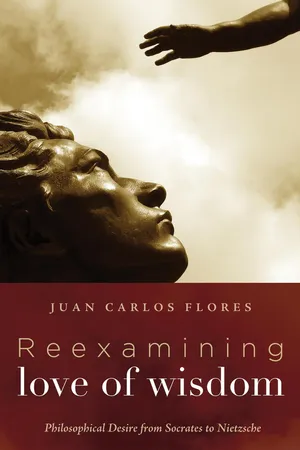
Reexamining Love of Wisdom
Philosophical Desire from Socrates to Nietzsche
- 172 pages
- English
- ePUB (mobile friendly)
- Available on iOS & Android
eBook - ePub
About this book
What is philosophy? Why does it matter? How have philosophy and its relation to religion and science changed from the ancient to the medieval and modern periods and beyond? What are the central philosophical ideas, from Socrates to Nietzsche? Reexamining Love of Wisdom addresses these questions. It offers a new perspective by organizing the material under the theme of philosophical desire and shows the timeless importance of philosophy understood as the love of wisdom. Flores provides an historical introduction to philosophy suitable for college students that is a resource for more advanced students or scholars interested in the history and nature of philosophy.
Information
Topic
PhilosophySubtopic
Philosophy History & TheoryChapter 1
Ancient Greek Love of Wisdom
As students of philosophy know, the word philosophy means literally love of wisdom. Philosophia, the Greek word for philosophy, is composed of two notions, namely, philia, which means love, and sophia, which means wisdom. This literal meaning also indicates its original and deeper meaning. Philosophy, as it comes to life in ancient Greece, meant the pursuit of wisdom, the human activity engaged in seeking wisdom. At first, philosophy was not a set of doctrines, or a profession, or an academic subject, or even wisdom as such. According to the original lovers of wisdom, philosophy never can be identical to wisdom, because wisdom is primarily knowledge of divine, eternal things. Mortals, by definition, cannot fully assimilate divine things, since these things transcend them.1 They can only work towards an ever more adequate understanding of the divine and eternal. This conviction is shared by many ancient philosophers, including Socrates (469–399 BC), his student Plato (ca. 429–347 BC), and Plato’s student Aristotle (384–322 BC). Among the thinkers who lived before Socrates (the so-called Presocratics), Pythagoras of Samos (ca. 570–494 BC) is reputedly the first to call himself a philosopher, rather than a sage or wise man (sophos).
These Greek philosophers, as lovers of wisdom, distinguish themselves from the Greek sophists, who see themselves as already wise. The term sophist includes etymologically only the notion of wisdom (sophia) and lacks the notion of love (philia) included in the term philosopher. According to the sophist, human beings can be possessors of wisdom. For Protagoras (ca. 490–420 BC), the paradigm of Greek sophists, wisdom can be the property of human beings because, as he puts it, man is the measure of all things.2 This means, for Protagoras, that truth is equivalent to appearance, and so every human being is able to judge accurately what appears to him or her. In this sense, every individual is as wise as another. Protagoras’ concept of wisdom is different from the philosophical concept of wisdom. For Protagoras, wisdom is a wholly human affair, without reference to the divine.
However, there is a sense in which a human being can be wiser than another, according to Protagoras. Since truth is appearance, wisdom in the strict sense is the control of appearances, especially through rhetoric and argument, in order to make one’s own judgment or “wisdom” prevail. The ultimate goal of wisdom is, therefore, success in practical affairs. These ancient Greek sophists were professional teachers who traveled from town to town, teaching young men their way to achieve worldly success, and charging good money for it. This understanding of wisdom as the art of manipulation earns the term sophistry its negative connotations in later history,3 even if the reality indicated by the term still thrives, often with a great deal of prestige.
On the other hand, the philosophers, such as Socrates, Plato, and Aristotle, do not value wisdom only in practical or utilitarian terms, and they certainly do not conceive of the practical benefits of wisdom in Protagoras’ terms. Rather, to the philosophers, wisdom is fundamentally desirable for its own sake, even if wisdom entails practical benefits. To them, seeking wisdom is the highest expression of human freedom. Of all the human activities, the pursuit of wisdom is the best precisely because it is the freest. At the same time, wisdom is the highest form of knowledge because it is the freest form of knowledge.4
Human beings think and use knowledge in all areas of life—in speaking, tilling the soil, riding horses, building ships, etc. Certainly, some human beings think better than others, know more than others, and use knowledge better than others, but all human beings engage in thinking and knowing, capacities that characterize the mind and define human life. However, in most activities, thinking and knowing serve some ulterior purpose, such as growing food, providing shelter, or obtaining some pleasure. In these activities, thinking and knowing are subservient to something else, such as the various needs of the body; the human mind is not strictly free, since it is employed as a means to some ulterior end.
On the other hand, the freedom of the mind or soul would have to consist in the pursuit of its proper end, an end that it seeks and values for its own sake. For the original lovers of wisdom, the proper goal and fulfillment of the mind must correspond to its essence—an entity that thinks, questions, and investigates. Hence, the proper goal of the mind (and of human nature, if indeed the mind is the commanding and defining aspect of human life) consists in the acquisition of free rather than servile knowledge. And only in pursuing knowledge for its own sake is the mind freely pursuing its proper end, dictating its own course of action, and seeking its own kind of satisfaction. Naturally, this interest in knowledge as such becomes a search for the greatest and best form of knowledge, for knowledge of the most important things. This knowledge is wisdom, and philosophy is the dedication to wisdom.
Philosophy, therefore, originates in freedom. This is possible when human beings possess the leisure, as well as the requisite dispositions, habits, and education, to engage in the free pursuit of knowledge. Human beings who must toil simply to procure the necessities of life have no time for philosophy. Human beings dedicated to the pursuit of wealth and power have no time for philosophy, and probably no interest in it. Human beings who constantly seek the gratification of their appetites or passions have no capacity for philosophy. Human beings with little intellectual talent or deficient educations will not be well equipped for the pursuit of wisdom. Finally, human beings who engage in the study of philosophical ideas for purposes other than wisdom itself are not true philosophers. In short, engaging in philosophy genuinely is very difficult.
Moreover, the possession of these prerequisites is not sufficient for the pursuit of wisdom. In addition to them, the essential component must be present—a powerful love of wisdom. What is the source and nature of this love? To answer this question specifically, we must look at how this love manifests itself in different philosophers. However, one common factor associated with the origin of love of wisdom, according to the Greek philosophers, is wonder. Philosophy, they say, begins in wonder.5 The experience of wonder provides a pure motivation for knowledge, since wonder seeks fulfillment in knowledge as such. However, as we shall see throughout this book, the concrete expression of love of wisdom entails various dimensions, and this expression varies among philosophers.

The ancient Greek philosophers recognized that philosophy is the most fulfilling and freest of all human activities. To them, philosophy is the activity through which the highest human faculty works freely towards its own fulfillment. Philosophy, as the freest pursuit, is also the least necessary, but it is the noblest, since it the highest calling of the highest faculty. For this reason, philosophy is the highest form of desire or love, which seeks the highest form of human fulfillment.
Philosophy, in this ancient Greek sense, is difficult not only because freedom is difficult to obtain; the vast majority of human beings are occupied by so many necessities and (nonphilosophical) desires. Philosophy is intrinsically difficult because seeking knowledge for its own sake is also seeking the highest form of knowledge, which is knowledge of the ultimate truths. As the ancient Greek philosophers quickly recognized, human beings are not the highest beings in the universe. To them, wisdom concerns itself primarily with divine, eternal things, which transcend humanity. The ultimate reason, therefore, why human beings cannot possess wisdom fully has to do with the very place of human beings in the universe. Mortals, as such, are incapable of assimilating fully what exceeds them. At the same time, to these Greek thinkers, approaching the divine is the greatest human calling and fulfillment.
Socrates, Plato, and Aristotle share, in general outline, this view of the nature and goal of philosophy. They understand themselves, in being lovers of wisdom, as answering to the highest human calling. In addition, they understand their calling and activity as genuine freedom. The three would say that philosophy begins in wonder. Finally, the three understand wisdom in reference to the divine. However, even though the drive that fuels their activity springs from the same general source—from the soul’s desire to fulfill its highest calling—they interpret and develop this source in different ways. Their different loves for wisdom give us three fertile and influential ways to develop the philosophical drive that springs from the core of the human being.
Developing this topic requires more than analyzing how terms such as love, wisdom, philosophy, and love of wisdom appear in texts. For the present motivation is not the question of a nominal definition. Philosophy or love of wisdom, as understood by Socrates, Plato, and Aristotle, is the highest human calling. Their respective loves for wisdom reveal their interpretation and development of this calling, and their views regarding its ultimate purpose. This requires a look at some of their fundamental principles.
i.1 Socrates and the Desire for Self-Knowledge
Socrates is famous for saying that he knows nothing, that his reputation for wisdom stems from his awareness of his own ignorance, unlike most people, who think they know what they really do not know. Against this background, it is rather surprising that in Plato’s Symposium Socrates boldly claims that the one thing he does know is love.6 Socrates’ knowledge of love, specifically love of wisdom, is mentioned in other Platonic texts as well. A couple of questions impose themselves. Why is love the one thing Socrates, that paradigm of the philosopher, claims to know? What is the nature of Socrates’ love of wisdom?
As students of Greek philosophy know, distinguishing Socrates’ philosophy from Plato’s is not simple, since Plato wrote most of the documents we possess regarding Socrates, and Socrates appears in the vast majority of Plato’s dialogues. At the same time, scholars generally agree in calling a group of Plato’s dialogues “Socratic dialogues” since they are closest to the original Socrates. Moreover, among these Socratic dialogues, Plato’s Apology is probably the most accurate portrayal of the historical Socrates.7 Accordingly, Socrates’ description of his philosophical activity in the Apology will be our chief indication of his love of wisdom.
In the Apology, Socrates presents his defense to the Athenian assembly against the charges that eventually lead to his condemnation and death. Even though in the Apology Socrates is being indicted for specific charges, namely, for corrupting the Athenian youth as well as for impiety (not believing in the traditional gods), Socrates provides a broader defense. Socrates’ defense is twofold, since (as he claims) his accusers are twofold, namely, his early accusers and his recent accusers (those who bring him to trial in the Apology, a...
Table of contents
- Title Page
- Acknowledgments
- Introduction
- Chapter 1: Ancient Greek Love of Wisdom
- Chapter 2: Medieval Love of Wisdom
- Chapter 3: The Modern Break—Disparate Philosophical Loves
- Bibliography
Trusted by 375,005 students
Access to over 1.5 million titles for a fair monthly price.
Study more efficiently using our study tools.
Frequently asked questions
Yes, you can cancel anytime from the Subscription tab in your account settings on the Perlego website. Your subscription will stay active until the end of your current billing period. Learn how to cancel your subscription
No, books cannot be downloaded as external files, such as PDFs, for use outside of Perlego. However, you can download books within the Perlego app for offline reading on mobile or tablet. Learn how to download books offline
Perlego offers two plans: Essential and Complete
- Essential is ideal for learners and professionals who enjoy exploring a wide range of subjects. Access the Essential Library with 800,000+ trusted titles and best-sellers across business, personal growth, and the humanities. Includes unlimited reading time and Standard Read Aloud voice.
- Complete: Perfect for advanced learners and researchers needing full, unrestricted access. Unlock 1.5M+ books across hundreds of subjects, including academic and specialized titles. The Complete Plan also includes advanced features like Premium Read Aloud and Research Assistant.
We are an online textbook subscription service, where you can get access to an entire online library for less than the price of a single book per month. With over 1.5 million books across 990+ topics, we’ve got you covered! Learn about our mission
Look out for the read-aloud symbol on your next book to see if you can listen to it. The read-aloud tool reads text aloud for you, highlighting the text as it is being read. You can pause it, speed it up and slow it down. Learn more about Read Aloud
Yes! You can use the Perlego app on both iOS and Android devices to read anytime, anywhere — even offline. Perfect for commutes or when you’re on the go.
Please note we cannot support devices running on iOS 13 and Android 7 or earlier. Learn more about using the app
Please note we cannot support devices running on iOS 13 and Android 7 or earlier. Learn more about using the app
Yes, you can access Reexamining Love of Wisdom by Juan Carlos Flores in PDF and/or ePUB format, as well as other popular books in Philosophy & Philosophy History & Theory. We have over 1.5 million books available in our catalogue for you to explore.