- 168 pages
- English
- ePUB (mobile friendly)
- Available on iOS & Android
eBook - ePub
About this book
Are stress and feelings of inadequacy your constant companions?
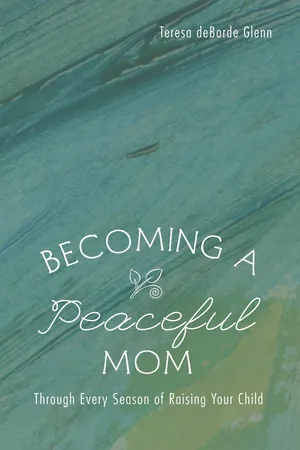
Peaceful mom. It hardly seems that the words could go together. Yet the peace we crave can be ours in every season of raising children. Whether you have teenagers or toddlers, being a mom is a daunting and amazing responsibility. And it's a part of God's design for you.
You are deeply loved by God. Draw from the well of a relationship with him--even if it's a new well--to sift through all that the world plops in your path. Learn to partner with him. Grow stronger and more confident and begin to see your self the way God sees you--as a woman, as a mom, and as his child.
Be encouraged and motivated through prayer and dialogue examples, personal stories, and scripture applications. Consider your approach to being a mom, making commitments, and the power of forgiveness. Discover how God works through you to raise and shape your children, as you learn and grow with a peace that is truly beyond understanding.
Information
Print ISBN
9781498293273
9781498293297
Part One
Define Your Ordinary
1
We Need Answers
If I just had a few minutes of peace! Why is it so evasive? Maybe I don’t really understand what peace is . . .
At my wit’s end, I reached for an old children’s dictionary on the bookcase. An elementary definition is all my frazzled mind can absorb. One definition described peace as quiet or calm. I laughed out loud when I read the sentence example: “He lived alone in the mountains and enjoyed peace of mind.” If I lived alone in the mountains, I would probably have peace of mind too!
Some days run smoothly, but others feel so chaotic. Who doesn’t daydream about having a few hours alone? I want to experience being peaceful—at home with my kids. There has to be a way.
Illusions of a quick fix seduce us: I’ll be a different person when . . . Things will settle down around here when . . . Life would be simpler if . . . We are convinced that a change (or two) within our circumstances—employing a cleaning service, finishing a home project, finding a less demanding job, or placing our children in a few more programs—is the key to a more calm and self-controlled me. Unfortunately, changes like these only temporarily convey the peace we crave.
How do we become and remain a peaceful mom? In the midst of the noisy chatter and unpredictable moments that each day surely brings, we can experience peace daily, and it won’t cost us a dime. The source of this anchoring peace is God.
Say Goodbye
“What was I thinking? Don’t get me wrong; I love being a mom . . . but I had no idea it would be this hard.” My friend, a mother of four, unloaded feelings common to many moms. Being a mom is amazing—and amazingly hard. An entirely new, ever-evolving dimension to how we see and know ourself is triggered.
Some of us dreamed about being a mom and having several kids. Now we have them, and it’s not at all what we had imagined! Reality has set in: Being the mom is not like babysitting or being the fun aunt. We keep the children all the time—there is no hand-off! We feel unprepared and sometimes paralyzed with self-doubt.
Homebound or schedule-bound due to our child’s needs, we try to adjust to the loss of personal freedom:
• Going to the store: It takes twice as long to pull everything and everyone together, just to get out the door.
• At the store: Shopping is a team event and a fuller experience. Now it includes teaching, pacifying, maybe correcting, and finding roaming children.
• If we are employed: Our personal time before and after work has become a time to process and plan family-oriented matters.
• Meeting a friend for lunch or going out with our husband: It takes twice as long to find an open date and costs twice as much to go—that is, if we find a babysitter.
• If we have left a career or job we enjoyed: We miss the relationships, the intellectual stimulation, and perhaps an aspect of personal identity.
Whatever our adjustment is, life as we knew it has changed. Unfortunately, many of us don’t process this fact. We add on this big change, try to resume a prior rhythm, and move forward, sort of.
Big change is worth marking to identify what is different, how we feel about it, and how to wisely move forward.
My husband and I were thrilled to learn I was pregnant. After much discussion and prayer, we agreed I would leave my career and stay home once the baby came. As much as I enjoyed being a stay-at-home mom, I missed teaching. I did not realize how daily tangible rewards like interaction with faculty, a clearly defined purpose, and evidence of fruit from my efforts impacted me. My mood swung up as I delighted in my baby boy and swung down when I missed the classroom and all that it represented.
Tired of weekly highs and lows, I realized it was time to mark a season’s end—to say good-bye to a former lifestyle. I marked my big change through a prayer. First, I thanked God for all the years and memories I cherished as a teacher. Next, I identified what I missed about it and released these things and that season to him to mark its end. To mark my new beginning, I thanked God for the opportunity to be a mom and to stay at home. I asked him to fill the voids created from leaving my job and to teach me how to live into this big change. For the next three years, as each new school year began, I felt a pull on my heart to return to the classroom. When I gave my feelings to God, the pull lessened. Peace and clarity of purpose for being home increased.
Practice: Mark Change
1. Thank God for the season that is ending.
2. Identify what you will miss.
3. Release these things and release the season to God.
4. Thank God for the new opportunity he is presenting.
5. Ask God to fill all voids if/when you feel them.
6. Invite God to lead you forward.
Ironically, ten years later, I returned to full-time employment. I took time to recognize that my season as a stay-at-home mom had ended. With a mixture of sadness, gratitude, and anticipation for what this big change might be like, I released that season to God. At times, we will realize that life has changed. The sooner we let go or say good-bye to the way life was and welcome God’s design for raising our children, the sooner we can embrace and enjoy our new season as women who are moms.
Discovery Overload
From day one as a mom and as our family grows, new dimensions of our character unfold. We identify strengths and weaknesses. We discover qualities in our personality that we never knew were there. For instance, we’re more animated than we imagined or not as patient as we assumed.
At the same time, our child learns about himself, experiencing many firsts in an ever-changing environment as he grows up. From the time he’s a baby, he trusts us, as he opens his mouth to have all kinds of flavors and textures put in. He discovers the parts of his body and what they do. He tries to learn to make his mouth form words and assumes that we can understand him. As he enters various environments, he adjusts to verbal boundaries like “Yes, you can” or “No, don’t touch that,” and he learns to interpret our facial expressions and voice tones. He continues to meet people in our extended family, neighborhood, church, school, and the surrounding community. And as he meets peers, he observes them, their behavior, and their parental relationships.
As we take our child places, introduce him to more people, and mingle with other parents, we realize we need to devise and periodically evaluate defined expectations for our child—rules, manners, and anything else we think he needs to learn. Then we have to figure out how we are going to teach these things. As the child receives our instruction, he decides what to do with what he is taught. Sometimes he listens; sometimes he doesn’t. Sometimes he obeys; sometimes he doesn’t. This relational process continues through his teen years.
Are you tired yet?!
If you’re overwhelmed by the current season with your child or feel the burden of the complexities ahead, you are not alone. Feeling inadequate is a familiar trait among the sisterhood of mothers.
“He who calls you is faithful; he will surely do it” (1 Thessalonians 5:24). This is good news. God has purposes that he wants to accomplish through us. He is with us, for us, and he will do it.
See Our Need
Our parenting efforts evolve from a conglomeration of the methods of our parents, our friends, what we read, hear, and observe, and our own ideas. Perhaps we pray for our kids or ourselves regularly. More often desperation or discouragement catalyzes prayer from the reverberating pain in our heart.
Many of us unintentionally compartmentalize our relationship with God. He wants our relationship with him to permeate every aspect of how we live. Specifically as mothers, he wants us to partner with him as we raise our children.
When I am overwhelmed or disheartened, I claim what I know is true: Our Creator knows my capabilities, and with all-knowing confidence he gave me the responsibility of being a mother. This rekindles my conviction to live into God’s confidence in me, rather than trying to muster self-confidence. On occasion, wearily yet resolutely I pray aloud in my house: God, you believe in me....
Table of contents
- Title Page
- Acknowledgements
- Part One: Define Your Ordinary
- Part Two: Become Who You Were Made to Be
- Part Three: Navigating the Bumpy Road of Commitments
- Part Four: The Power of Forgiveness
Trusted by 375,005 students
Access to over 1.5 million titles for a fair monthly price.
Study more efficiently using our study tools.