eBook - ePub
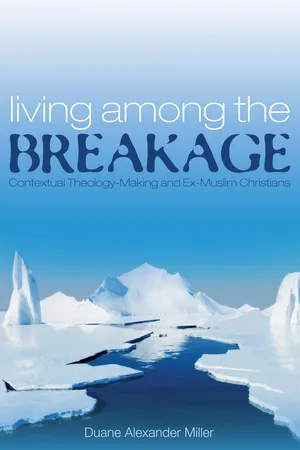
Living among the Breakage
Contextual Theology-Making and Ex-Muslim Christians
- 272 pages
- English
- ePUB (mobile friendly)
- Available on iOS & Android
eBook - ePub
About this book
Around the world people are leaving Islam for Christianity in unprecedented numbers. This book seeks to look into the world of some of these converts, trying to discern the shape of their newfound faith. Why do they convert? What challenges do they face? And ultimately, what do they in their own complex and sometimes difficult circumstances claim to have understood about God that, while in Islam, they had not? In other words, what is the content of their contextual theology? In seeking to answer these questions, Miller looks into the world of an unintentional church plant in the Arab world consisting of believers from a Muslim background, visits with groups of Iranian converts in the diaspora, and examines the written testimonies of still other converts. In a world where Muslim-Christian relations are increasingly important and sometimes tendentious, this book examines the lived faith and contextual theology of people who have chosen to leave Islam and embrace Christianity.
Information
Topic
Theology & ReligionSubtopic
Christian Church1
Theology-Making and Power
Reason for this Research
During my early days in the Middle East, while studying Arabic, I met a few Christians who were converts from Islam and became aware of the challenges they faced. I wanted to learn more about converts from Islam to Christianity.
In the latter half of the twentieth century an unprecedented number of known conversions from Islam to Christianity have occurred. This book asks, do these converts engage in the activity of making their own theologies? And if so, what sort of theologies are they making, and what knowledge about God are they proposing and indeed assuming?
This leads to further questions: what are the various forms that “God knowledge” might take? Theology-making is a process; if it is taking place some model of what that looks like will also be needed. Theology-making, if it is occurring at all, is taking place within a set of contexts—what are they? There is also the question of who: are only certain persons qualified to be theology-makers? And a final question is why? If these believers are making theology, then what are their goals?
In trying to answer the research question, and those that it entails, it is necessary to examine some aspects of the contexts in which these converts might be making theology.
But returning to my initial interest in Christian converts from Islam, I tried to research the topic, and found that there is a great deal of material in the field of missiology which seeks to specify how to make Muslims into followers of Christ and what such converts should look like. In 2008 I interviewed an Anglican priest living in Egypt who knew some Christians from a Muslim background (CMBs), and I asked him about their theology—what sort of theology do they produce? He responded that they do not produce theology; rather they are worried about things like family life and work and how to remain safe in the midst of an Islamic society. As I continued to read and research I realized that the Anglican priest and I had been thinking about theology in terms of our own Western tradition wherein theology is often systematized, communicated/discussed through books and journals, taught and learned at seminaries/universities, and wherein the goal of the theology-making task is grasping certain knowledge. This was something of an epiphany for me.
The missiologists I had read were doing (applied) theology about/for ex-Muslim Christians. But in reading the material written by actual converts and in meeting and spending time with them, I started to suspect that they might be intensely involved in the process of making their own theology. The Anglican priest was correct that CMBs are not publishing systematic theological texts. But they are asking questions, and they are identifying problems and challenges, which often emerge from their own specific contexts. This work is an effort to explore both the questions they are asking, the means whereby they are proposing and evaluating possible solutions, and the conclusions, if any, they are coming to. It is an attempt to test my initial hypothesis.
Research Methodology
Apart from archival/textual collection of material, I did research in two main ways, quantitative and qualitative, although the division between those is not rigid.
For chapter 3 a brief questionnaire was circulated to numerous people with experience in ministry to Muslims and/or Christian ministry within an Islamic context. This does not claim to be a random, quantitative survey though. Some of the respondents I knew myself, and others were contacts of two colleagues, who wish to remain anonymous and helped to gather this information. Regarding the contacts I knew personally, I had met them in various ways, including during my time studying Arabic in the Middle East and theology in the USA, through churches that I had attended or where I knew someone, and through research/publication networks for people with a common interest in Christianity in the Muslim world. Additional details on that questionnaire will be described in the body of that chapter.
Fieldwork: Locations and Languages
As with the questionnaire, the selection of the places where I carried out my fieldwork was largely dictated by where I could gain access. I wanted to do research in at least one place where apostasy from Islam could lead to persecution. I speak Arabic so the logical scope of that was somewhere in the Arab world, as using a translator has several drawbacks. Having lived in the Arab world for several years I was familiar with the region’s cultural and religious contours, and having done fieldwork among a minority population there meant that I was not new to the challenges involved.7 Because of security and ethical issues it is not possible to go into greater detail about precisely how and where the research was done. Suffice to say that a well-connected indigenous colleague of mine and I were discussing research interests and he connected me with Andraus (chapter 4). Interviews were carried out in either Arabic or English, according to the preference of the person being interviewed.
In relation to the Iranian congregations in the USA and the UK, this was also determined largely by pragmatic circumstances. On several occasions I was invited or encouraged to visit Iranian Christian (IC) communities in other places, but restraints related to finance and travel made that impossible. Traveling to Iran to research an illegal activity (apostasy) was not possible: personal safety apart, the Iranian government would hardly grant a visa for such research. As I do not speak Farsi, interacting with Anglophone ICs in the Diaspora was a welcome option. On the few occasions when I did interact with a new arrival from Iran one of the Anglophone ICs would translate for me, but this happened rarely.
The study of CMBs is very much unresearched. When a study of a community is produced, there are very few existing studies of other communities to which it can be compared. In relation to the topic of theology-making, there is one unpublished doctoral thesis which cannot be circulated for security reasons. Therefore I felt that given the constraints of time, money and travel, it would be helpful to find communities that are quite different from each other. ICs in the Diaspora and Arabophone Christians in the Middle East seemed to meet those criteria.
As to Arabs CMBs in the Diaspora, I did meet and interview a number of them individually. They do not exist in sufficient numbers to form their own Muslim-background congregations and so attend conventional Arabophone or Anglophone congregations.
Interviews and Participation
A key source of information was interviews. Interviews ranged between 20 and 90 minutes. Each started with a notification of my institutional affiliation, that I would not use specific place or person names and an offer to share the eventual results of my research.
I recorded answers in a notepad, though sometimes a digital voice recorder was used. I noted early on that having a voice recorder made most people feel uneasy, especially ex-Muslims, whereas me taking hand-written notes did not. So I determined that a notepad was preferable, even though “individuals who rely exclusively upon memory and notes always stand the chance of being charged with incompleteness or bias.”8 It was not uncommon for interviews to be followed up by additional meetings, phone calls, or email correspondence. Most interviews were done with Muslim-background believers and ministry leaders working with such individuals. I also kept a journal of the process and memories which came to me at the time of research or at the time of transcription, which formed an additional resource—the “headlines” or “headnotes”—which shape how the written or recorded notes are construed and interpreted.9 Usually, within a few days of the final interview, I would go back over my notes and add any clarifications or observations that after reflection seemed interesting or important. Then I would transcribe them to a Word document for future access. In all, about 100 interviews were carried out in nine sites.10
While interviews were a main source of my information, I also observed some of their religious events, like seminars, prayer meetings, evangelistic activities, and church services. I stayed in people’s houses overnight, ate with them, and went with them to meetings and Sunday worship. This is not uncommon for ethnographic fieldwork which “. . . focuses on the everyday, and on otherwise unheard, or muted, voices.”11 I never paid money to any of my informants, but when we would meet over a meal, I would offer to pay for that.
If asked, I clarified that I was not a member of the clergy. I explained my interest in studying and understanding their community, with phrases like, “I’m curious to learn more about Iranian Christians” or “I’m doing research on Christians who used to be Muslims.” For the layperson these explanations were readi...
Table of contents
- Title Page
- Preface
- Acknowledgments
- Abbreviations
- A Brief Introduction
- Chapter 1: Theology-Making and Power
- Chapter 2: The Context of the Ex-Muslim Christian
- Chapter 3: The Twentieth Century
- Chapter 4: Context and the Birth of a Muslim-Background Congregation in the Arab World
- Chapter 5: Liberation and Wisdom in the Texts of Ex-Muslim Christians
- Chapter 6: Iranian Christians in the American and British Diaspora
- Chapter 7: Theology-Making
- Conclusion
- Bibliography
Trusted by 375,005 students
Access to over 1.5 million titles for a fair monthly price.
Study more efficiently using our study tools.
Frequently asked questions
Yes, you can cancel anytime from the Subscription tab in your account settings on the Perlego website. Your subscription will stay active until the end of your current billing period. Learn how to cancel your subscription
No, books cannot be downloaded as external files, such as PDFs, for use outside of Perlego. However, you can download books within the Perlego app for offline reading on mobile or tablet. Learn how to download books offline
Perlego offers two plans: Essential and Complete
- Essential is ideal for learners and professionals who enjoy exploring a wide range of subjects. Access the Essential Library with 800,000+ trusted titles and best-sellers across business, personal growth, and the humanities. Includes unlimited reading time and Standard Read Aloud voice.
- Complete: Perfect for advanced learners and researchers needing full, unrestricted access. Unlock 1.5M+ books across hundreds of subjects, including academic and specialized titles. The Complete Plan also includes advanced features like Premium Read Aloud and Research Assistant.
We are an online textbook subscription service, where you can get access to an entire online library for less than the price of a single book per month. With over 1.5 million books across 990+ topics, we’ve got you covered! Learn about our mission
Look out for the read-aloud symbol on your next book to see if you can listen to it. The read-aloud tool reads text aloud for you, highlighting the text as it is being read. You can pause it, speed it up and slow it down. Learn more about Read Aloud
Yes! You can use the Perlego app on both iOS and Android devices to read anytime, anywhere — even offline. Perfect for commutes or when you’re on the go.
Please note we cannot support devices running on iOS 13 and Android 7 or earlier. Learn more about using the app
Please note we cannot support devices running on iOS 13 and Android 7 or earlier. Learn more about using the app
Yes, you can access Living among the Breakage by Duane Alexander Miller in PDF and/or ePUB format, as well as other popular books in Theology & Religion & Christian Church. We have over 1.5 million books available in our catalogue for you to explore.