eBook - ePub
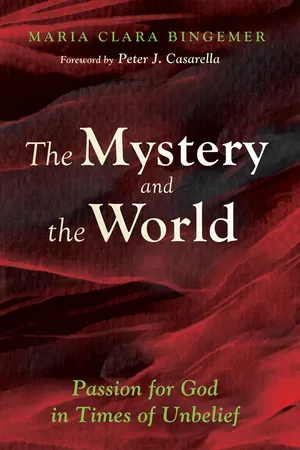
The Mystery and the World
Passion for God in Times of Unbelief
- 402 pages
- English
- ePUB (mobile friendly)
- Available on iOS & Android
eBook - ePub
The Mystery and the World
Passion for God in Times of Unbelief
About this book
During the past century, an enormous effervescence of events changed the sociopolitical configuration of the world. The interpretation of these facts helped further deepen the crisis in which modern thought already found itself--and it generated the uncertain and unstable environment in which we live today, the so-called postmodernity, late modernity, or hypermodernity.
In this context, one of the most profound impacts is most certainly the one on religion. During the twentieth century, religion proved not to be banished from the human horizon as the masters of suspicion intended.
Known as the godless century, the twentieth century saw also a resuscitation of the search for the sense of life and spirituality. With the crisis of modern reason, humankind turned toward consumerism and provisional and "light" practices. The last century represents not only the height of the postmodernization process but also the rescue of the transcendent and absolute, even if it is an absolute without face and identity. It is in this scenario that religious experiences, apparently exiled by modern rationality, begin to occur and multiply again.
Mystical experiences will be, then, the basis for highlighting recurrent characteristics with universal import. But they will show a different configuration than before. One will be able to find them not in so-called sacred spaces but in very secular ones; not so much within institutions but at the borders, or even outside them; not configured by a specific tradition but in an interface that makes more than one tradition meet and dialogue.
Information
Topic
Theology & ReligionSubtopic
Christianity1
Premature or Late Modernity
A Question of Culture
Before properly embarking on an analysis of the issue of mysticism as a pivotal experience to be presented to human beings today, it is important for us to analyze the context in which we live. In this chapter we will try to develop such an analysis, examining the main facts and the economic, social, political, and cultural components that characterized the twentieth century.
During the past century, there was an enormous effervescence of events that changed the sociopolitical configuration of the world. The interpretation of these facts helped to further deepen the crisis in which modern thought already found itself. And it generated the uncertain and unstable environment in which we live today, so-called postmodernity, late modernity, or hypermodernity.
We will try to see how, in this context, what emerges as a foundational and pivotal criterion for human life is no longer Enlightenment reason, but rather an incentive for an unrestrained consumerism that makes human beings believe they will find happiness there. But the degree of frustration brought about by this sterile pursuit unleashes a spiritual anxiety that is reflected in the search for very different forms of contact with the divine and the Sacred.
Thus the change of epoch we are living through has a strong impact on religion and belief, and obliges us to rethink its configuration and the way to live it out and transmit it.
The Death of Utopia and the Predominance of One Model
The word utopia was a name given by the English humanist Thomas More (1478–1535) to an imaginary island with an ideal sociopolitical system. It is formed from the negative Greek adverb ou (“not”) and the word topos (“place”) and means “that which does not have a place,” the no topos. This word, which was unknown to the Greek world, was the title given by Thomas More to a work that, according to the author himself, must be considered a “literary trifle that slipped almost unconsciously from his pen” to later gain fame and notoriety. At first, according to More, the work was intended to be only a little lampoon about “the best of republics,” situated on the new island, Utopia. The text, published in Louvain, Belgium, in November 1516, would soon find an exceptional audience among European intellectuals and would come to characterize not only a genre but an entire sociological literature. Today, in fact, besides the literature of utopian ideas, there is also a literature of reflection on these ideas. The production on this theme is feverish and dynamic. The utopia has an important place not only in the sociology of retrospective knowledge but also in that of prospective action.1
According to the Houaiss dictionary, utopia is that which is outside of reality, which never existed in the past and can never exist in the future. It is a plan or a dream that cannot be realized, or that can be realized only in an unforeseeable moment in the future. It also has the connotation of an ideal never achieved and always pursued. That is why, in a more colloquial sense, the word acquired the meaning of an impossible and unrealizable dream. In Portuguese, and in general in the Latin languages, utopia is any imaginary description of an ideal society based on just laws and on politico-economical institutions that are truly committed to the well-being of the collectivity. By extension, a utopia is said to be a project of an unrealizable nature, a project that is the fruit of a noble and generous ideal yet is impracticable. Colloquially, the word utopia is thus used as a synonym of chimera or fantasy.
Returning to Thomas More, utopia means, then, “in no place”: a place that is not any place, an absent presence, an unreal reality, a nostalgic beyond, an Otherness without identification. To this name the author adds a series of paradoxes with names derived from the prefix a-, which in Greek means “absence of”: Amaurote, the capital of the island, is a ghostly city; the Anyder is a river without water in its bed; its ruler, Ademus, is a prince without people; its inhabitants, the Alaopolitanes, are citizens without a city; and their neighbors, the Achorians, are inhabitants without a country. “This philological prestidigitation has the admitted objective of announcing the plausibility of a world inside out—and a latent and undeclared objective of denouncing the legitimacy of the theoretically real world, the world of laws.”2
After Thomas More, the definition of utopia gained in prominence and consistency, and also in complexity. The utopia came to be something like an imaginary plan for another reality, for another society, which would renovate the organizing components and structures of the current reality, such as the economy, politics, and religion. Many utopias have passed through and inspired human history, some with deplorable results, others giving strength to the human project and moving history. The secret of the dynamism of the utopia lies in the Otherness that informs it from inside. For this reason the utopia is not simply a fiction and a fantasy that should not be taken seriously. As Desroche says, “The fantasy in question is that of an imagination which, even if constituted by situations, is not less constitutive of other situations. History makes utopias, but utopias also make history.”3
Utopias are the engine of history because they make apparent the possibility of an alternative to the way history is configured today. The process would occur in the following sequence:
the fantasy gave birth to the project, the project to the audience, the audiences to larger circles through publicity, the publicity to plans for realization, the plans to strategies, the strategies to social forces, the forces to an opinion, and this power of opinion to a power of government.4
But everything began with a dream, dreamed with others and converted into an alternative and a plan. Following this line, Gramsci says that religion is the most gigantic utopia ever seen in history.5 In the case of historical Christianity, we tend to agree with the Italian philosopher, since the Christian “alternative” shaped the entire Western part of the world. But it could be argued that in politics, socialism, for example, was also a huge utopia. This is confirmed in the large sociopolitical and cultural cataclysm provoked by its fall, which turned a page in contemporary history.
In Marxism, utopia means an abstract and imaginary model of an ideal society conceived as a criticism of the existing social organization, with no chance of implementation because of its lack of connection to the political and economic conditions of concrete reality. From this came the concept of “utopian socialism.” To other thinkers, such as the sociologist Karl Mannheim (1893–1947) or the philosopher Ernst Bloch (1885–1977), utopia means something very different: an alternative plan of social organization capable of indicating achievable and concrete potentialities in a given established political order, contributing in this way to its transformation. According to this last conception, therefore, a utopia would be an engine of history, something that would impel it toward its goal.
The event normally identified as the end point in the crisis of modernity and the beginning of so-called postmodernity was the fall of the Berlin Wall in 1989, consummating a death that had been announced long beforehand: that of real socialism. From that moment, the concept of “the death of utopia” emerged on the proscenium of modern debate, referring to that historical fact, which was of extreme importance in the twentieth century and defined the transition to the twenty-first century.
The twentieth century was born under the aegis of socialism. It was the first century in which capitalism and socialism openly vied for hegemony over the world. The generations of the 1960s and 1970s were protagonists of the revolutionary ideas and movements that emerged in this period, inspired by the writings of Marx, the Russian and Cuban revolutions, and the subsequent guerrilla movement led by Ernesto “Che” Guevara until his death in Bolivia in 1967, and inspired also by the hippie movement, the protests against the Vietnam War, and the rejection of the consumerist societ...
Table of contents
- Title Page
- Foreword
- Introduction
- Chapter 1: Premature or Late Modernity
- Chapter 2: Secular Culture and the Crisis of Religion
- Chapter 3: Religious or Mystical Experience
- Chapter 4: Mystical Biographies and Theological Narrative
- Chapter 5: Stories and Experiences of Love
- Conclusion
- Appendix: Translator’s Note Regarding Sources and Footnotes for Chapter 5
- Bibliography
Trusted by 375,005 students
Access to over 1.5 million titles for a fair monthly price.
Study more efficiently using our study tools.
Frequently asked questions
Yes, you can cancel anytime from the Subscription tab in your account settings on the Perlego website. Your subscription will stay active until the end of your current billing period. Learn how to cancel your subscription
No, books cannot be downloaded as external files, such as PDFs, for use outside of Perlego. However, you can download books within the Perlego app for offline reading on mobile or tablet. Learn how to download books offline
Perlego offers two plans: Essential and Complete
- Essential is ideal for learners and professionals who enjoy exploring a wide range of subjects. Access the Essential Library with 800,000+ trusted titles and best-sellers across business, personal growth, and the humanities. Includes unlimited reading time and Standard Read Aloud voice.
- Complete: Perfect for advanced learners and researchers needing full, unrestricted access. Unlock 1.5M+ books across hundreds of subjects, including academic and specialized titles. The Complete Plan also includes advanced features like Premium Read Aloud and Research Assistant.
We are an online textbook subscription service, where you can get access to an entire online library for less than the price of a single book per month. With over 1.5 million books across 990+ topics, we’ve got you covered! Learn about our mission
Look out for the read-aloud symbol on your next book to see if you can listen to it. The read-aloud tool reads text aloud for you, highlighting the text as it is being read. You can pause it, speed it up and slow it down. Learn more about Read Aloud
Yes! You can use the Perlego app on both iOS and Android devices to read anytime, anywhere — even offline. Perfect for commutes or when you’re on the go.
Please note we cannot support devices running on iOS 13 and Android 7 or earlier. Learn more about using the app
Please note we cannot support devices running on iOS 13 and Android 7 or earlier. Learn more about using the app
Yes, you can access The Mystery and the World by Maria Clara Bingemer, Jovelino Ramos,Joan Ramos in PDF and/or ePUB format, as well as other popular books in Theology & Religion & Christianity. We have over 1.5 million books available in our catalogue for you to explore.