eBook - ePub
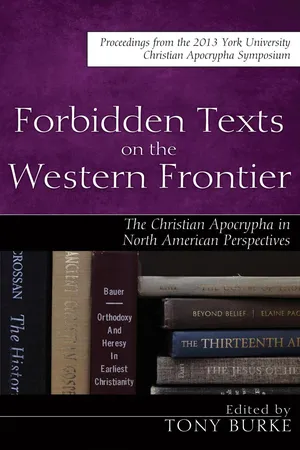
Forbidden Texts on the Western Frontier: The Christian Apocrypha in North American Perspectives
Proceedings from the 2013 York University Christian Apocrypha Symposium
- 400 pages
- English
- ePUB (mobile friendly)
- Available on iOS & Android
eBook - ePub
Forbidden Texts on the Western Frontier: The Christian Apocrypha in North American Perspectives
Proceedings from the 2013 York University Christian Apocrypha Symposium
About this book
North American study of the Christian Apocrypha is known principally for its interest in using noncanonical texts to reconstruct the life and teachings of Jesus, and for its support of Walter Bauer's theory on the development of early Christianity. The papers in this volume, presented in September 2013 at York University in Toronto, challenge that simplistic assessment by demonstrating that U.S. and Canadian scholarship on the Christian Apocrypha is rich and diverse. The topics covered in the papers include new developments in the study of canon formation, the interplay of Christian Apocrypha and texts from the Nag Hammadi library, digital humanities resources for reconstructing apocryphal texts, and the value of studying late-antique apocrypha. Among the highlights of the collection are papers from a panel by three celebrated New Testament scholars reassessing the significance of the Christian Apocrypha for the study of the historical Jesus. Forbidden Texts on the Western Frontier demonstrates the depth and breadth of Christian Apocrypha studies in North America and offers a glimpse at the achievements that lie ahead in the field.
Information
Topic
Theology & ReligionSubtopic
Biblical Studies1
Introduction
The York Christian Apocrypha Symposium Series was created in 2011 as a forum to showcase the work of North American scholars who study the Christian Apocrypha (CA). For the second symposium, titled “Forbidden Texts on the Western Frontier: The Christian Apocrypha in North American Perspectives,” we decided to take that mandate seriously and look directly at ourselves, to consider what makes CA Studies in the U.S. and Canada unique, to celebrate our strengths, and reflect on our weaknesses.
North America has no shortage of accomplished scholars in the field, but it has lacked the visibility and prestige enjoyed by our European colleagues, due in part to their highly-regarded publishing initiatives and the collaborative synergy that made these initiatives possible. Since 1904, German scholars have worked together to produce the celebrated Neutestamentliche Apokryphen in deutscher Übersetzung volumes, currently being updated by the editorial team of Christoph Markschies and Jens Schröter.1 The French and Swiss scholars who established the Association pour l’étude de la littérature apocryphe chrétienne (AELAC) have produced their own collection, the two-volume Écrits apocryphes chrétiens,2 as well as a number of critical editions in the Corpus Christianorum Series Apocryphorum, the journal Apocrypha, and a series of pocketbook editions of individual texts (La collection de poche Apocryphes); they also meet regularly at an annual summer réunion and smaller meetings during the winter months. Readers looking for texts in English translation have been served with a number of collections by individual scholars, including J. K. Elliott’s The Apocryphal New Testament (an update of the collection of M. R. James from 1924), and several compendia assembled by Bart Ehrman. But none of these are collaborative projects on the scale of the French and German collections. It must be acknowledged that membership in the AELAC has become increasingly international over the past decade and North American scholars have assembled with their European colleagues at the group’s meetings and have contributed to their publishing endeavors—notably, Tony Burke, Kristian Heal, F. Stanley Jones, Brent Landau, Pierluigi Piovanelli, Jean-Michel Roessli, and Stephen Shoemaker are all members of the group and have published in their series’ and/or the Apocrypha journal. Similarly, the first volume of the Markschies-Schröter collection includes work by three scholars based in Canada: Wolf-Peter Funk, Stanley Porter, and Wendy Porter. Nevertheless, North American scholarship can profit from gatherings that take place closer to home and from collaborating on scholarly endeavors that address the interests of North American readers.
Efforts have been made to satisfy these needs. U.S. and Canadian (and some international) CA scholars have met at annual meetings of the Society of Biblical Literature for decades, contributing papers to the Christian Apocrypha Section, as well as the Nag Hammadi and Gnosticism Section, and various sessions on such topics as ancient fiction, pseudepigraphy, and second-century Christianity. The North American Patristics Society is also a venue for work on CA texts. The first formal North American gathering focused entirely on CA scholarship took place at the University of Ottawa in 2006 at a workshop organized by Pierluigi Piovanelli entitled “Christian Apocryphal Texts for the New Millennium: Achievements, Prospects, and Challenges.”3 The papers presented at the workshop covered a variety of texts and topics, thus demonstrating the vibrancy and diversity of the field in North America. The workshop concluded with a discussion of collaborative projects and the possibility of forming an academic association, but after a failed attempt to mount a second workshop in 2007, the momentum begun in 2006 was temporarily lost.
Nearly ten years later, much has changed. The first York Christian Apocrypha Symposium, convened in 2011 by Tony Burke with assistance from Phil Harland, continued the efforts of the Ottawa workshop to bring together CA scholars from across the continent. This initial gathering had rather humble goals. Nine U.S. and Canadian scholars assembled for one day of discussion of a single text, one that has captured the attention of North American scholars and the wider public: the Secret Gospel of Mark.4 Shortly after, Burke and Brent Landau began work on New Testament Apocrypha: More Noncanonical Scriptures, a collection of texts in translation with contributions primarily from North American scholars. The project, a sister to Old Testament Pseudepigrapha: More Noncanonical Scriptures compiled by Richard Bauckham, James Davila, and Alexander Panayotov, aims to supplement Elliott’s The Apocryphal New Testament with new and neglected texts that have never-before appeared in English CA collections. Then, in 2013 Burke joined forces with Landau once again to mount this second York Symposium, this time on a much larger scale. They decided to construct a “state-of-the-art” for CA Studies in North America, with invited presenters looking at the past, present, and future of the field on the continent. Part of that future is the creation, at last, of a North American academic association devoted to the study of the CA. The objectives of collaboration and organization are on their way to being achieved but they are made possible only by the efforts of the many scholars working in the field today and by the perspectives that have shaped and continue to inform their work.
Christian Apocrypha Studies in the United States
CA Studies in the U.S. is characterized, chiefly by its critics, as having two propensities: the integration of noncanonical texts into the quest for the historical Jesus and the support of Walter Bauer’s theory on the development of early Christianity. Both of these characteristics are said to be hallmarks of the so-called “Harvard School,”5 but they infuse also the work of the controversial Jesus Seminar as well other scholars working throughout North America.
Brent Landau’s essay in this volume traces the history of the Harvard School to Helmut Koester, who joined the faculty of Harvard Divinity School in 1958. Koester’s approach to the CA is marked by his reluctance to favour one category of texts, canonical or noncanonical, over another; all are representatives of early Christian literature, and all have the potential to provide insights into the origins of Christianity.6 This perspective has led Koester to propose theories of the development of New Testament literature that incorporate apocryphal texts at an early stage in the process. Koester’s legacy is observable in the work of his doctoral students—including Ron Cameron, Julian Hills, Bentley Layton, Elaine Pagels, and Richard Valantasis—but perhaps his impact is most observable in the work of the Jesus Seminar. The Seminar was formed in 1985 by Robert Funk, who assembled around 200 scholars, primarily North American, as well as non-scholars with academic training, with the twin goals of arriving at a consensus about the life and teaching of Jesus and then presenting these findings to a wide audience. The Seminar’s methodological principles entailed examining all Christian texts composed before 300 CE, including noncanonical texts, as possible repositories of authentic Jesus traditions. Seminar member John Dominic Crossan, the author of several best-selling studies of the historical Jesus,7 is particularly well-known for his early dating of noncanonical texts and became, for many people, the public face of the Seminar and thus the target of much of the criticism levelled against it.8 Other Seminar members include Charles Hedrick, F. Stanley Jones, John Kloppenborg, and Stephen Patterson. The approach of the Seminar is reflected in the group’s collection of texts, The Complete Gospels,9 which places new translations of the canonical gospels side-by-side with select CA texts; the book is the closest North American scholarship has come before now to producing a multi-author CA collection. The Seminar has also published, through its imprint Polebridge Press, a number of CA texts in translation in the series Early Christian Apocrypha edited by Julian Hills.10
Of course Helmut Koester is not the only scholar at Harvard who has contributed significantly to the study of the CA. François Bovon joined the school in 1993 from the University of Geneva, bringing with him European CA scholarship’s interest in examining late apocryphal texts and its emphasis on conducting manuscript research. Bovon trained a number of young CA scholars, including Ann Graham Brock, Nicole Kelley, Brent Landau, Catharine Playoust, and Glenn Snyder. Harvard also is home to Karen L. King who joined the faculty in 1997. King works primarily with Coptic apocrypha and is best known for her work on the Gospel of Mary and for her challenge to the scholarly construct of “Gnosticism” in her monograph What Is Gnosticism?11 Her students include Benjamin Dunning and AnneMarie Luijendijk. Both Bovon and King brought to Harvard Divinity School new approaches to the study of the CA. As influential as Koester has been to the field, it would be wrong to characterize the “Harvard School,” indeed all study of the CA in the U.S., solely by Koester’s developmental theories of early Christian literature.
Prominent also in CA Studies is Claremont Graduate University in California. There James M. Robinson established the Coptic Gnostic Library Project at the Institute for Antiquity and Christianity in 1966. The project initiated the publication of a facsimile edition of the Nag Hammadi codices, the first English translation of the library in 1977 (revised in 1988),12 and a series of critical editions published by Brill as The Coptic Gnostic Library. Among the scholars who worked on the project were Charles Hedrick, who narrates some of his activities at...
Table of contents
- Illustrations and Tables
- Foreword
- Preface
- Abbreviations
- Contributors
- Chapter 1: Introduction
- Chapter 2: North American Approaches to the Study of the Christian Apocrypha on the World Stage
- Appendix: The AELAC (Association pour l’étude de la Littérature Chrétienne)
- Chapter 3: The “Harvard School” of the Christian Apocrypha
- Chapter 4: Excavating Museums
- Chapter 5: Scriptural Trajectories Through Early Christianity, Late Antiquity, and Beyond
- Chapter 6: Jesus at School among Christians, Jews, and Muslims
- Chapter 7: Nag Hammadi, Gnosticism, Apocrypha
- Chapter 7: Canon Formation
- Chapter 8: Apocryphal Gospels and Historical Jesus Research: A Reassessment
- Chapter 9: Apocryphal Gospels and Historical Jesus Research: A Response to Stephen Patterson
- Chapter 10: Apocryphal Gospels and Historical Jesus Research: A Response to Stephen Patterson
- Chapter 11: The Distinctive Sayings of Jesus Shared by Justin and the Pseudo-Clementines
- Chapter 12: The Tiburtine Sibyl, the Last Emperor, and the Early Byzantine Apocalyptic Tradition
- Chapter 13: Confused Traditions?
- Chapter 14: Digital Humanities and the Study of Christian Apocrypha
- Chapter 15: Select Digital Humanities Resources
- Chapter 16: Conversions of Paul
- Bibliography
Trusted by 375,005 students
Access to over 1.5 million titles for a fair monthly price.
Study more efficiently using our study tools.
Frequently asked questions
Yes, you can cancel anytime from the Subscription tab in your account settings on the Perlego website. Your subscription will stay active until the end of your current billing period. Learn how to cancel your subscription
No, books cannot be downloaded as external files, such as PDFs, for use outside of Perlego. However, you can download books within the Perlego app for offline reading on mobile or tablet. Learn how to download books offline
Perlego offers two plans: Essential and Complete
- Essential is ideal for learners and professionals who enjoy exploring a wide range of subjects. Access the Essential Library with 800,000+ trusted titles and best-sellers across business, personal growth, and the humanities. Includes unlimited reading time and Standard Read Aloud voice.
- Complete: Perfect for advanced learners and researchers needing full, unrestricted access. Unlock 1.5M+ books across hundreds of subjects, including academic and specialized titles. The Complete Plan also includes advanced features like Premium Read Aloud and Research Assistant.
We are an online textbook subscription service, where you can get access to an entire online library for less than the price of a single book per month. With over 1.5 million books across 990+ topics, we’ve got you covered! Learn about our mission
Look out for the read-aloud symbol on your next book to see if you can listen to it. The read-aloud tool reads text aloud for you, highlighting the text as it is being read. You can pause it, speed it up and slow it down. Learn more about Read Aloud
Yes! You can use the Perlego app on both iOS and Android devices to read anytime, anywhere — even offline. Perfect for commutes or when you’re on the go.
Please note we cannot support devices running on iOS 13 and Android 7 or earlier. Learn more about using the app
Please note we cannot support devices running on iOS 13 and Android 7 or earlier. Learn more about using the app
Yes, you can access Forbidden Texts on the Western Frontier: The Christian Apocrypha in North American Perspectives by Tony Burke, Burke in PDF and/or ePUB format, as well as other popular books in Theology & Religion & Biblical Studies. We have over 1.5 million books available in our catalogue for you to explore.