Ecumenism in postwar Asia, institutionalized in the Christian Conference of Asia, displayed a remarkable this-worldliness from its inception in the 1940s. This tendency was in contrast to the tension between the church-centric and world-centric approaches to Christian mission that marked conciliar mission thinking in the West. This work examines the development of such this-worldly holiness in Asian ecumenism, focusing on M. M. Thomas of India and C. S. Song from Taiwan.
Special attention is drawn to the idea of “God’s this-worldly presence” that considers God as redemptively at work in world history apart from the church. The study first compares the development of this-worldly holiness in the West and Asia and then examines the thinking of Thomas and Song. The chapters on these two theologians discuss their backgrounds, the basic concerns motivating their intellectual searches, and responses to the questions arising from such concerns. These chapters also try to understand how these theologians view the relationship between God and the world. In so doing, the study highlights the significance of the idea of God’s this-worldly presence shared by Thomas and Song in spite of differences in their backgrounds, approaches, and theological formulations.
Having compared Thomas and Song, the study concludes that the idea of God’s this-worldly presence became central to Asian ecumenism because it offered a common unifying vision to Asian Christians who come from a region characterized by tremendous diversity. The idea helped them to see the diverse peoples, cultures, and religions in Asia under one God who transcends the diversity and still takes it seriously.
eBook - ePub
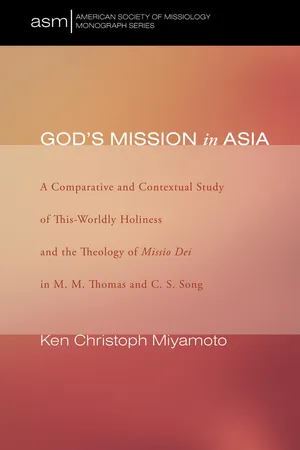
God's Mission in Asia
A Comparative and Contextual Study of This-Worldly Holiness and the Theology of Missio Dei in M. M. Thomas and C. S. Song
- 244 pages
- English
- ePUB (mobile friendly)
- Available on iOS & Android
eBook - ePub
God's Mission in Asia
A Comparative and Contextual Study of This-Worldly Holiness and the Theology of Missio Dei in M. M. Thomas and C. S. Song
About this book
Information
Topic
Theology & ReligionSubtopic
Christian Ministrychapter 1
Modernization and Christianity in Asia
Some Theoretical Issues Related to Today’s Contextual Theology
In the last several centuries, most peoples in Asia were constantly exposed to the expansion of the Western powers. The Second World War brought the colonial rule of the West to an end, and the postwar period was marked by the emergence of many new independent nations in Asia. Yet the process of globalization has become predominant in the past several decades, and Western values and worldview have become deeply intertwined with the indigenous ones. Thus, the influence of the West has transformed Asian societies profoundly. Modern science and technology have thoroughly reorganized their political and economic systems and brought about urbanization and industrialization. Modern education has created the new type of intellectuals and national leaders which was unknown in pre-modern Asia. Still modernization has not always resulted in the improvement of the material conditions of human life. In many nations, modern capitalism has radically accelerated the maldistribution of wealth and widened the gap between the rich and the poor. Indeed, the “underdevelopment” of many countries in Asia, Africa, and Latin America is merely the other side of the prosperity of modern capitalism in the North.1
The impact of the West is also evident in the religious and cultural aspects of social life in Asia. Both reform movements within traditional religions and religious fundamentalism have emerged as responses to, or reactions against, the Western values and worldview transplanted by colonialism, Christian missions, and secular ideologies. Nationalism, enlivened by Western secular ideologies, often inspired the struggle of Asian nations for independence and nation-building. Since the end of the Cold War, another type of nationalism—“religious nationalism” inspired by traditional religious sentiments transformed by Western influences—has emerged as a major cause both for international and domestic conflicts in various parts of the world.
Still another important development was the emergence of the Christian communities in Asia as a result of the Western missionary movement. These communities are mostly small. Yet they have frequently exercised a significant influence on the transformation of their societies. In what way then have Christians in Asia responded to the historical reality of their societies rapidly changing under the dynamic impact of the West? This is the question I want to deal with in this study. To address this question, the study will focus on two leading Christian intellectuals from Asia, namely, M. M. Thomas of India and C. S. Song from Taiwan, and look into the ways in which they tried to bridge and reconcile the discrepancy between the historical reality of Asia and their religious faith rooted in the West. In this introductory chapter, however, I will first discuss some theoretical issues underlying the study and define several important concepts. Then, a conceptual framework will be provided for understanding contemporary Christian theology in Asia. In the last section, I will briefly discuss the subject and outline of this study.
Modernization, Religion, and the Problem of Meaning
The essence of the Western influence on world history is the impact of modernity. The significance of modernity is well summarized by the sociologist Anthony Giddens:
The modes of life brought into being by modernity have swept us away from all traditional types of social order, in quite unprecedented fashion. In both their extensionality and their intensionality the transformations involved in modernity are more profound than most sorts of change characteristic of prior periods.2
In recent years, the confidence in modernity, particularly in the ideas of rationalism and progress conceptualized in the framework of the Enlightenment, has increasingly weakened. The impact of modernity is, nonetheless, deeply felt everywhere on earth, and much of its effect is most likely irreversible. An example for this situation is a growing number of ethno-religious conflicts in today’s world. Most of them arise from traditional ethno-religious sentiments awakened and intensified by modernization. Thus, the complex and multifaceted effect of modernization on traditional religions and cultures is drawing more and more attention.
The question of traditional and modern societies has always attracted the interest of Western social scientists.3 Two founders of social science, Max Weber and Emile Durkheim, dealt with the question extensively. Weber, who considered history as the process of rationalization, contrasted a “magical” traditional society with a “rationalized” or “disenchanted” modern society.4 Durkheim similarly distinguished between two types of society: a society where homogeneity and resemblance are predominant, and a society dominated by a high degree of differentiation and interdependence. He thought that it was a “historical law” that the society of the first type (primitive and traditional societies) would gradually be replaced by that of the second type (modern society).5 History was thus conceived by him as a process toward a greater differentiation.
Generally speaking, it is not easy to define the notions of modernity and modernization with precision. As Charles Ryerson writes,
Structurally, modernisation has often been described as increasing complexity, differentiation, and adaptability of organizational units. Recruitment to occupations on the basis of achievement rather than by ascriptive criteria and the spread of potential power to wider groups in the society have also often been stressed as the indices of modernisation.6
Modernization has been explained also in terms of the attainment of higher efficiency in the political and economic life of society. The Philippine scholar Josefa M. Saniel thus defined the notion as “the process of transforming a society’s traditional political, economic, and social systems into modern systems ideally characterized by the highest possible degree of efficiency with the least expenditure of energy.”7 In this type of definition, technical efficiency is considered as the key feature of modernity.
After the Second World War, especially in the 1960s, the modernization process of newly independent nations in Asia confronted scholars as well as politicians with a new question: this question was about the relationship between traditional values and modernization in the midst of social change.8 Among the scholars who devoted themselves to this question, the American sociologist Robert N. Bellah contributed greatly to the discussion of modernization by pointing out the significance of the cultural dimension of the modernization process. Distinguishing the “rationalization of means” from the “rationalization of ends,” Bellah wrote:
The modernization of societies and personalities is not concerned solely . . . with maximization of technical efficiency. Such modernization has increased the possibility of rational conscious choice of ends. It is this point, indeed, that our definition of “progress” . . . as an increase in learning capacity primarily implies. Modernization involves the increased capacity for rational goal-setting because it gives the system—society, organization, personality—a more comprehensive communications network through which it is possible to access the needs and potentialities of all parts of the system.9
Bellah thus considered modernization not only as the “maximization of technical efficiency” but also as “the increased capacity for rational goal-setting,” and he argued that such a new capacity must entail “the changed sense of identity and a new way of posing limit images.” Defined in this way, modernization was now seen as the “internal problem for religion” as well as culture for “it involves the heart of religious concerns.”10
Such an approach of Bellah’s to modernization was based on his understanding of modernity, which even today remains helpful. Emphasizing its cultural dimension, he primarily viewed modernity “as a spiritual phenomenon or a kind of mentality” rather than “as a form of political or economic system.” He thus defined it “as a new attitude toward the phenomenon of change.”11 Following Weber’s Protestant ethic thesis, Bellah considered that such an attitude originated in Protestantism, in particular in Puritanism. According to him,
This new mentality, which was...
Table of contents
- Title Page
- Acknowledgments
- Abbreviations
- Chapter 1: Modernization and Christianity in Asia
- Chapter 2: This-Worldly Holiness and the Missio Dei Concept in Ecumenical Mission Thinking
- Chapter 3: This-Worldly Holiness and the Missio Dei Concept in Asian Ecumenical Thinking
- Chapter 4: The Theology of God’s This-Worldly Presence in M. M. Thomas
- Chapter 5: The Theology of God’s Mission of Incarnation in C. S. Song
- Chapter 6: Conclusion
- Bibliography
Trusted by 375,005 students
Access to over 1.5 million titles for a fair monthly price.
Study more efficiently using our study tools.
Frequently asked questions
Yes, you can cancel anytime from the Subscription tab in your account settings on the Perlego website. Your subscription will stay active until the end of your current billing period. Learn how to cancel your subscription
No, books cannot be downloaded as external files, such as PDFs, for use outside of Perlego. However, you can download books within the Perlego app for offline reading on mobile or tablet. Learn how to download books offline
Perlego offers two plans: Essential and Complete
- Essential is ideal for learners and professionals who enjoy exploring a wide range of subjects. Access the Essential Library with 800,000+ trusted titles and best-sellers across business, personal growth, and the humanities. Includes unlimited reading time and Standard Read Aloud voice.
- Complete: Perfect for advanced learners and researchers needing full, unrestricted access. Unlock 1.5M+ books across hundreds of subjects, including academic and specialized titles. The Complete Plan also includes advanced features like Premium Read Aloud and Research Assistant.
We are an online textbook subscription service, where you can get access to an entire online library for less than the price of a single book per month. With over 1.5 million books across 990+ topics, we’ve got you covered! Learn about our mission
Look out for the read-aloud symbol on your next book to see if you can listen to it. The read-aloud tool reads text aloud for you, highlighting the text as it is being read. You can pause it, speed it up and slow it down. Learn more about Read Aloud
Yes! You can use the Perlego app on both iOS and Android devices to read anytime, anywhere — even offline. Perfect for commutes or when you’re on the go.
Please note we cannot support devices running on iOS 13 and Android 7 or earlier. Learn more about using the app
Please note we cannot support devices running on iOS 13 and Android 7 or earlier. Learn more about using the app
Yes, you can access God's Mission in Asia by Ken Christoph Miyamoto in PDF and/or ePUB format, as well as other popular books in Theology & Religion & Christian Ministry. We have over 1.5 million books available in our catalogue for you to explore.