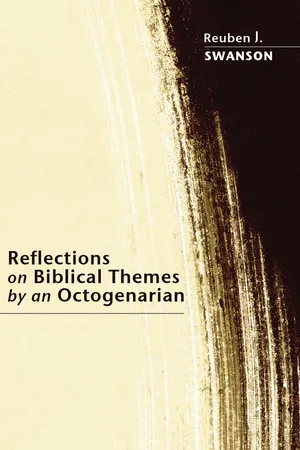
Reflections on Biblical Themes by an Octogenarian represents the journey into faith by the author of the essays over the span of sixty years in the pastoral ministry and as a professor on college, university, and theological school levels. There has been a continuing growth in understanding from the beginnings of a rather conservative religious background and training to a more mature appreciation and understanding of life. This growth came about through the interchange in the classroom as a student in preparation for ministry, then as a pastor in the everyday work experience and interchange with parishioners and especially in the interchange with students in the classroom. This more mature understanding and growth is reflected in the essays presented in this volume on various themes as listed in the Table of Contents. It is hoped that they will be of value to lay persons and to professionals in the life of the church and in the academic world, and that they will stimulate thought and discussion in parishes and in institutions of higher learning. Some of the viewpoints may seem to be controversial, but how are we to grow intellectually and spiritually unless we wrestle seriously with the deep and profound questions of our faith and life? These reflections are offered with the hope and prayer that they will stimulate discussion and growth in the life of the church in both parish and academic settings.
- 210 pages
- English
- ePUB (mobile friendly)
- Available on iOS & Android
eBook - ePub
Reflections on Biblical Themes by an Octogenarian
About this book
Information
Topic
Theology & ReligionSubtopic
Christian ChurchThe Composition of the Gospels
¶ It has long been a commonplace among New Testament scholars that there is a unique relationship among the first three gospels, Matthew, Mark, and Luke. The word “Synoptic” has been coined to identify this relationship, a Greek word meaning “to see together.” The similarities in content, in arrangement of materials, and even the word by word agreement have led many to conclude that two of the authors used the one as a source when they composed their gospels. On the one hand, the three gospels are distinct from the Fourth Gospel in most particulars, although there are frequent references in the latter gospel that suggest a familiarity with the content of the Synoptics; on the other hand, the similarity of the three to one another has led to the view that the earliest gospel composed became a basic source for the other two.
There are widely divergent views among contemporary scholars, however, as to the order in which the gospels were written. The view held by the majority is as follows: Mark is the primary gospel and the authors of Matthew and Luke used Mark as a source when they composed their gospels. A second view held by a rather vocal minority is that Matthew was the earliest gospel to have been composed, the author of Luke used Matthew as a source, then the author of Mark used both Matthew and Luke as sources when he composed his gospel. This view is known as the “Griesbach Hypothesis,” since the earliest formulation of this thesis is attributed to the eighteenth century scholar J. J. Griesbach. Other possibilities, for example, Luke was the earliest gospel and the authors of Matthew and Mark used Luke as a source, have been argued, but the most viable view in the opinion of this writer is the first, that is, the priority of Mark. This essay will attempt to set forth the reasons and the documentation in support of the Markan priority. The foil for the argument will be the Griesbach Hypothesis and a critique of the method that attempts to substantiate the order of Matthean priority and its subsequent conclusion that Luke used Matthew as a primary source and that Mark used Matthew and Luke when composing his gospel.
Omissions of Matthean Pericopes in Mark
Mark is by far the shorter of the three gospels consisting of forty-two pages in a modern critical edition as compared to sixty-nine pages for the gospel of Matthew and seventy-three for Luke. Thus Mark is shorter than Matthew by twenty-seven pages and shorter than Luke by thirty-one pages. If the author of Mark used Matthew and Luke as sources, the conclusion must be that he radically abridged those gospels by omitting large portions of each. It is of interest therefore to note those pericopes that were omitted by the author of Mark. A comparison with Matthew indicates that the following are omitted by the author of Mark:
1) the infancy narratives (chapters 1–2),
2) the so-called “Sermon on the Mount” (chapters 5–7),
3) the opening of the eyes of two blind men (9.27–31),
4) the casting out of a demon from a man who was dumb (9.32–34),
5) the easy yoke and the light burden (11.28–30),
6) the parable of the weeds among the wheat (13.24–30)
7) and its interpretation (13.36–43),
8) the parables of the hidden treasure, the pearl, the net, and the householder’s treasure (13.44–53),
9) healings on the mountain (15.29–31),
10) the announcement, “You are Peter” (16.17–19),
11) a midrash on the temple tax (17.24–27),
12) a discourse on forgiveness (18.15–22),
13) the parables of the unmerciful servant (18.23–35),
14) the laborers in the vineyard (20.1–16),
15) and the two sons (21.28–32),
16) a series of woes upon scribes and Pharisees (23.15–36),
17) the parables of the ten virgins (25.1–13)
18) and of the son of man coming in glory as judge (25.31–46),
19) the death of Judas (27.3–10),
20) the guard posted at the tomb (27.62–66),
21) the bribing of the guard at the tomb (28.11–15),
22) and the command to make disciples (28.16–20).
Omissions of Matthean Pericopes in Luke
A comparison to Luke’s gospel indicates the omission of the following pericopes by the author of Mark:
1) the infancy narratives (chapters 1–2),
2) the genealogy of Jesus (3.23–38),
3) the rejection at his home town Nazareth (4.16–30)
4) the great catch of fish (5.1–11),
5) the sermon on the plain (6.20–49),
6) a dead man raised at Nain (7.11–17),
7) the women ministering to Jesus (8.1–3),
8) all but a few reminiscences of the long section known as the journey through Perea to Jerusalem (9.51–18.14) that includes such materials as
a) the seventy-two sent out for mission (10.1–12, 17–20),
b) a parable on the theme “Who is my neighbor?” (10.30–37),
c) Jesus visit in the home of Martha and Mary (10.38–42),
d) the friend at midnight (11.5–8),
e) a woman blesses Jesus (11.27–28),
f) a parable on covetousness (12.13–21),
g) girded loins and burning lamps (12.35–40),
h) fire upon the earth (12.49–53),
i) the need for repentance (13.1–4),
j) the parable of the fruitless fig tree (13.6–9),
k) a woman freed from an infirmity on the Sabbath (13.10–17),
l) a Pharisee warns Jesus that Herod seeks to kill him (13.31–33),
m) a man with dropsy healed on the Sabbath (14.1–6),
n) a parable on seating oneself at a marriage feast (14.7–14),
o) parables of a tower builder and a warring king (14.28–33),
p) parables of the lost coin and the lost son (15.8–32),
q) the parable of the dishonest steward (16.1–12),
r) the parable of the rich man and Lazarus (16.19–31),
s) servants who do their duty cannot expect special favor (17.7–10),
t) ten lepers cleansed (17.11–19),
u) the parable of the judge and the importunate widow (18.1–8),
v) the parable of the Pharisee and the tax collector (18.9–14),
and following this large interpolation,
9) Jesus and the tax collector Zacchaeus (19.1–10),
10) Jesus weeps over Jerusalem (19.41–44),
11) Jesus teaches in the temple daily (21.47–48),
12) the two swords (22.35–38),
13) Jesus before Herod (23.6–12),
14) women lament the condemnation of Jesus (23.27–31),
15) the two travelers to Emmaus (24.13–35),
16) the appearance in Jerusalem and the command to await the coming of the Holy Spirit (24.36–49), and
17) his ascension at Bethany (24.50–53).
In addition, there are pericopes used in common by Matthew and Luke not found in Mark including such well known ones as
1) the healing of the centurion’s servant (M 8.5–13) or slave (L 7.1–10),
2) the demands of discipleship (M 8.18–22; L 9.57–62),
3) the plentiful harvest and the need for laborers (M 9.37–38; L 10.2),
4) a comparison of John the Baptist and the “Coming One” (M 11.2–19; L 7.18–35),
5) the woes and thanksgivings (M 11.20–27; L 10.12–15, 21–22),
6) the fruits of the good and of the bad trees (12.33–35; L 6.43–45),
7) the sign of Jonah (M 12.38–42; L 11.29–31),
8) the unclean spirit seeking rest (M 12.43–45; L 11.24–26),
9) the parable of the leaven (M 13.33; L 13.20–21),
10) the parable of the lost sheep (M 18.10–14; L 15.3–7),
11) the parable of the wedding feast (M 22.1–14) or the great banquet (L 14.16–24),
12) Jerusalem foreseen as forsaken and desolate (M 23.37–39; L 13.34–35),
13) the parable of the faithful and wise slave (M 24.45–51; L 12.42–48), and
14) the parable of the talents (M 25.14–30) or the pounds (L 19.11–27).
It must be noted that Mark has pericopes that are not reported in either Matthew or Luke:
1) the parable of the seed growing spontaneously (4.26–29),
2) the healing of a deaf man with a speech impediment (7.31–37),
3) the restoring of sight to a blind man at Bethsaida (8.22–26), and
4) the account of the young man who fled naked when Jesus was arrested (14.51–52).
The Question of Omissions in Mark
The question rises, and it is a serious one, How is it that the author of Mark failed to use any of these materials in his composition of a gospel if indeed he used the gospels of Matthew and Luke as sources? It seems incomprehensible that any or all of such vital materials as are found in the above lists could have been ignored if the author was acquainted with them firsthand. It is not difficult to understand or to explain how the authors of Matthew and Luke omitted the four pericopes from Mark cited in the previous paragraph in view of the wealth of materials they have reported. The absence of such a volume of quality traditions from the teachings and from the signs and wonders that Jesus did is very difficult, if not impossible, to explain if we adopt the thesis that the author of Mark used the gospels of Matthew and Luke as sources. The problem seems readily explicable if one posits that the author of Mark was the earliest composer of a gospel, that he composed his gospel in Rome, and that his principal source of information was the Apostle Peter.
In the view of this writer, Mark was the great and ingenious pioneer who first created the literary form that came to be called an euaggelion, or gospel. Accordingly he is the greatest of the gospel writers, the creator and innovator, although we more often than not fail to give him due respect by focusing attention upon the gospels of Matthew and Luke and referring to Mark’s gospel only as a last resort. After all they are so rich in content, in the type and quality of material that is useful in our spiritual life and growth, that it is only natural for Mark to come in a poor third in our estimate of what a gospel should be. But the absence of large quantities of material from the earliest gospel is just what is to be expected from a comparative study based upon the history of religions.
The Order of Development for a Major World Religion
A study of the history of any of the great religions of the world is very instructive for an understanding of the development of tradition as reflected in our gospels. The pattern, Mark as a source for Matthew and Luke, is in large agreement with what we find in the development of the tradition in Judaism, Islam, Hinduism, and Buddhism, to mention the most noteworthy examples. Mark reflects a low Christology in comparison to Matthew and Luke; that is, the Jesus portrayed by Mark is a very human figure with few, if any, divine qualities. It should be evident to us that no one of Jesus’ contemporaries, not even those closest to him, had any intimation or understanding that he was a divine being. You may say that the so-called miracle stories refute this predication, but such is not the case since the very human disciples are reported in our sources to have had powers to do signs and wonders as well. This question is discussed in greater detail in another essay in these series.
The historic development of all religions follows a basic pattern. First, the decisive figure of the founder; second, the community of devotees who perpetuate the traditions of his life and teaching; third, the growth of the tradition about what the teacher had said and done; and, finally, the expansion of the tradition about the founder himself and the attribution to him of divine and supernatural powers. The lines of demarcation between the periods are never clearly defined; there is more often an overlapping and impinging of the succeeding period upon the previous time.
This is precisely how I would define the development within the early Christian community and the relationship of the gospels to one another. First, the life and teaching of Jesus that culminates in his death and resurrection. Second, the period of the early Christian community that preserves and perpetuates the traditions about his teachings and his deeds. This is that period in the life of the early community narrated in the Book of the Acts of the Apostles, although the account itself was written in period three and already reflects the viewpoints of period four. I would place the composition of the gospel of Mark at the very beginning of period three at a time when the influence of period two still prevails.
At this point in time the figure of the teacher as he appeared in life still dominates the life and the thinking of the community. Some of the original followers may still be alive, although the majority are either dead or at some place in mission where they are not readily consulted. The tradition that Peter is a main source for the information reported about Jesus by the author of Mark is altogether credible. His Jesus is very human, a man of action and deeds rather than a profound teacher or a divine and supernatural being. This is in character with the image of Peter reflected in all our gospels and in the Acts of the Apostles. According to this understanding it becomes clear why the author does not report from the mass of traditions found in the later gospels where the emphasis is more upon Jesus as a teacher rather than a man of action. The author of Mark has no need to report stories about the infancy and early life of the teacher; in fact, he cannot because this belongs to a later stage of tradition as witnessed by every major religious tradition. Compare, for example, the development of the tradition about the Buddha in the history of Budd...
Table of contents
- Title Page
- • Foreword
- • In the Beginning
- • The Conception and Birth of Jesus
- • Genealogies in Matthew and Luke
- • The Baptism of Jesus
- • Signs and Wonder Stories in the Gospels
- • The Gospel of Matthew as an Anti-Pauline Polemic
- • Textual Criticism
- • The Composition of the Gospels
Trusted by 375,005 students
Access to over 1.5 million titles for a fair monthly price.
Study more efficiently using our study tools.
Frequently asked questions
Yes, you can cancel anytime from the Subscription tab in your account settings on the Perlego website. Your subscription will stay active until the end of your current billing period. Learn how to cancel your subscription
No, books cannot be downloaded as external files, such as PDFs, for use outside of Perlego. However, you can download books within the Perlego app for offline reading on mobile or tablet. Learn how to download books offline
Perlego offers two plans: Essential and Complete
- Essential is ideal for learners and professionals who enjoy exploring a wide range of subjects. Access the Essential Library with 800,000+ trusted titles and best-sellers across business, personal growth, and the humanities. Includes unlimited reading time and Standard Read Aloud voice.
- Complete: Perfect for advanced learners and researchers needing full, unrestricted access. Unlock 1.5M+ books across hundreds of subjects, including academic and specialized titles. The Complete Plan also includes advanced features like Premium Read Aloud and Research Assistant.
We are an online textbook subscription service, where you can get access to an entire online library for less than the price of a single book per month. With over 1.5 million books across 990+ topics, we’ve got you covered! Learn about our mission
Look out for the read-aloud symbol on your next book to see if you can listen to it. The read-aloud tool reads text aloud for you, highlighting the text as it is being read. You can pause it, speed it up and slow it down. Learn more about Read Aloud
Yes! You can use the Perlego app on both iOS and Android devices to read anytime, anywhere — even offline. Perfect for commutes or when you’re on the go.
Please note we cannot support devices running on iOS 13 and Android 7 or earlier. Learn more about using the app
Please note we cannot support devices running on iOS 13 and Android 7 or earlier. Learn more about using the app
Yes, you can access Reflections on Biblical Themes by an Octogenarian by Reuben J. Swanson in PDF and/or ePUB format, as well as other popular books in Theology & Religion & Christian Church. We have over 1.5 million books available in our catalogue for you to explore.