eBook - ePub
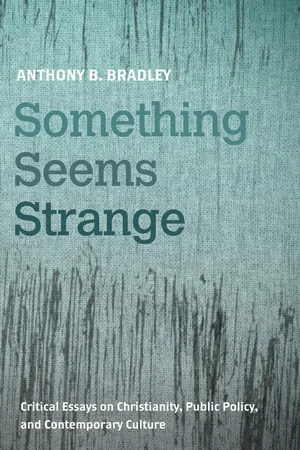
Something Seems Strange
Critical Essays on Christianity, Public Policy, and Contemporary Culture
- 302 pages
- English
- ePUB (mobile friendly)
- Available on iOS & Android
eBook - ePub
Something Seems Strange
Critical Essays on Christianity, Public Policy, and Contemporary Culture
About this book
Life happens at the intersection of faith and culture. Whether we are Christians or not, we all have some narrative about the way the world ought to be that shapes how we view the world and live our lives. In this book, Anthony Bradley explores those intersections in ways that analyze and direct our imaginations toward the best practices that lead to human flourishing. Economics, political philosophy, sociology, psychology, and theology are just a few of the disciplines used in an attempt to make sense of a world where things are not the way they are supposed to be. Something does seem strange about the world, but we are not left without tools and principles that we need to make life work at the intersections of faith and culture. The aim of Something Seems Strange is to provide a model of thinking about life at those intersections, so that people can lively freely according to their God-given design.
Information
section one
The Church and the Christian Life
The New Legalism
Is Paul’s urging to live quietly, mind your own affairs, and work with your hands (1 Thessalonians 4:11) only for losers? Do you feel that you’re wasting your gifts if you “settle” into an ordinary job, get married early and start a family, or live in a small town or suburb? Acton Institute Power Blogger Anthony Bradley has some provocative thoughts on the “new legalism.”—Marvin Olasky
Back in 2013 I made the following observation on Facebook and Twitter:
“Being a ‘radical,’ ‘missional’ Christian is slowly becoming the ‘new legalism.’ We need more ordinary God and people lovers (Matt 22:36-40).”
This observation was the result of a long conversation with a student who was wrestling with what to do with his life, given all of the opportunities he had available to him. To my surprise, my comment exploded over the internet with dozens and dozens of people sharing the comment and sending me personal correspondence.
I continue to be amazed by the number of youth and young adults who are stressed and burnt out from the feelings of shame and inadequacy they experience if they happen not to be doing something unique and special. Today’s millennial generation is being fed the message that, if they don’t do something extraordinary in this life, they are wasting their gifts and potential. The sad result is that many young adults feel ashamed if they “settle” into ordinary jobs, get married early and start families, live in small towns, or as 1 Thessalonians 4:11 says, “aspire to live quietly, and to mind [their] affairs, and to work with [their] hands.” For too many millennials, being an ordinary person, who works a non-glamorous job, lives in the suburbs, and has nothing spectacular to boast about, is a fate to be avoided at all costs.
Here are a few thoughts on how we got here.
Anti-Suburban Christianity
In the 1970s and 1980s, the children and older grandchildren of the builder generation (born between 1901 and 1920) sorted themselves and headed to the suburbs to raise their children in safety, comfort, and material ease. And now millennials (born between 1977 and 1995), taking a cue from their baby boomer parents (born between 1946 and 1964) to despise the contexts that provided them their advantages, have a disdain for America’s suburbs. This despising of suburban life has been inadvertently encouraged by well-intentioned religious leaders inviting people to move to neglected cities to make a difference, because, after all, the Apostle Paul did his work primarily in cities, cities are important, and cities are the final destination of the Kingdom of God. They were told that God loves cities and they should, too.1 The unfortunate message became that you cannot live a meaningful Christian life in the suburbs.
Missional Narcissism
There are many churches that are committed to being what is called missional. This term is used to describe a church community where people see themselves as missionaries in local communities. A missional church has been defined, as “a theologically formed, Gospel-centered, Spirit-empowered, united community of believers who seek to faithfully incarnate the purposes of Christ for the glory of God,” says Scott Thomas of the Acts 29 Network.2 The problem is that this push for local missionaries coincided with the narcissism epidemic we are facing in America, especially with the millennial generation.3 As a result, living out one’s faith became narrowly celebratory only when done in a unique and special way, a “missional” way. Getting married and having children early, getting a job, saving and investing, being a good citizen, loving one’s neighbor, and the like, no longer qualify as virtuous. One has to be involved in the arts and social justice activities—even if justice is pursued without sound economic or social teaching. I actually know of a couple who were being so “missional” they decided to not procreate for the sake of taking care of orphans.
To make matters worse, some religious leaders have added a new category to Christianity called “radical Christianity” in an effort to trade-off suburban Christianity for mission. This movement is based on the book Radical by David Platt and is fashioned around “an idea that we were created for far more than a nice, comfortable Christian spin on the American dream. An idea that we were created to follow One who demands radical risk and promises radical reward.”4 Again, this was a well-intentioned attempt to address lukewarm Christians in the suburbs, but because it is primarily reactionary and does not provide a positive construction for the good life from God’s perspective, it misses “radical” ideas in Jesus’ own teachings like “love.”
The combination of anti-suburbanism with new categories like “missional” and “radical” has positioned a generation of youth and young adults to experience an intense amount of shame for simply being ordinary Christians who desire to love God and love their neighbors (Matthew 22:36-40). In fact, missional, radical Christianity could easily be called the “new legalism.” A few decades ago, an entire generation of baby boomers walked away from traditional churches to escape the legalistic moralism of “being good,” but what their millennial children received in exchange, in an individualistic American Christian culture, was shamed-driven pressure to be awesome and extraordinary young adults expected to tangibly make a difference in the world immediately. But this cycle of reaction and counter-reaction, inaugurated by the baby boomers, does not seem to be producing faithful young adults. Instead, many are simply burning out.
Why is Christ’s command to love God and neighbor not enough for these leaders? Maybe Christians are simply to pursue living well and invite others to do so according to how God has ordered the universe. An emphasis on human flourishing, ours and others’, becomes important because it is characterized by a holistic concern for the spiritual, moral, physical, economic, material, political, psychological, and social context necessary for human beings to live according to their design. What if youth and young adults were simply encouraged to live in pursuit of wisdom, knowledge, understanding, education, wonder, beauty, glory, creativity, and worship in a world marred by sin, as Abraham Kuyper encourages in the book Wisdom and Wonder? No shame, no pressure to be awesome, no expectations of fame but simply following the call to be men and women of virtue and inviting their friends and neighbors to do the same in every area of life.
It is unclear how millennials will respond to the “new legalism,” but it may explain the current trend of young Christians leaving the church after age 15 at a rate of 60 percent. Being a Christian in a shame-driven “missional,” “radical” church does not sound like rest for the weary. Perhaps the best antidote to these pendulum swings and fads is simply to recover a mature understanding of vocation so that youth and young adults understand that they can make important contributions to human flourishing in any sphere of life because there are no little people or insignificant callings in the Kingdom.
Poor Whites Need Jesus and Justice, Too
If you want to hear crickets in a room full of educated, missionally minded, culture-shaping evangelicals, ask this question: “What are you doing to serve the needs of poor white people?”
A recent seminary graduate, who is white, asked me what he needed to do to prepare to plant a church in a small lower-class town that is 76 percent black and 21 percent white. He was rightly cautious after reading in Aliens in the Promised Land about Rev. Lance Lewis’ call for a moratorium on white evangelicals planting churches in black areas because of evangelicalism’s cultural obtuseness and patriarchal disposition toward ethnic minorities. Since most black communities in the South are already saturated with churches, I asked this young man why he was not interested in planting a church among the lower-class whites in his county. His humble response: “It had not occurred to me to plant a church among lower-class whites.”
While urban, justice-loving evangelicals easily shame white, suburban, conservative evangelicals for their racially homogenized lives, both communities seem to share a disdain for lower-class white people. “Rednecks,” “crackers,” “hoosiers,” and “white trash” are all derogatory terms used to describe a population of lower-class whites who have suffered centuries of injustice and social marginalization in America, especially from educated Christians.
Even though lower-class whites comprise the largest percentage of America’s welfare recipients and the largest percentage of those living below the poverty line, evangelicals remain largely focused on poverty among African-Americans and Hispanics. The imagery conjured by “social justice” and “mercy-ministry” rhetoric is a collage of underprivileged African-American and Hispanic kids living in “da hood.” When evangelicals are challenged to relocate to poor areas for the sake of the being “missional,” small towns and rural areas with high concentrations of lower-class whites, like Springfield, MO, or Troy, NY, do not normally make the list. While Christian colleges and seminaries across America are teeming with “urban ministry” programs, there is only one large, accredited seminary in America that has a degree program targeted specifically for rural ministry: ...
Table of contents
- Title Page
- Acknowledgements
- Introduction
- Section One: The Church and the Christian Life
- Section Two: Politics and Economics
- Section Three: Education
- Section Four: Contemporary Culture
- Bibliography
Trusted by 375,005 students
Access to over 1.5 million titles for a fair monthly price.
Study more efficiently using our study tools.
Frequently asked questions
Yes, you can cancel anytime from the Subscription tab in your account settings on the Perlego website. Your subscription will stay active until the end of your current billing period. Learn how to cancel your subscription
No, books cannot be downloaded as external files, such as PDFs, for use outside of Perlego. However, you can download books within the Perlego app for offline reading on mobile or tablet. Learn how to download books offline
Perlego offers two plans: Essential and Complete
- Essential is ideal for learners and professionals who enjoy exploring a wide range of subjects. Access the Essential Library with 800,000+ trusted titles and best-sellers across business, personal growth, and the humanities. Includes unlimited reading time and Standard Read Aloud voice.
- Complete: Perfect for advanced learners and researchers needing full, unrestricted access. Unlock 1.5M+ books across hundreds of subjects, including academic and specialized titles. The Complete Plan also includes advanced features like Premium Read Aloud and Research Assistant.
We are an online textbook subscription service, where you can get access to an entire online library for less than the price of a single book per month. With over 1.5 million books across 990+ topics, we’ve got you covered! Learn about our mission
Look out for the read-aloud symbol on your next book to see if you can listen to it. The read-aloud tool reads text aloud for you, highlighting the text as it is being read. You can pause it, speed it up and slow it down. Learn more about Read Aloud
Yes! You can use the Perlego app on both iOS and Android devices to read anytime, anywhere — even offline. Perfect for commutes or when you’re on the go.
Please note we cannot support devices running on iOS 13 and Android 7 or earlier. Learn more about using the app
Please note we cannot support devices running on iOS 13 and Android 7 or earlier. Learn more about using the app
Yes, you can access Something Seems Strange by Anthony B. Bradley in PDF and/or ePUB format, as well as other popular books in Social Sciences & Christian Theology. We have over 1.5 million books available in our catalogue for you to explore.