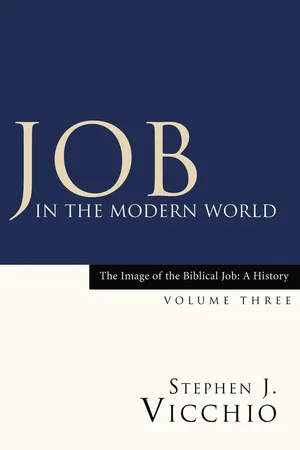
In this third of a three-volume work, the author traces the interpretation of the book of Job from the Authorized Version of the Bible (King James Version) through philosophers of the seventeenth, eighteenth, and nineteenth centuries. He also covers Job in the literature of the Romantics, Blake, Melville, and Dostoyevsky. As appendices, he treats Job in Geography (Uz), Job and Zoology (Behemoth and Leviathan), and Job in Film.
Volume 1: Job in the Ancient World
Volume 2: Job in the Medieval World
Volume 3: Job in the Modern World
- 258 pages
- English
- ePUB (mobile friendly)
- Available on iOS & Android
eBook - ePub
Job in the Modern World
About this book
Information
29
Job in Nineteenth-Century Biblical Hermeneutics
What is the purpose of the book? It has been answered in so many ways, that a judgment regarding it must be put forth with the greatest diffidence. Almost every theory that has been adopted has found itself in collision with one or more parts of which the book now consists, and has been able to maintain itself only by sacrificing these parts upon its alter.
—A. B. Davidson
Introduction to The Book of Job with Notes, Introduction, Appendix
In the 19th century the new Higher Criticism changed forever our ways of looking at the Bible.
—Bruce Metzger
Oxford Companion to the Bible
Doubts whether particular portions of the present book belonged to the original form of it have been raised by many. M.L. De Wette expressed himself as follows, “It appears to us that the present book of Job has not all flowed from one pen. As many books of the Old Testament have been several times written over, so has this one.”
—Crawford Howell Toy
“Job,” in Encyclopedia Britannica
Introduction
The seventeenth century saw the development of the first historical-critical approaches to the study of the Bible. By the closing decades of the 18th century, the rational study of the Bible had developed to the extent that hermeneutical handbooks setting forth the new method were readily available in German university towns. Books by Ernesti, Semler, Lessing, Herder, and Eichhorn, all trumpeted the new method.1
Before the eighteenth century, historical criticism of the Bible had been confined for the most part to critics of the church and synagogue, but in the last decades of the eighteenth century European and American study of the Bible was no longer confined to church theologians and clergy. The rise of the German universities was the main impetus in moving the Bible to the arena of secular studies.
In some ways, this movement from the German churches to the universities in the late eighteenth to nineteenth centuries is parallel to the movement of the Bible from the cloistered monasteries to the newly formed universities of the twelfth century.
In the German universities of the early nineteenth century, there was an air of freedom and a romantic sense of daring. In many ways, Hegel set the tone for the universities. Philosophy was to solve the riddles of history. The supposed facts would be shown to be myth, which then would be dissolved into a larger synthesis.
By the end of the nineteenth century, the historical-critical study of the Bible came to be regarded as the only worthwhile kind of scholarly exegesis. It was to guide both biblical scholars and theologians for the next century.
Perhaps the most interesting aspect of the development of these new interpretive methods was how much they were guided by nineteenth-century philosophical presuppositions. Many nineteenth-century exegetes, for example, generally understood that miracles are simply misinterpretations of entirely natural events. The Hegelian distinction between “external ideas” and “temporal forms” was frequently employed by interpreters of the period. By the 1870s, the biblical text was understood principally with historical and literary tools that might be applied to any other text.
By the close of the nineteenth century, more than two hundred major works on the book of Job had appeared in Western Europe and the United States in the preceding one hundred years, more than eighty percent of those in the last third of the century.2 After 1870, commentaries on Job were dominated by historical-critical, form-critical, and the history of religions approaches.
The number of critical questions raised in these new approaches about the book of Job was immense. Issues about authorship, textual integrity, cultural influences, and literary form were raised unselfconsciously in ways that had rarely been brought forth before. Indeed, these questions became the questions asked about the book in the final two decades of the nineteenth century, and, for the most part, through the entire twentieth century and beyond. These new methods cast a long shadow over biblical scholarship from the late nineteenth century to the present, and to find the sources of that shadow, we must return to the treatment of Job by German scholars in the nineteenth century.
Job in Early German Scholarship
The first German commentaries on the biblical book of Job were produced in 1773, 1774, and 1779, by J. D. Michaelis and J. C. Doederlein.3 These were followed a short time later with Job commentaries by J. R. Scharer (1810), H. Ewald (1830), D. Umbreit (1837), L. Hirzel (1839), and B. Welte (1849).4
For the most part, these commentaries were the first to use historical-critical, form-critical, and history of religions approaches to the book of Job. Of these commentaries, Ewald is the most important one. Ewald did much of the early groundwork applying the new methods to the book of Job.
The publication of the commentaries by Ewald, Umbreit, and Hirzel gave rise to a second wave of German commentaries on the book of Job. Included in this second group are commentaries by K. Schottmann (1851), C. A. Berkholz (1859), Franz Delitzsch (1864), A. Dillmann (1869), and E. W. Hengstenberg (1870).5
The final three decades of the nineteenth century saw a final wave of German Job commentaries. These include works by E. O. Merx (1871); F. Hitzig (1874), V. Bottcher (1885), J. G. E. Hoffmann (1891), C. Siegfried (1894), F. Bathgen (1894), G. Bickel (1894), K. Budde, (1895), G. Beer (1897), and B. Duhm (1897). Of these, those by Merx, Budde, Beer, and Bickel were most often quoted by subsequent scholars writing in German.6
These commentaries were followed by a number of other German commentaries on the book of Job in the first two decades of the twentieth century. Included in this group are commentaries by J. Hontheim (1904), S. Ottli (1908), C. Steuernagel (1910), Paul Volz (1911), N. J. Scholgel (1916), A. B. Ehrlich (1918), M. Jastrow (1920), and V. E. Reichter (1925).7 Of these commentaries, those by Ehrlich and Jastrow are the most useful.
The 1930s saw the emergence of another seven or eight German commentaries on the book of Job. These include: P. Szczygiel (1931), K. A. Busch (1937), G. Holscher (1937), E. J. Kissane (1939), E. G. Kraeling (1939), H. Buckers (1939), and F. Wutz (1939). Of these commentaries, those by Kissane, Kraeling, and Graeling were the most often quoted by subsequent German scholars.8
Finally, the 1940s saw the emergence of a few more German commentaries on the book of Job, including those by R. A. Schroder (1948), G. Fohrer (1948), G. Holscher (1948); F. Delitzsch (1949), and H. W. Hertzberg (1949). Of these German commentaries on the book of Job, those by Fohrer and Delitzsch had the most lasting effects on later German scholarship.9
Job in Nineteenth-Century German Scholarship
Books about Job published in German during the early nineteenth century showed signs of both the new academic freedom and the newly fashionable forms of exegesis. Between 1800 and 1825, six major works appeared in German on Job. Of these six early books, the three most notable were those by De Wette (1807), Gaab (1809), and Stuhlmann (1804).10 All three men made strikingly original contributions, using the new critical methods, to the study of Job. each developed a modified documentary hypothesis on the book, arguing that the poetry is considerably older than the prose. De Wette, professor at Heidelberg and Berlin, put the matter this way:
It appeared to us that the present book of Job has not all flowed from one pen. As many books of the Old Testament have been several times written over, so has this one.11
Later in the century, Budde (1876), Grill (1890), and Laue (1896) would provide philological and further form-critical evidence for the priority of the prose.12 By the close of the century, Karl Kautzsch in his Das Sogenannte Volksbuch von Hiob gave a summary of all the theories concerning the relationship of the poetry of Job to its prose.13
Between 1826 and 1849, fifteen major works on Job were published in German.14 During this period, Stickel (1842) used form-critical methods to debate the proper date of the book of Job. He argued on the strength of the similarity o...
Table of contents
- Title Page
- Introduction
- Chapter 21: Job in the King James Version
- Chapter 22: Job in Seventeenth-Century Philosophy
- Chapter 23: John Milton’s View of Job
- Chapter 24: Job in the Enlightenment
- Chapter 25: Job in Romanticism
- Chapter 26: Job in William Blake
- Chapter 27: Job in Nineteenth-Century Dialectical Philosophy
- Chapter 28: Melville, Dostoyevsky, and the Book of Job
- Chapter 29: Job in Nineteenth-Century Biblical Hermeneutics
- Chapter 30: Job in Late Nineteenth-Century Popular Philosophy
- Appendix E: Job in Geography The Search for the Land of Uz
- Appendix F: Job and Zoology The Identities of Behemoth and Leviathan
- Appendix G: The Biblical Book of Job in Film
Trusted by 375,005 students
Access to over 1.5 million titles for a fair monthly price.
Study more efficiently using our study tools.
Frequently asked questions
Yes, you can cancel anytime from the Subscription tab in your account settings on the Perlego website. Your subscription will stay active until the end of your current billing period. Learn how to cancel your subscription
No, books cannot be downloaded as external files, such as PDFs, for use outside of Perlego. However, you can download books within the Perlego app for offline reading on mobile or tablet. Learn how to download books offline
Perlego offers two plans: Essential and Complete
- Essential is ideal for learners and professionals who enjoy exploring a wide range of subjects. Access the Essential Library with 800,000+ trusted titles and best-sellers across business, personal growth, and the humanities. Includes unlimited reading time and Standard Read Aloud voice.
- Complete: Perfect for advanced learners and researchers needing full, unrestricted access. Unlock 1.5M+ books across hundreds of subjects, including academic and specialized titles. The Complete Plan also includes advanced features like Premium Read Aloud and Research Assistant.
We are an online textbook subscription service, where you can get access to an entire online library for less than the price of a single book per month. With over 1.5 million books across 990+ topics, we’ve got you covered! Learn about our mission
Look out for the read-aloud symbol on your next book to see if you can listen to it. The read-aloud tool reads text aloud for you, highlighting the text as it is being read. You can pause it, speed it up and slow it down. Learn more about Read Aloud
Yes! You can use the Perlego app on both iOS and Android devices to read anytime, anywhere — even offline. Perfect for commutes or when you’re on the go.
Please note we cannot support devices running on iOS 13 and Android 7 or earlier. Learn more about using the app
Please note we cannot support devices running on iOS 13 and Android 7 or earlier. Learn more about using the app
Yes, you can access Job in the Modern World by Stephen J. Vicchio in PDF and/or ePUB format, as well as other popular books in Theology & Religion & Biblical Criticism & Interpretation. We have over 1.5 million books available in our catalogue for you to explore.