- 300 pages
- English
- ePUB (mobile friendly)
- Available on iOS & Android
eBook - ePub
About this book
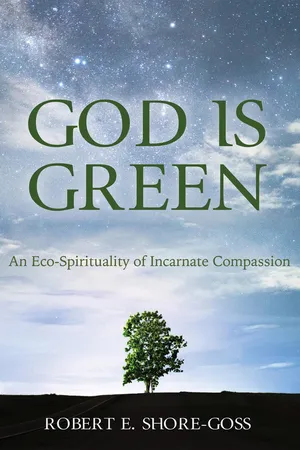
At this time of climate crisis, here is a practical Christian ecospirituality. It emerges from the pastoral and theological experience of Reverend Robert Shore-Goss, who worked with his congregation by making the earth a member of the church, by greening worship, and by helping the church building and operations attain a carbon neutral footprint.
Shore-Goss explores an ecospirituality grounded in incarnational compassion. Practicing incarnational compassion means following the lived praxis of Jesus and the commission of the risen Christ as Gardener. Jesus becomes the "green face of God." Restrictive Christian spiritualities that exclude the earth as an original blessing of God must expand. This expansion leads to the realization that the incarnation of Christ has deep roots in the earth and the fleshly or biological tissue of life.
This book aims to foster ecological conversation in churches and outlines the following practices for congregations: meditating on nature, inviting sermons on green topics, covenanting with the earth, and retrieving the natural elements of the sacraments. These practices help us recover ourselves as fleshly members of the earth and the network of life. If we fall in love with God's creation, says Shore-Goss, we will fight against climate change.
Information
Topic
Theology & ReligionSubtopic
Christian Ministry1
Snakes, Worms, and Compassion: The Legacy of Saint Francis of Assisi
Do people have ethical obligations toward rocks? To almost all Americans, still saturated with ideas historically dominant in Christianity . . . the question makes no sense at all. If the time comes when to any considerable group of us such a question is no longer ridiculous, we may be on the verge of a change of value structures that will make possible measures to cope with the growing ecologic crisis. One hopes that there is enough time left.
—Lynn White29
I could say I want to imagine the world as it has never been.
—Leonardo Boff30
In 1968, at UCLA, a medieval European historian—Lynn White Jr. shook the Christian churches with a published article entitled “The Historic Roots of Our Ecologic Crisis.”31 White argued that Judeo-Christianity was at fault for the impending environmental crisis that started with the Industrial Revolution whose cultural perspective comprehended the Earth was there for human consumption and exploitation. White writes, “Popular religion in antiquity was animistic. Every stream, every tree, every mountain contained a guardian spirit who had to be carefully propitiated before one put up a mill in a stream, or cut the tree, or mined the mountain.”32 Christianity became an urban movement and stood contrary to the agrarian religions of the Mediterranean in the first century C.E.33 In its opposition to competing religions, Christianity replaced all the ancient deities connected to nature and thus de-sacralized the natural world. He observes:
To a Christian a tree can be no more than a physical fact. The whole concept of the sacred grove is alien to Christianity and to the ethos of the West. For nearly two millennia, Christian missionaries have been chopping down sacred groves which are idolatrous because they assume spirit in nature.34
He faults readings of the Bible that justify human domination over nature and establish human privilege over and against nature. White points out that Christianity made a distinction between humans formed in the image and likeness of God and the rest of life and creation. Anthropocentrism is the particular worldview that non-human beings (animals) and nature are instrumentally available for human flourishing and well-being. In other words, it reduces the status of all creation and elevates humanity as the purpose of creation. Humans have souls, other life does not. In other words, nature is soul-less, and nature and other life are inferior to humanity with a spiritual soul. Humanity was made to dominate and subdue creation. Thus, two simultaneous correlations—the strong stress on anthropocentrism and the degradation of the material world for the spiritual—became a strong theological combination that contributed to Christianity’s ecological harm.35 Humanity, on the hierarchical scale of being, remains under just God and angels (spiritual beings) and above other life and plants and the Earth (material reality without a soul).
In the last four centuries, Christian writers and theologians believed that nature and the animal world had no value except for humanity’s use and disposal. Humanity was uniquely and solely made in the image of God:
Especially, in its Western form, Christianity is the most anthropocentric religion the world has seen . . . Man shares, in great measure, God’s transcendence in nature. Christianity, in absolute contrast to ancient paganism and Asia’s religions . . . not only established a dualism of man and nature but also insisted that it is God’s will that man exploit nature for his proper ends.36
Humans have understood themselves on hierarchical scale to animals as God is to humans. Some understood that we were God’s vice-regents on Earth, and Earth was to be subdued, conquered, ruled, and exploited for human purposes. This anthropocentrism has contributed to the environmental crisis and the reckless arrogance of human technology and fossil fuel industry without regard to the environmental consequences.
Lynn White firmly claimed that science and technology will not solve our environmental crisis: “More science and more technology are not going to get us out of the present ecological crisis until we find a new religion, or rethink our old one.”37 Since he faulted “Christian arrogance toward nature” as the source the contemporary ecological crisis, White logically concluded that the remedy had to be religious and had to be a spiritual antidote for such arrogance. The remedy to our crisis called for a change of human hearts and minds about nature—requiring us to abandon our contempt for nature and other life, an indifference to using the Earth for our slightest needs and whims or for profit. It required religious values to provide personal and social change from its anthropocentric perspective. White argued for humility as a virtue to provide an antidote to an arrogant Christian anthropocentricism that has precipitated and contributed to the environmental crisis. He proposed the model of St. Francis of Assisi, “the greatest spiritual revolutionary in Western history,” a model of humility and fellowship with nature.38
Critique of White
But nearly five decades earlier hundreds of church leaders, biblical scholars, and theologians attacked White’s argument and, of course, painted him personally with the epithets as “godless,” “secular” or a “junior antichrist” in the employment of Communist Russia.39 White’s seminal article, however, had a catalytic impact upon biblical and theological scholars in the development of ecological theology. Hargrove contends that White‘s complaint was essentially correct and his arguments generated vigorous religious debate.40 White unfortunately laid blame on Christianity with no viable solutions for many, and Hargrove wished the debate never occurred.41 A few scholars perceived that White’s article was a turning point in the Christian environmental movement, launching an explosion of scholarship refuting White or recovering ecological issues from the biblical and theological tradition.42 Others noted that the arguments against White fixated on his initial article and criticism of Christianity and the dominion-stewardship debate.43 Few ever read White’s follow-up articles. I intuited that his answer had origins in his youth and expressed a credible solution to the environmental...
Table of contents
- Title Page
- Introduction
- Chapter 1: Snakes, Worms, and Compassion: The Legacy of Saint Francis of Assisi
- Chapter 2: No Original Sin, But Anthropocentrism
- Chapter 3: The Ecology of Jesus: Jesus as the “Green Face of God”
- Chapter 4: Christ the Gardener
- Chapter 5: “God Gave God”: Ecological Interrelatedness
- Chapter 6: Greening Biblical Hermeneutics
- Chapter 7: Greening the Heart of Faith
- Chapter 8: “Who Is My Neighbor?”
- Chapter 9: Incarnational Spirituality: Engaged Compassionate Action
- Epilogue: The Tree of Life
- Bibliography
Trusted by 375,005 students
Access to over 1.5 million titles for a fair monthly price.
Study more efficiently using our study tools.
Frequently asked questions
Yes, you can cancel anytime from the Subscription tab in your account settings on the Perlego website. Your subscription will stay active until the end of your current billing period. Learn how to cancel your subscription
No, books cannot be downloaded as external files, such as PDFs, for use outside of Perlego. However, you can download books within the Perlego app for offline reading on mobile or tablet. Learn how to download books offline
Perlego offers two plans: Essential and Complete
- Essential is ideal for learners and professionals who enjoy exploring a wide range of subjects. Access the Essential Library with 800,000+ trusted titles and best-sellers across business, personal growth, and the humanities. Includes unlimited reading time and Standard Read Aloud voice.
- Complete: Perfect for advanced learners and researchers needing full, unrestricted access. Unlock 1.5M+ books across hundreds of subjects, including academic and specialized titles. The Complete Plan also includes advanced features like Premium Read Aloud and Research Assistant.
We are an online textbook subscription service, where you can get access to an entire online library for less than the price of a single book per month. With over 1.5 million books across 990+ topics, we’ve got you covered! Learn about our mission
Look out for the read-aloud symbol on your next book to see if you can listen to it. The read-aloud tool reads text aloud for you, highlighting the text as it is being read. You can pause it, speed it up and slow it down. Learn more about Read Aloud
Yes! You can use the Perlego app on both iOS and Android devices to read anytime, anywhere — even offline. Perfect for commutes or when you’re on the go.
Please note we cannot support devices running on iOS 13 and Android 7 or earlier. Learn more about using the app
Please note we cannot support devices running on iOS 13 and Android 7 or earlier. Learn more about using the app
Yes, you can access God is Green by Bob Shore-Goss in PDF and/or ePUB format, as well as other popular books in Theology & Religion & Christian Ministry. We have over 1.5 million books available in our catalogue for you to explore.