- 292 pages
- English
- ePUB (mobile friendly)
- Available on iOS & Android
eBook - ePub
About this book
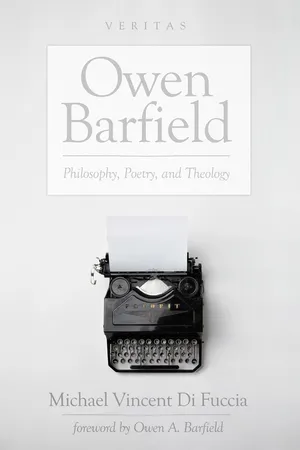
In this book Michael Di Fuccia examines the theological import of Owen Barfield's poetic philosophy. He argues that philosophies of immanence fail to account for creativity, as is evident in the false shuttling between modernity's active construal and postmodernity's passive construal of subjectivity. In both extremes subjectivity actually dissolves, divesting one of any creative integrity. Di Fuccia shows how in Barfield's scheme the creative subject appears instead to inhabit a middle or medial realm, which upholds one's creative integrity. It is in this way that Barfield's poetic philosophy gestures toward a theological vision of poi?sis proper, wherein creativity is envisaged as neither purely passive nor purely active, but middle. Creativity, thus, is not immanent but mediated, a participation in being's primordial poi?sis.
Information
Topic
Theology & ReligionSubtopic
Christian TheologyPart I
“Aesthetic” Participation
Part I explores what Owen Barfield called aesthetic participation; that is, the poetic philosophy upon which his thought is based. Chapter 1 explicates the insights Barfield unveiled in his earliest studies in philology and etymology. In his first two works of non-fiction, Poetic Diction and History in English Words, and later in his Speaker’s Meaning, he attempts to overturn the dominative conception regarding the developmental history of language (a progression from literal roots to later metaphorical utterance) by suggesting paradoxically against this that language has always been metaphorical, only recently has it been taken in its more literal or objective sense. This evolution yielded the modern bifurcation between poetic and philosophical language (which elsewhere he classifies as “poetic” and “prosaic” language, respectively) that one could argue undergirds the majority of modern and postmodern discourse. Against this, Barfield attempts to show that no language is ever purely literal or objective, but instead subject and object inevitably participate in one another; and it is this claim that is tarried with throughout the essay. Further, this poetic philosophy challenges modern and postmodern assumptions regarding the type of discourse that is most capable of accounting for the real.24 To unfurl this contention, chapter 1 concludes by suggesting that Heidegger’s poetry fails to account for the true nature of being, because it is ironically based upon a myth of his own founding (“onto-theology”) that perpetuates the division that Barfield’s poetic philosophy seeks to assuage and then proceeds on these false premises. It is argued that a philosophy that divorces itself from theology presupposes a rupture between poetic and philosophical discourse that Barfield’s poetic philosophy does not presuppose. Heidegger’s shortcoming is revealed in his untenable account of poetry that shuttles between univocity and equivocity. Further, by presupposing this immanent trajectory one is left to ground subjectivity as either active or passive. Heidegger, in choosing the latter, concludes that poetry, the best of language, is actually meaningless, and his view serves as the basis for subsequent postmodern accounts of subjectivity. The close of chapter 1 maintains that Heidegger’s poetry is not poetry at all because it strips the subject of creativity, while Barfield’s poetic philosophy evokes a middle realm that outwits such passivity endowing the subject with a real co-operative dignity.
In chapter 2 the essay then further traces the division between poetry and philosophy by reviewing the philosophical reception of one of Barfield’s greatest influences, Samuel Taylor Coleridge. The essay suggests that Barfield’s poetic philosophy also presents a formidable alternative to modern philosophical discourse. Instead of identifying the Kantian a priori as regulative, Coleridge, by envisaging the a priori as “constitutive,” implicitly resituates Kantian subjectivity. Distinct from, and unbeknownst to his post-Kantian critics, the “Platonic” Coleridge’s subject is not a ground in him- or herself but a subject by participation. For Coleridge, subjects and objects exist in a polar tension. So for him a language best capable of articulating the true nature of being is poetic. The subject is not one who is a closed ground in oneself, but one whose posture is open to the divine. This inspired poetic utterance allows the subject to exceed the strictures of a pure philosophy precisely because the subject is not a ground in him- or herself (not purely active or passive) but is situated in a medial realm through which he or she paradoxically receives from the divine in the act of speaking or naming. To be clear this is not to conceive of the poetic utterance as a crossing of an untraversable boundary into a Kantian sublime as postmodernity would have it, but such language is indicative of a participation in that which lies beyond the threshold; that is, “reason in her most exalted mood.”25 It is this particular reading of Coleridge, as a poet and philosopher, which Barfield develops in his What Coleridge Thought; one in which the subject is endowed with a real creative capacity when suspended in a medial realm. In the close of Part I, the essay suggests that this poetic vision of creativity accentuates a theological opening and thereby exposes the myth of closed (immanent or secular) philosophy presupposed by both post-Kantian philosophy and Heidegger. This opening within immanence, reiterated in Parts I and II and further expounded in Part III, reveals that being is at all times shot through by theological transcendence.
24. Hipolito, “Owen Barfield’s Poetic Diction,” 3–38. Hipolito indicates that for Barfield it is only through metaphor that one encounters the real.
25. Wordsworth, The Prelude.
1
Poetic Language
Barfield’s hallmark as a philosopher has been his use of grammar and semantics to support his metaphysic . . . in a period where philosophers usually employ linguistic analysis to discredit metaphysics.
—Adey26
Few and unimportant would the errors of men be, if they did but know, first what they themselves mean: and secondly, what the words mean by which they attempt to convey their meaning.
—Coleridge27
The Evolution of Consciousness
Any serious investigation of the thought of Owen Barfield must take seriously the influence of Anthroposophist Rudolph Steiner (1861–1925).28 Outlandish elements aside (see subsection below, “Barfield’s Reception of Steiner”), Barfield never disavowed Steiner’s theory of the “Evolution of Consciousness.” Indeed, Barfield himself states that this theory is the main theme that underlies all of his literary achievements.29 One can scarcely locate a Barfieldian text that is not imbued with the idea that human consciousness evolves. One sees this in his earliest works, History in English Words (1926) and Poetic Diction (1928), in his middle works, Romanticism Comes of Age (1944) and his most well-known work Saving the Appearances: a Study in Idolatry (1957), and in his later works, Worlds Apart: A Dialogue of the 1960s (1963), Unancestral Voice (1965), Speaker’s Meaning (1967), The Rediscovery of Meaning (1977), and History, Guilt, and Habit (1979). This chapter opens with a general overview of Steiner’s evolution of consciousness and serves as a context for explicating the particulars of Barfield’s thought throughout the essay. After summarizing Barfield’s reception of S...
Table of contents
- Title Page
- Foreword
- Acknowledgements
- Introduction
- Part One: “Aesthetic” Participation
- Part Two: Sociological Participation
- Part Three: Theological Participation
- Concluding Remarks
- Bibliography
Trusted by 375,005 students
Access to over 1.5 million titles for a fair monthly price.
Study more efficiently using our study tools.
Frequently asked questions
Yes, you can cancel anytime from the Subscription tab in your account settings on the Perlego website. Your subscription will stay active until the end of your current billing period. Learn how to cancel your subscription
No, books cannot be downloaded as external files, such as PDFs, for use outside of Perlego. However, you can download books within the Perlego app for offline reading on mobile or tablet. Learn how to download books offline
Perlego offers two plans: Essential and Complete
- Essential is ideal for learners and professionals who enjoy exploring a wide range of subjects. Access the Essential Library with 800,000+ trusted titles and best-sellers across business, personal growth, and the humanities. Includes unlimited reading time and Standard Read Aloud voice.
- Complete: Perfect for advanced learners and researchers needing full, unrestricted access. Unlock 1.5M+ books across hundreds of subjects, including academic and specialized titles. The Complete Plan also includes advanced features like Premium Read Aloud and Research Assistant.
We are an online textbook subscription service, where you can get access to an entire online library for less than the price of a single book per month. With over 1.5 million books across 990+ topics, we’ve got you covered! Learn about our mission
Look out for the read-aloud symbol on your next book to see if you can listen to it. The read-aloud tool reads text aloud for you, highlighting the text as it is being read. You can pause it, speed it up and slow it down. Learn more about Read Aloud
Yes! You can use the Perlego app on both iOS and Android devices to read anytime, anywhere — even offline. Perfect for commutes or when you’re on the go.
Please note we cannot support devices running on iOS 13 and Android 7 or earlier. Learn more about using the app
Please note we cannot support devices running on iOS 13 and Android 7 or earlier. Learn more about using the app
Yes, you can access Owen Barfield by Michael V. Di Fuccia in PDF and/or ePUB format, as well as other popular books in Theology & Religion & Christian Theology. We have over 1.5 million books available in our catalogue for you to explore.