- 140 pages
- English
- ePUB (mobile friendly)
- Available on iOS & Android
eBook - ePub
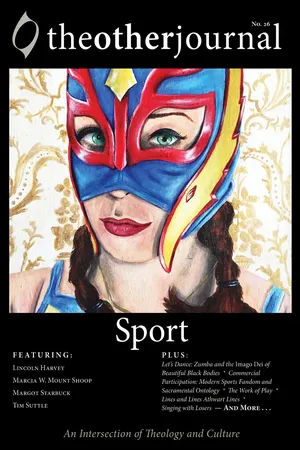
The Other Journal: Sport
About this book
FEATURING: Adam Joyce, Lincoln Harvey, Marcia W. Mount Shoop, Margot Starbuck, and Tim Suttle
PLUS:
Let's Dance: Zumba and the Imago Dei of Beautiful Black Bodies * Commercial Participation: Modern Sports Fandom and Sacramental Ontology * The Work of Play * Lines and Lines Athwart Lines * Singing with Losers --AND MORE . . .
The ancient Olympic games were held every four years at the temple of Zeus. They were a major cultural and religious event that doubled as a contest between rivaling nation-states. Certain strands of mythology even suggest that Heracles, the strongest of mortal men, organized the event and built the Olympic stadium in honor of his father, Zeus. Today, few athletes devote their efforts to the honor of Zeus, but there remains a certain religiosity at work in sport's place within Western culture. Fame, fortune, and honor; character and fair play; skill and artistic perfection also remain at stake, just in new ways. As Marcia W. Mount Shoop explains in her interview with Jessica Coblentz, sports still "tap into our most primal existential needs for vitality, for purpose, for creativity, for connection and community, and for work and play," and in this, our twenty-fifth issue of The Other Journal, we dive into these characteristics of sport, starting literally with Jennifer Stewart Fueston's poem "A Swim" and then continuing on to the ancient Greek stadium at Nemea. Our contributors consider the ethics, commodification, and embodiment of particular events, as well as the personal and cultural stories which weave in and out of sport. They do the hard work of conscientious fandom at football games; walk us through baseball liturgies; and take us to the windy courts of Philo, Illinois, where noted author David Foster Wallace was an outdoor tennis savant. They show us how to fly and then how to lose. And they invite us to dance, "to let our bodies taste the salt of our sweat, hear the pant of exhalation, and feel the perspiration on our skin, for it is in these very possibilities," argues John B. White, "that we relate to God, others, and self."
The issue features essays and reviews by Jeff Appel, Andrew Arndt, Ben Bishop, Jen Grabarczyk-Turner, Lincoln Harvey, Jonathan Hiskes, Adam Joyce, Lakisha R. Lockhart-Rusch, Benj Petroelje, Justin Randall Phillips, Heather L. Reid, Margot Starbuck, Tim Suttle, and John B. White; an interview by Jessica Coblentz with Marcia W. Mount Shoop; creative nonfiction by Brett Beasley, Meghan Florian, and Katie Karnehm-Esh; poetry by Bethany Bowman, Catherine Thiel Lee, and Jennifer Stewart Fueston; and art by Allen Forrest, Gerald Lopez, and Abigail Platter.
Information
Topic
Theology & ReligionSubtopic
Christian Theology1 A Swim
The desire is to dive down,
slip under the surface,
slide effortless through blue.
To let go of breath in all
its regular insistence,
the heart’s demands.
To see beneath, a milky
light arresting altered eyes,
liquid dissolving distances
between what’s concealed
and visible. The flesh
permits departure
not escape. The body
quieted, not shed. Arms
propel, limbs animate,
their rhythm patterning
our daily breath,
while we swim
in substances we barely see,
through and into, but
not beyond.
2 The Training of the Olympian Soul
You begin a visit to the ancient stadium at Nemea at the ruins of the apodyterio, literally the “un-dressing room,” where athletes removed their clothes in preparation for their events—and a favorite setting for Socrates’s spiritual undressing of Athenian youth. Like the otherworldly Greek sanctuaries themselves, the apodyterio was a place to shed your attachment to the mundane world of the everyday, to prepare to reveal and celebrate the higher dimensions of your humanity.
Next, you walk down the long stone tunnel where you would have stood along with other ancient athletes in cool and quiet darkness, waiting for your names to be called. Eyeing the bright light and shimmering heat of the track outside, hearing the muffled rumblings of the crowd, you would likely have experienced a moment of deep uncertainty, a delicate spot of aloneness. Finally, your name would have been called, at which time you would burst out into the light, naked both literally and metaphorically, ready to face the challenge and be tested in front of everyone—your competitors, your family, your friends and enemies—ready to submit your soul, under the brilliant Mediterranean sun, ready to be inspected by the gods themselves.1
Observing a society where shame and failure were unmercifully disdained, where there were no consolations for losers or rewards for simply taking part, we might ask, what force drove a person to do this, to risk the humiliation of failure, to strive for unattainable heights? It was more than recreation, more than social custom, more than professional obligation. It was a burning drive for spiritual excellence that went beyond the practical considerations of everyday life in order to discover what was best in humanity. It was a philosophical and transcendent force, something fundamental to human character and, though less pervasive now than it was in ancient Greek culture, it is a force that I believe is still alive today.
Olympism and AretĒ
The ancient Olympians were not athletes; they were gods. The philosophical ideal of aretē was envisioned as a god-like perfection of body, will, and mind, a holistic pursuit of human excellence. The modern Olympic movement preserves this ancient goal of holistic excellence in the first fundamental principle of Olympism listed in the Olympic Charter:
Olympism is a philosophy of life, exalting and combining in a balanced whole the qualities of body, will and mind. Blending sport with culture and education, Olympism seeks to create a way of life based on the joy of effort, the educational value of good example, social responsibility and respect for universal fundamental ethical principles.2
And so, to an Olympian, sports are not merely linked to physical achievements; they are a way of life and a social responsibility, and this commitment harkens all the way back to the ancient Greeks.
Athletic competition is at the heart of Greek culture. It appears in Homer’s epics and claims its spiritual center in Olympia. It is intimately connected to some of Greek civilization’s best-known gifts: classical sculpture, democracy, and especially philosophy. The competitive struggle intrinsic to sport was emulated intellectually by Socrates, Plato, and Aristotle—all of whom plied their trade in gymnasia.
Plato, who was himself a competitive wrestler, makes extensive physical training part of his educational programs for aretē. In the Republic, gymnastics is claimed to be for the benefit of the soul (410c). Although his explanation as to how gymnastics develops the soul is limited, connections can be made between athletics and philosophy beyond their common goal of improving the soul.3 Indeed, through the voice of Socrates, Plato connects as “counterparts” proper engagement in philosophic argument with proper participation in physical training (Republic 539d). His point here is that those who use argument for the “sport” of defeating others rather than the higher goal of finding truth and leading a virtuous life are akin to those who practice athletics for philonikia, the love of victory, rather than the pursuit of personal excellence or aretē. Plato feels that the former are not worthy of the name “philosopher”—are the latter worthy of the name Olympian?
Seen as something distinct from philosophy, the goal of sports may appear to be winning a prize or philonikia. Indeed, it may seem that sports were structured for just that purpose, to declare one competitor superior to the others. Undoubtedly, sports are frequently practiced to that end. But in line with Plato’s claims about argumentation, I contend that the metaphysics of sporting contests suggests that their purpose is for something greater than mere competition, entertainment, or profit. A look at the basic structure of sports, a structure that hasn’t changed since ancient times, reveals that the fundamental goal of sports are to cultivate and celebrate human excellences (i.e., aretē).
What do I mean by the basic structure of sports? If we look all the way back to Homer’s Iliad, we find athletic contests that were sufficiently familiar to the practitioners to conclude that such games were already a longstanding tradition by the time of the Trojan war.4 The events include a footrace, a chariot race, a weight throw, and contests in wrestling and boxing. They all reflect a similar format: competitors are selected, rules are articulated, valuable prizes...
Table of contents
- Title Page
- Letter from the Editors
- 1 A Swim
- 2 The Training of the Olympian Soul
- 3 Holy Play: Toward a Christian Engagement with Physical Fitness
- 4 Hunger
- 5 Let’s Dance: Zumba and the Imago Dei of Beautiful Black Bodies
- 6 The Redemptive and Demonic in Big-Time Sports: An Interview with Marcia W. Mount Shoop
- 7 La Pasión del Luchador y el artista Gerald Lopez
- 8 Commercial Participation: Modern Sports Fandom and Sacramental Ontology
- 9 We’re Number One: Sport as the Liturgy of Empire
- 10 How Does a Sacrificial Moral Ethic Help Parents Navigate Youth Sports?
- 11 Raising an American Boy in a Division-One Town
- 12 You Always Begin an Essay (or a Theology) in the Middle: A Review of Stanley Hauerwas’s The Work of Theology
- 13 Runners and Losers
- 14 Lines and Lines Athwart Lines: Givenness, Limits, and the Practice of Sport
- 15 Jesus Christ and the Rules of the Game
- 16 Fitness Centers and Health Clubs: Missing the Mark?
- 17 Peacock
- 18 Every Year Is Our Year
- 19 The Work of Play
- 20 Singing with Losers
- 21 Wrestler
- Contributors
Trusted by 375,005 students
Access to over 1.5 million titles for a fair monthly price.
Study more efficiently using our study tools.
Frequently asked questions
Yes, you can cancel anytime from the Subscription tab in your account settings on the Perlego website. Your subscription will stay active until the end of your current billing period. Learn how to cancel your subscription
No, books cannot be downloaded as external files, such as PDFs, for use outside of Perlego. However, you can download books within the Perlego app for offline reading on mobile or tablet. Learn how to download books offline
Perlego offers two plans: Essential and Complete
- Essential is ideal for learners and professionals who enjoy exploring a wide range of subjects. Access the Essential Library with 800,000+ trusted titles and best-sellers across business, personal growth, and the humanities. Includes unlimited reading time and Standard Read Aloud voice.
- Complete: Perfect for advanced learners and researchers needing full, unrestricted access. Unlock 1.5M+ books across hundreds of subjects, including academic and specialized titles. The Complete Plan also includes advanced features like Premium Read Aloud and Research Assistant.
We are an online textbook subscription service, where you can get access to an entire online library for less than the price of a single book per month. With over 1.5 million books across 990+ topics, we’ve got you covered! Learn about our mission
Look out for the read-aloud symbol on your next book to see if you can listen to it. The read-aloud tool reads text aloud for you, highlighting the text as it is being read. You can pause it, speed it up and slow it down. Learn more about Read Aloud
Yes! You can use the Perlego app on both iOS and Android devices to read anytime, anywhere — even offline. Perfect for commutes or when you’re on the go.
Please note we cannot support devices running on iOS 13 and Android 7 or earlier. Learn more about using the app
Please note we cannot support devices running on iOS 13 and Android 7 or earlier. Learn more about using the app
Yes, you can access The Other Journal: Sport by Other Journal in PDF and/or ePUB format, as well as other popular books in Theology & Religion & Christian Theology. We have over 1.5 million books available in our catalogue for you to explore.