- 232 pages
- English
- ePUB (mobile friendly)
- Available on iOS & Android
eBook - ePub
About this book
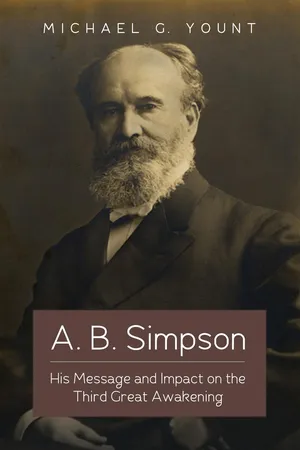
This volume looks at the Third Great Awakening, one of the most exciting times in the history of American Christianity. A. B. Simpson's impact on the Third Great Awakening and his influence on the modern church is examined. Emphasis is placed on the denomination he founded, the Christian and Missionary Alliance.
Simpson's message, the Fourfold Gospel, is also explored. The Fourfold Gospel is: Christ as the Christian's Savior, Sanctifier, Healer, and Coming King. The denomination Simpson founded took this message not only to North America, but also throughout the world.
Five movements made up the Third Great Awakening and Simpson's contribution to each one is examined. These five movements include: Evangelizing, Holiness Movement, Healing Movement, Pre-millenial Movement, and Urban and Worldwide Outreach.
As this book concludes with a look at Simpson's influence on the church today, we are reminded that as the church goes through the twenty-first century, the Fourfold Gospel continues to be proclaimed just as it was during the Third Great Awakening.
Information
Topic
Theology & ReligionSubtopic
Christian TheologyI
The Great Century
Introduction
The church historian Kenneth Scott Latourette called the period of the church from AD 1800 to 1914 “The Great Century of the Church.” He referred to it this way because of the worldwide expansion of the church during this period. He writes, “In geographic extent, the movements issuing from it, and in its effect upon the race, the nineteenth century Christianity had a far larger place in human history than at any previous time.”1 There were a number of factors that led to the expansion of the church, and we will be looking at them in this chapter.
The main focus of the book will be Albert Benjamin Simpson and the role he played in the Third Great Awakening.
This was a time of great changes in the church, possibly the most changes since the birth of the church in the first century. It was a time of excitement, growth, and great outreach by the church. During this period, men such as Asahel Nettleton, Charles Finney, and D. L. Moody led thousands to Christ and brought them into the church. Moody preached to more people in his lifetime than anyone else until Billy Graham began his ministry after World War II. Finney and Moody’s impact was felt in North America and in Great Britain. It was D. L. Moody and Ira Sankey who helped spread the revival to the British Isles. After ministering in the British Isles, they came to the United States to minister.
The Great Century was a period of missionary outreach. It began with a British cobbler-turned-minister, William Carey. Carey went to India in 1793 and generated interest in missions work literally to the ends of the earth. In the first half of the nineteenth century, the focus of missions was on the coastal regions of Asia and Africa. The missionaries would follow the colonial powers as they settled in these countries. Later in the nineteenth century, Hudson Taylor, a missionary to China, left the safety of the colonial-controlled areas and went to the interior of the country, away from his countrymen. Others followed Hudson Taylor’s example to reach the interior of Africa and Asia. Missionary boards arose to send out missionaries into these unreached areas.2 Moody also impacted this worldwide missionary movement by starting the Student Volunteer Missionary Movement, which raised up numerous college students to go into the mission field in the later half of the nineteenth century.
In the eighteenth century, John and Charles Wesley were integral in what would come to be known as the First Great Awakening in Great Britain, at which time they also founded the Methodist Church. The Wesleys taught the importance of holiness and the necessity of a second work of grace for sanctification. This emphasis on holiness spread throughout the British Isles and came to America through the ministry of Francis Asbury. Salvation and sanctification were preached together throughout the United States. The message was spread by the Methodist circuit riders who preached the gospel to enthusiastic audiences. This enthusiasm was a reaction against the cold orthodoxy found in many of the denominations at the time in the United States. The holiness movement spread from the Methodist Church to other Christian churches until it became one of the major forces in British and American Christianity in the nineteenth century.
The nineteenth century was also a period of new ideas that came into conflict with Christianity. It was a time when the Bible was under attack by Bible scholars and theologians in Germany. Men such as Julius Wellhausen and F. C. Baur were teaching that the Scriptures were simply like any other book written by man. They taught that the Scripture was not inspired by God, destroying the average churchgoer’s confidence in the Word of God. Many Bible students would study in Germany and would find their faith shaken by this higher criticism. It was during this time that Charles Darwin took the world by storm with the publication of his book On the Origin of the Species in 1859. He introduced the theory of evolution, which challenged all Christendom. It called into question the divine origin of man. This affected not only Great Britain, but also Europe and the United States. In America, the majority of the church fought against the idea of evolution. Although the higher critical method was becoming popular in Britain, a large part of the church that rejected its claims.
During this period, large number of immigrants flooded the United States. The Industrial Revolution was taking place in both Great Britain and America. The cities in both nations became filled with factories. People moved to the cities to work in the factories and lived in squalid conditions. In the United States, poor immigrants from Europe flooded the urban areas looking for work. Overpopulation in these areas caused ghetto-like conditions. The church attempted to reach out with the gospel and to improve living conditions. In England, William Booth tried to reach the poor through the Salvation Army he founded. The Salvation Army preached the gospel and tried to meet people’s physical needs with food and job training. In the United States, men such as Washington Gladden and Walter Rauschenbusch introduced the Social Gospel, which was concerned with improving the living conditions of the working man and the poor. This Social Gospel claimed to be concerned with the whole person, but it focused primarily on people’s physical wellbeing. The Social Gospel movement began to weaken after World War I.
The Evangelists
The two most influential evangelists in the nineteenth century, both of whom were integral to the Second Great ...
Table of contents
- Title Page
- Foreword
- Acknowledgements
- Introduction
- Chronology of the Life and Ministry of Albert Benjamin Simpson
- Chronology of “The Great Century” (1792—1919)
- Chapter 1: The Great Century
- Chapter 2: A. B. Simpson: The Forgotten Man in Renewal
- Chapter 3: Simpson’s Place in Evangelism
- Chapter 4: Simpson’s Impact on the Holiness Movement
- Chapter 5: Simpson’s Influence on the Healing Movement
- Chapter 6: Simpson’s Involvement in the Premillennial Movement
- Chapter 7: Simpson’s Contributions to Urban and Worldwide Evangelization
- Chapter 8: Simpson’s Message and Its Ramifications on the Church Today
- Appendix
- Bibliography
Trusted by 375,005 students
Access to over 1.5 million titles for a fair monthly price.
Study more efficiently using our study tools.
Frequently asked questions
Yes, you can cancel anytime from the Subscription tab in your account settings on the Perlego website. Your subscription will stay active until the end of your current billing period. Learn how to cancel your subscription
No, books cannot be downloaded as external files, such as PDFs, for use outside of Perlego. However, you can download books within the Perlego app for offline reading on mobile or tablet. Learn how to download books offline
Perlego offers two plans: Essential and Complete
- Essential is ideal for learners and professionals who enjoy exploring a wide range of subjects. Access the Essential Library with 800,000+ trusted titles and best-sellers across business, personal growth, and the humanities. Includes unlimited reading time and Standard Read Aloud voice.
- Complete: Perfect for advanced learners and researchers needing full, unrestricted access. Unlock 1.5M+ books across hundreds of subjects, including academic and specialized titles. The Complete Plan also includes advanced features like Premium Read Aloud and Research Assistant.
We are an online textbook subscription service, where you can get access to an entire online library for less than the price of a single book per month. With over 1.5 million books across 990+ topics, we’ve got you covered! Learn about our mission
Look out for the read-aloud symbol on your next book to see if you can listen to it. The read-aloud tool reads text aloud for you, highlighting the text as it is being read. You can pause it, speed it up and slow it down. Learn more about Read Aloud
Yes! You can use the Perlego app on both iOS and Android devices to read anytime, anywhere — even offline. Perfect for commutes or when you’re on the go.
Please note we cannot support devices running on iOS 13 and Android 7 or earlier. Learn more about using the app
Please note we cannot support devices running on iOS 13 and Android 7 or earlier. Learn more about using the app
Yes, you can access A. B. Simpson by Michael G. Yount in PDF and/or ePUB format, as well as other popular books in Theology & Religion & Christian Theology. We have over 1.5 million books available in our catalogue for you to explore.