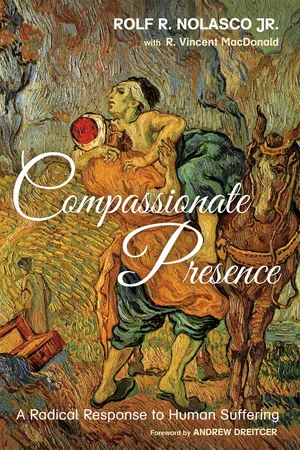
eBook - ePub
Compassionate Presence
A Radical Response to Human Suffering
- 136 pages
- English
- ePUB (mobile friendly)
- Available on iOS & Android
eBook - ePub
Compassionate Presence
A Radical Response to Human Suffering
About this book
Compassion plays a central role in the teachings of all world religions. Christianity in particular demonstrates its vitality through compassionate engagement with those suffering with Christ serving as a paradigm and source of motive power. These concrete acts of mercy and solidarity disclose God's intimate regard for the welfare of humanity. The purpose of this book is to affirm compassion as the pulsating heartbeat of Christian theology and praxis through the hermeneutical perspectives of brain science, psychology, and practical theology. More importantly, it offers readers specific compassion cultivation practices that will nurture the trait of compassion as a way of incarnating God's compassionate presence and response to a world marked with suffering of all kinds.
Information
Topic
Theology & ReligionSubtopic
Christian TheologyChapter One
Compassion and Suffering
It was Friday morning, November 8, 2013, when news about the devastating and life-negating effects of Typhoon Haiyan in Tacloban, Philippines reached the comfort of our homes in Canada. Images of a city reduced to rubble of shattered dwellings and dreams, lifeless bodies and displaced survivors, flattened infrastructures and concerned rescuers splashed on our TV screen. Chaos blanketed the city and suffering of all kinds is etched on the faces of those who survived Haiyan. We sat in our living room aghast at what we saw and simultaneously grieved with the Filipinos whose lives were turned upside down by nature’s wrath. Immediately after the typhoon had waned, we learned of the overflowing display of kindness and support that came flooding from all over the world to help survivors rebuild their lives anew.
Sophia, a fifty-five-year-old woman, walked into her therapist’s office visibly distraught and defeated. Her face looked haggard and her voice started to quiver as she narrated her marital woes. Her husband of thirty years carried on an affair with his co-worker for almost a year, she confessed with great sadness and pain. Burdened with raging and conflicting emotions, she launched into a litany of questions and gestures that revealed a heart that was wounded and shattered into pieces. Her sense of confidence as a woman and lover was shaken and the future of their marriage now uncertain. Sophia’s cry of anguish and desperation has evoked a need for gentle therapeutic accompaniment and compassionate response in her therapist.
The news about the gruesome murder of Tina Fontaine, a fifteen-year- old teenager from the Sagkeeg First Nation, and the brutal sexual assault of sixteen-year-old Rinelle Harper in the fall of 2014 have cast a glaring spotlight on the persistent problem of racism in Winnipeg and Canada as a whole. The violence committed against these two young aboriginal women and the continuing onslaught of racist comments hurled at First Nations people reveal the depth of intolerance and racism embedded in the collective psyche of this supposedly progressive and inclusive country. Yet against this dark and gloomy backdrop was a beacon of light in the form of a community coming together at a vigil to show its support and declare its commitment to work against all forms of racism and discrimination.
These are just a few stories of suffering that are eerily familiar and evocative, and come to us with disconcerting regularity. The sight and sound of individuals in excruciating pain contained in these stories break through the armor of illusory separation and break open an intense desire to help, to intervene, and to make a difference. Compassion is its name and it is triggered when we bear witness to the suffering of another. This response is at the heart of Christianity. It is rooted in the incarnation of Christ, which made visible the depth of God’s love, solidarity, and intimate regard for humanity. It is also part of who we are as beings created in the image of God who is full of compassion and love.
The religious character of compassion opens up a way of addressing the issue of human suffering, which leads the question of the sovereignty and goodness of God. Why is there so much suffering in the world? If God is love, good, and powerful, why does God let suffering continue? These burning questions are often raised by many a Christian who tries to make sense of the ubiquitous and debilitating nature of suffering in their lives. And sadly, the answers often given are full of platitudes or guilt-inducing or run-on statements in defense of God.
What follows is neither an attempt to explain suffering away nor will it try to quickly justify suffering as a means to some higher and loftier end. Instead, this theological reflection endeavors to identify the cause of suffering and the unique role that compassion play in addressing this problem. Before we proceed, though, it is important to say at this juncture that we are mindful of the limits of words in describing, let alone easing, the pain and suffering of another. However, we hope that this theological excursus will help illumine and inform the path of compassion we all are called to take and inspire us to come alongside people who are desperately looking to find meaning out of the chaos and disorientation that suffering brings. In this journey of faithful companionship, concrete acts of compassion are usually coupled with and most acutely experienced when offered in comforting silence, coupled with quiet reassurance that sufferers are not alone in this painful process. At least, this has been our own experience when providing accompaniment in therapy and also when on the receiving end of this same gesture of concern from others.
Suffering and the Problem of Evil
One cannot really talk about suffering without touching on the age-old problem of evil that many a theologian, biblical scholar, and philosopher has grappled with over the centuries. Evil and human suffering cross paths in dire situations and they often leave a scar no balm can quickly soothe. Yet, no matter how intertwined they are, a distinction needs to be made between human suffering and the problem of evil to avoid collapsing these realities into one and the same thing—e.g., suffering as evil.
We begin by addressing the problem of evil. Augustine of Hippo (354–430 AD), an early Christian theologian and philosopher, claims that evil is the corruption or rejection of good. It does not exist in its own right, like there is an evil force dueling it out with a benevolent entity for dominion and supremacy, but instead is “parasitic on something good.”4 Of course, this does not really explain why evil exists in the first place. Instead, it refutes the dualistic idea that there are “two equally ultimate principles behind good and evil” which “makes it more and more difficult to affirm equally ultimate powers independent of God, thus compromising his omnipotence.”5 Simply put, a doctrine of God’s sovereignty precludes the presence of another malevolent force that exists apart from God and that can threaten God’s sovereignty over all creation (Isa 45:6–7).
Human suffering is the exact opposite of good. We are not talking about the good or value that may come out of suffering, though that is certainly possible and consequential at times. We are talking about the physical and mental suffering that evil, as a corruption of good, brings about. In most cases this corruption is engineered by human beings whose propensity to tarnish and taint the good is awfully rampant and often unbridled. But as we know, that is not the only cause of human suffering that we see around us. Equally ominous and intractable is the suffering inflicted by forces of nature that can claim thousand of lives in an instant. As we can see, human beings are besieged either by the choices of others or themselves (moral evil) and the seemingly capricious nature of the natural world (natural evil). Regardless of the source, though, the impact remains the same—human beings suffer greatly often beyond what they can bear—and the need for a compassionate response remains urgent.
Human suffering can be traced back partly to the moral evil that pervades reality. By moral evil we mean the “wickedness of human beings . . . this is, evil that is seen in things that are said and done, things that are perpetrated, caused, exploited, by human action or inaction.”6 The story of Sophia vivifies what this means in concrete terms. Her husband has willfully strayed from his commitment to remain faithful to her by engaging in an extramarital affair with his co-worker. This has resulted in marital discord that led to a temporary separation immediately after he was confronted. The psychological impact this had on Sophia was so severe she needed to undergo weekly therapy sessions. She was deeply hurt and was tormented by images of her husband in bed with another woman. She had lost confidence in herself as a person and lover and started to blame herself for her husband’s indiscretion. Her defeated demeanor, bouts of crying, and debilitating fear of losing her marriage pervaded her time in therapy. In this story, we see that the good inherent in the marriage is now corrupted by someone’s wayward choice.
On a larger scale we are also assaulted everyday by horrifying news of suffering wreaked by human beings whose moral compasses have gone awry, are fractured, or are seemingly nonexistent at times, in the case of antisocial behavior. Take the case of the two teenagers in Winnipeg who suffered horribly, even fatally for one of them, because of their gender and ethnicity. The blood that courses through their veins made them easy targets for perpetual racism and discrimination, leaving them feeling unsafe, profiled, and violated in their own land. There are countless other stories of this nature from other people of different ethnic or racial backgrounds. The good that is inherent in cultural and racial diversity is corrupted by a distorted view that sameness needs to be upheld and defended and difference is a threat that needs to be avoided or punished.
The picture gets worse when we turn our eyes to the history of the Christian church, which is replete with stories of unspeakable acts often executed either in the name of God or by those who claim to be followers of God. In fact, strands of the contemporary chur...
Table of contents
- Title Page
- Foreword
- Acknowledgements
- Introduction
- Chapter 1: Compassion and Suffering
- Chapter 2: Compassion and the Other
- Chapter 3: The Face of Compassion
- Chapter 4: Compassionate Mind
- Chapter 5: Cultivating Compassion
- Chapter 6: Extending Compassion
- Bibliography
Trusted by 375,005 students
Access to over 1.5 million titles for a fair monthly price.
Study more efficiently using our study tools.
Frequently asked questions
Yes, you can cancel anytime from the Subscription tab in your account settings on the Perlego website. Your subscription will stay active until the end of your current billing period. Learn how to cancel your subscription
No, books cannot be downloaded as external files, such as PDFs, for use outside of Perlego. However, you can download books within the Perlego app for offline reading on mobile or tablet. Learn how to download books offline
Perlego offers two plans: Essential and Complete
- Essential is ideal for learners and professionals who enjoy exploring a wide range of subjects. Access the Essential Library with 800,000+ trusted titles and best-sellers across business, personal growth, and the humanities. Includes unlimited reading time and Standard Read Aloud voice.
- Complete: Perfect for advanced learners and researchers needing full, unrestricted access. Unlock 1.5M+ books across hundreds of subjects, including academic and specialized titles. The Complete Plan also includes advanced features like Premium Read Aloud and Research Assistant.
We are an online textbook subscription service, where you can get access to an entire online library for less than the price of a single book per month. With over 1.5 million books across 990+ topics, we’ve got you covered! Learn about our mission
Look out for the read-aloud symbol on your next book to see if you can listen to it. The read-aloud tool reads text aloud for you, highlighting the text as it is being read. You can pause it, speed it up and slow it down. Learn more about Read Aloud
Yes! You can use the Perlego app on both iOS and Android devices to read anytime, anywhere — even offline. Perfect for commutes or when you’re on the go.
Please note we cannot support devices running on iOS 13 and Android 7 or earlier. Learn more about using the app
Please note we cannot support devices running on iOS 13 and Android 7 or earlier. Learn more about using the app
Yes, you can access Compassionate Presence by Rolf R. Nolasco Jr.,Rob Vincent MacDonald in PDF and/or ePUB format, as well as other popular books in Theology & Religion & Christian Theology. We have over 1.5 million books available in our catalogue for you to explore.