- 124 pages
- English
- ePUB (mobile friendly)
- Available on iOS & Android
eBook - ePub
About this book
"In Overture to Practical Theology, Jeanne Stevenson-Moessner takes a new route to introduce theology students and others to the field of practical theology. Although she is certainly aware of relatively recent efforts to show the academic credentials of practical theology through careful definition (citing that of David Tracy), analysis of components, and linkages to other disciplines within and without the overall framework of theology, she proceeds by means of a double analogy, rather than abstract academic precision, to illumine practical theology. Actual case studies also helpfully illumine aspects of her work." From the Foreword by James N. Lapsley.
The book examines biblical foundations, historical roots, and current manifestations of social justice ministry. Stevenseon-Moessner shows how practical theology addresses racism, sexism, violence, anti-Semitism, ecological imbalance, and life at the margins of society--the vexing issues of today's ministry.
Information
Topic
Teología y religiónSubtopic
Ministerio cristianoStanza 1
Warming Up
Practical Theology-in-Relationship
Introduction
An orchestra consists of musicians in relationship. This connectedness results in sonatas, concertos, symphonies, and requiems that are distinct from a solo performance. Theology is the music of religious inquiry. Theology is also the formal study of faith, doctrine, history, religious education, sacred texts, and spirituality. Theologians, like musicians, are given the opportunity to create beyond the formal disciplines in which they have been trained. In community, they create a religious rhythm that can be organically and structurally related to others in ministry, in theological investigation, in academic research.
This book will look at one discipline, or area, of theology: practical theology. Instead of regarding practical theology as a “soloist” or “guest musician,” this book will consider how practical theology plays in concert with other disciplines or areas in theology. As the discussion “warms up,” Stanza One presents practical theology-in-relationship to other theological disciplines using an image that I found in the early works of German theologian Friedrich Schleiermacher. It is an organic image that has much potential for theology. Unfortunately, Schleiermacher discarded the image after it was severely criticized. He failed to underscore the circular and revitalizing movement among the areas of theological inquiry that he aptly depicted in his “scandalous” model. The model that occasioned such a strong reaction was that of a tree:
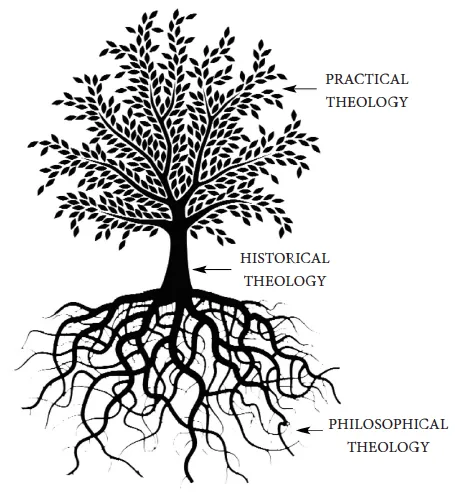
The vertical thrust of the tree, of course, placed practical theology at the top as the crown, or highest part, of the structure. The “scandal” of this image grew out of the hierarchical interpretation of the tree analogy in which the sap or “living substance of reflection” flowed only upward, from the roots to the crown. Contemporary theologians have noted other examples of Schleiermacher’s “hierarchical thinking.”1 I do not know whether Schleiermacher intended such an inference of superiority with his positioning of practical theology at the top of the tree. I do know that the “hierarchical representation” of the crown as the highest point of theological reflection neglected both the equality and mutuality of all three parts of the tree as well as the circular pattern of movement among the various parts, including the earth. The branches, the foliage, the fruits, the leaves, and the flowers all continue to fall and to flow to the ground to replenish the soil from which the roots and trunk grow. Leonardo Boff, in Cry of the Earth, Cry of the Poor, has stated the cycle of enrichment in a similar but unique way: “The forest remains lush because the chain of nutrients is closed. Materials are decomposing on the soil, its covering, which is composed of leaves, fruits, small roots, and animal excrement. These things are enriched by the water dripping from the leaves and running off the trunks. It is not the soil that nourishes the leaves, but rather the trees that nourish the soil.”2
Thus, “the crown” can be interpreted nonhierarchically as the upper extremity that is connected organically to the whole. It is also expansive to note that some trees like older banyan trees have aerial prop roots. The European Beech has aerial roots as do swamp mangroves and certain rainforest trees in New Zealand. Branches can also extend to the ground as in the weeping cherry, fig, and willow trees. In the following pages, I will reclaim and recycle this organic image of the tree because of the unexplored possibilities it has yet to offer.
Background
In 1946, while theologian Karl Barth was spending the summer semester at the University of Bonn, he found in the rubble and ruins of war a bust of theologian Friedrich Schleiermacher. In some ways, it may seem that I am doing the same in this book—lifting an old image of Schleiermacher’s writings out of the remains of theological forays. These contemporary forays or discussions often delve into the much-discussed “clerical paradigm” attributed to Schleiermacher. The “clerical paradigm” grew out of a German context in the nineteenth century that envisioned the pastor or cleric as the “product” of the five-year, rigorous course of theological study. This, a controversial assessment, will be explored later in this chapter.
Authors such as Keith Clements suggest that feminist theology, with its emphasis on interconnectedness, could well offer additional insights on the images offered by Friedrich Schleiermacher.3 This suggestion follows mention of the startling admission that Schleiermacher made to Charlotte von Kathen: “If ever I find myself sportively indulging in an impossible wish, it is, that I were a woman.”4 According to one editor of his works, “this confession has provoked wry smiles or raised eyebrows from later commentators who are inclined to commend Schleiermacher to a psychiatrist without further ado.”5 Nevertheless, as a feminist theologian interested in healthy interdependency, I have chosen to delve into this discarded image, that is, Schleiermacher’s tree of theology, an image critiqued by others. He later discarded the image in the second edition of the Brief Outline of the Study of Theology (Kurze Darstellung des theologischen Studiums), a change which occurred during the time of his lectures in Halle and Berlin.
In this chapter, I am assuming, first, that there is something that beckons persons into connectedness. Every embryo begins in relationship in utero. After birth, infants thrive on the beam or gleam in the eyes of the beholders and caretakers. As normal development moves into self differentiation, there is a concurrent need for healthy relationship to others. Second, I am working on the additional assumption that, underlying our endeavors of self-differentiation in denominations, disciplines, and guilds, we are created to be organically related to others in ministry and theology. By organically, I mean more than having systemic coordination as a conductor would coordinate or assemble an orchestra. Organic is, according to Webster’s, “possessed of complex structure comparable to that of living beings.” This concept is not so far removed from the Hebrew Bible’s portrayal of creation through narratives that portray people as descendants of Adam and Eve. We are the family of humankind or the family of faith. Third, I am assuming that practical theology is an interdisciplinary enterprise and as such, is also interrelated with other theological disciplines.
With these assumptions, I have been drawn to reconsider Schleiermacher’s image of the organic unity of the theological disciplines in his Brief Outline of 1811, the image of the “tree” of theology. Finding an original copy of the Brief Outline of 1811 (Kurze Darstellung des theologischen Studiums zum Behuf einleitender Vorlesungen) in Tübingen, Germany, I reexamined this image. Such a sense of organic unity is not to be taken for granted in theological education. Without such an articulation of the interplay and interdependence among the disciplines, what theological institutions like seminaries and divinity schools offer will be at best a creative collection and combination of courses.
Schleiermacher reorganized the theological disciplines into three areas of inquiry: philosophical theology, historical theology, and practical theology. Philosophical theology dealt with the essence, the concepts, the first principles, the “idea” of Christianity. Schleiermacher in 1811 wrote: “Philosophical theology is the root of all theology.”6 Thus, the description of the “root” of theology is given. Historical theology, which included biblical studies, church history, dogmatic or systematic theology, and church statistics,7 was an inquiry into the Christian faith community, past and present. “Historical theology is essentially the trunk of theological study and encompasses in its own way the other two parts within itself.”8 Thus, the picture of the body, or trunk, is given to the paradigm. In addition, historical theology includes in its own way both philosophical and practical theology. Practical theology, accordingly, is “the crown of theological study.”9 From these depictions of roots, trunk or body, and crown...
Table of contents
- Title Page
- Foreword
- Preface
- Acknowledgments
- Stanza 1: Warming Up
- Stanza 2: Variations on the Theme
- Stanza 3: Movements
- Stanza 4: Discordant Notes
- Stanza 5: Symphonic Sound
- Stanza 6: Encore
- Requiem
- Bibliography
- Annotated Bibliography
Trusted by 375,005 students
Access to over 1.5 million titles for a fair monthly price.
Study more efficiently using our study tools.
Frequently asked questions
Yes, you can cancel anytime from the Subscription tab in your account settings on the Perlego website. Your subscription will stay active until the end of your current billing period. Learn how to cancel your subscription
No, books cannot be downloaded as external files, such as PDFs, for use outside of Perlego. However, you can download books within the Perlego app for offline reading on mobile or tablet. Learn how to download books offline
Perlego offers two plans: Essential and Complete
- Essential is ideal for learners and professionals who enjoy exploring a wide range of subjects. Access the Essential Library with 800,000+ trusted titles and best-sellers across business, personal growth, and the humanities. Includes unlimited reading time and Standard Read Aloud voice.
- Complete: Perfect for advanced learners and researchers needing full, unrestricted access. Unlock 1.5M+ books across hundreds of subjects, including academic and specialized titles. The Complete Plan also includes advanced features like Premium Read Aloud and Research Assistant.
We are an online textbook subscription service, where you can get access to an entire online library for less than the price of a single book per month. With over 1.5 million books across 990+ topics, we’ve got you covered! Learn about our mission
Look out for the read-aloud symbol on your next book to see if you can listen to it. The read-aloud tool reads text aloud for you, highlighting the text as it is being read. You can pause it, speed it up and slow it down. Learn more about Read Aloud
Yes! You can use the Perlego app on both iOS and Android devices to read anytime, anywhere — even offline. Perfect for commutes or when you’re on the go.
Please note we cannot support devices running on iOS 13 and Android 7 or earlier. Learn more about using the app
Please note we cannot support devices running on iOS 13 and Android 7 or earlier. Learn more about using the app
Yes, you can access Overture to Practical Theology by Jeanne Stevenson-Moessner in PDF and/or ePUB format, as well as other popular books in Teología y religión & Ministerio cristiano. We have over 1.5 million books available in our catalogue for you to explore.