- 182 pages
- English
- ePUB (mobile friendly)
- Available on iOS & Android
eBook - ePub
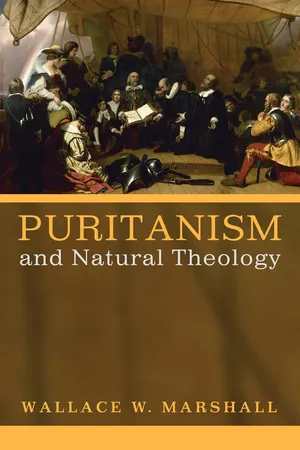
Puritanism and Natural Theology
About this book
The prevailing consensus among historians is that natural theology within Protestantism was born in the eighteenth century as a byproduct of the Enlightenment and had a sharply diminished if not nonexistent role within Puritanism.
Based on an exhaustive study of the writings of some sixty English and American Puritans spanning from the late sixteenth century to the early eighteenth century, this book demonstrates that the overwhelming majority of Puritan theologians not only embraced natural theology on a theoretical level but employed it in a surprising variety of pastoral, apologetic, and evangelical contexts, including their missionary activities to the Indians of New England. Some Puritans even asserted that people who had never heard about Christianity could be saved through the knowledge afforded them by natural theology.
This conclusion reshapes our understanding of the history of apologetics and sheds fresh light on the origins of the Enlightenment itself. Puritanism and Natural Theology also examines the crises of doubt experienced by several prominent Puritan theologians, advances our understanding of the oft-debated issue of the role of reason within Puritanism, and sets the Puritans' enthusiasm for natural science within the broader context of their beliefs about natural theology.
Information
Topic
Theology & ReligionSubtopic
Christian Theology1
Rational Theism and Practical Atheism
“How do you persuade yourself that there is a God?”
—William Perkins, 1590
“Many of the children of God . . . feel this temptation, Is there a God? bitterly assaulting them sometimes.”
—Thomas Shepard, 1640
While Puritans believed that reason could establish a fairly comprehensive system of theism, they recognized that there was a vast difference between the objective validity (or logical soundness) of the arguments of natural theology and its historical manifestations among ancient philosophers and “heathen” nations who were bereft of special revelation. As the early English Puritan William Pemble (1591/2–1623) put it, “there may be a twofold consideration of [natural theology]: 1. How far the Heathen have gone. 2. How far they might have gone in the knowledge of God and Godliness, if they had carefully used all Nature’s helps.” The latter of these was the key issue for natural theology, said the nonconformist minister and historian of philosophy Theophilus Gale (1628–79): “For that a thing be called natural, it is not necessary, that it be actually in all men; but it sufficeth if it may be derived from a natural principle.”28 Puritans also extended this distinction to the subjective realities of religious experience among Christians. They frankly acknowledged that doubts about the existence of God, providence, and immortality were common among even sincere believers, and indeed they were keen on pointing out that self-examination uncovered numerous subtle manifestations of this skepticism. But this perception did not in the least diminish their enthusiasm for natural theology. The proper response to this problem, as they saw it, was to reinforce rather than abandon the rational arguments for these foundational religious tenets.
Puritans were especially positive on the objective validity of the proofs for God’s existence. If people would simply apply their reason to this question in the same unbiased fashion as they handled the ordinary affairs of life, “they would conclude nothing more strongly than that God is,” said the English Congregationalist Matthew Barker (1619–98), noting Plato’s observation that it was this extreme unreasonableness of atheism that made it so rare, so that the few who indulged it hardly ever retained this opinion into old age. Atheism was thus “not only Impious but Irrational.” After presenting the argument from design, William Bates (1625–99), an English Puritan who advocated the restoration of Charles II but was swiftly disappointed by the Act of Uniformity, to which he felt unable to subscribe, concluded that the universe was so full of testimonies to the existence of God that “We must pluck out our Eyes, and extinguish common sense, not to see infinite Wisdom, Power and Goodness shining in them, the proper marks of the Deity.” “[W]hen we view the variety, harmony, and law of the creation,” remarked Ezekiel Hopkins (1634–90), the Bishop of Derry who unlike Bates subscribed to the Act of Uniformity, “our reason must needs be very short, if we cannot from these collect the infinite wisdom, power, and goodness of the Creator.”29
The same confidence appears as early as 1590 in the work of William Perkins (1558–1602), whom Patrick Collinson calls “the prince of Puritan theologians and the most eagerly read.” “How do you persuade yourself that there is a God?” he queried in his catechetical work, The Foundations of Christian Religion (1590). “Beside the testimony of the Scripture,” came the reply, “plain reason will show it.” The pervasiveness of this perspective among Puritan divines is indicated by Thomas Vincent’s (1634–78) didactic commentary on the Westminster Assembly’s Shorter Catechism, a work whose commendatory epistle was signed by no less than forty Puritan theologians. Vincent, an English nonconformist who won widespread respect for his fearless preaching and visitation of the sick and dying during the London plague of 1665, introduced the subject with the following question and answer, and afterwards proceeded to lay out five arguments for God’s existence:
Q. 6. How doth it appear that God is true, that he hath a true being, or that there is a God indeed?
A. By several arguments, sufficient to convince all the Atheists in the world, if they would hearken to their own reason.30
While presenting seven theistic proofs in a series of sermons on the Westminster Shorter Catechism, Thomas Watson (d. 1686), one of the most prolific devotional writers among the English Puritans, preached that atheism was so irrational that one could only regard it as symptomatic of one who had “sinned away his sense and reason.” This was why, said Watson’s co-pastor and fellow nonconformist Stephen Charnock (1628–80), in reference to the classic text of the Hebrew psalmist, “no better title than that of a fool is afforded to the atheist . . . . The demonstrations reason furnisheth us with for the existence of God, will be evidences of the atheist’s folly.” That God exists, Increase Mather (1639–1723) told his Boston congregation in a 1716 sermon on the divine existence and attributes, “is as Clear to the Understanding of a Rational Creature, as the Light of the Sun at Noon.” He considered atheism “the most unreasonable Thing that possibly can be. A man might with a great deal more Reason question his own Being, than to question the Being of the God of Heaven.” 31
Richard Baxter (1615–91), who as we will see went through a crisis of doubt regarding the truth of Christianity, yet thought the existence of God a matter beyond all question, arguing like Mather that since it was “the most certain, intelligible verity among all the whole world of Certainties, and Intelligibles,” its denial would logically entail the destruction of all human knowledge:
[N]othing in the world is so illustriously and Eminently Intelligible and Certain, as that there is a God. So that if this principle were denied, I doubt not upon that ground, to deny and destroy all the rest, and to prove that no man knoweth anything: and not only that sense is fallible, but that there is no such thing as a man in the world; nor any other Being, Truth, or Good, if there be not a First Being, Truth and Good.
Perhaps no Puritan theologian asserted the objective validity of the theistic proofs more forcefully than John Owen (1616–83), the dean of Christ Church at Oxford from 1651 to 1660 and a leading advocate of ecclesiastical independency. He viewed their rejection as a species of insanity. The evidences for God’s existence from the works of creation, he said, were “infallible,” so that “whoever knoweth how to use and exercise his reasonable faculty in the consideration of them, their original, order, nature, and use, must necessarily conclude that so it is.” If anyone denied these arguments, he added, “it is a sufficient reply, in case he be so indeed, to say he is phrenetic, and hath not the use of his reason; and if he be not so [phrenetic], that he argues in express contradiction unto his own reason, as may be demonstrated.”32
If some doubt remained after all this, said Charnock (Pascal-like), still only a foo...
Table of contents
- Title Page
- Acknowledgments
- Abbreviations
- Introduction
- Chapter 1: Rational Theism and Practical Atheism
- Chapter 2: The Role of Natural Theology
- Chapter 3: Reason, Learning, and the Mystery of God
- Chapter 4: The Limits of Natural Theology
- Chapter 5: Arguments for the Existence of God
- Chapter 6: Providence, Evil, and Immortality
- Appendix 1: The Role of John Locke in the History of Natural Theology and Evidentialism
- Appendix 2: Table of Puritans Represented in this Study
- Bibliography
Trusted by 375,005 students
Access to over 1.5 million titles for a fair monthly price.
Study more efficiently using our study tools.
Frequently asked questions
Yes, you can cancel anytime from the Subscription tab in your account settings on the Perlego website. Your subscription will stay active until the end of your current billing period. Learn how to cancel your subscription
No, books cannot be downloaded as external files, such as PDFs, for use outside of Perlego. However, you can download books within the Perlego app for offline reading on mobile or tablet. Learn how to download books offline
Perlego offers two plans: Essential and Complete
- Essential is ideal for learners and professionals who enjoy exploring a wide range of subjects. Access the Essential Library with 800,000+ trusted titles and best-sellers across business, personal growth, and the humanities. Includes unlimited reading time and Standard Read Aloud voice.
- Complete: Perfect for advanced learners and researchers needing full, unrestricted access. Unlock 1.5M+ books across hundreds of subjects, including academic and specialized titles. The Complete Plan also includes advanced features like Premium Read Aloud and Research Assistant.
We are an online textbook subscription service, where you can get access to an entire online library for less than the price of a single book per month. With over 1.5 million books across 990+ topics, we’ve got you covered! Learn about our mission
Look out for the read-aloud symbol on your next book to see if you can listen to it. The read-aloud tool reads text aloud for you, highlighting the text as it is being read. You can pause it, speed it up and slow it down. Learn more about Read Aloud
Yes! You can use the Perlego app on both iOS and Android devices to read anytime, anywhere — even offline. Perfect for commutes or when you’re on the go.
Please note we cannot support devices running on iOS 13 and Android 7 or earlier. Learn more about using the app
Please note we cannot support devices running on iOS 13 and Android 7 or earlier. Learn more about using the app
Yes, you can access Puritanism and Natural Theology by Wallace Williams Marshall III in PDF and/or ePUB format, as well as other popular books in Theology & Religion & Christian Theology. We have over 1.5 million books available in our catalogue for you to explore.