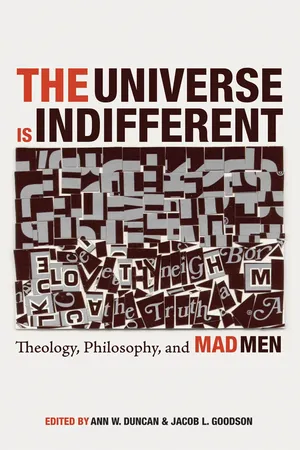
eBook - ePub
The Universe is Indifferent
Theology, Philosophy, and Mad Men
- 428 pages
- English
- ePUB (mobile friendly)
- Available on iOS & Android
eBook - ePub
The Universe is Indifferent
Theology, Philosophy, and Mad Men
About this book
Centered upon the lives of employees at a Manhattan advertising firm, the AMC television series Mad Men touches on the advertising world's unique interests in consumerist culture, materialistic desire, and the role of deception in Western capitalism.
While the subject matters of the chapters in this collection have a decidedly socio-historical focus, the authors use basic topics as starting points for philosophical, religious, and theological reflections. The authors show how Mad Men reveals deep truths concerning the social trends of the 1960s and early 1970s in American life and deserves a significant amount of reflection from philosophical, religious, and theological perspectives. Some of the chapters go beyond mere reflection and make deeper inquiries into what these trends say about American cultural habits, the business world within Western capitalism, and the rapid social changes (gender, race, and sexuality) that occur during this period. Chapters examine paradigms of masculinity and femininity as well as the presentation of motherhood, fatherhood, sexuality, and childhood.
This collection shows how social change represents the undercurrent of the interpersonal dramas of the characters on Mad Men, from the staid and conventional early seasons to the war, assassinations, riots, and counterculture of later seasons.
Information
Topic
Teologia e religioneSubtopic
Teologia cristianaPart 1
Business Ethics
Chapter 1
“It’s the Real Thing”
Identity and Sincerity in Mad Men
“Every Great Ad Tells a Story”—Narrative Ethics and Mad Men
Don’t fool yourself. This is some very dirty business.” Madison Avenue executive Roger Sterling’s admonition to his younger colleague Pete Campbell comes on the heels of a decision to ask office manager Joan Holloway to prostitute herself in order to win a coveted account with British automaker Jaguar.1 Although Sterling’s words ostensibly condemn Campbell’s plan, the ad exec’s actions tell a different story. Immediately prior to his comment, Sterling has acquiesced (along with the other partners in the room) to the “dirty business” Campbell proposes. Furthermore, it is Sterling who prevents any further protest or change of plans, lodging his (apparent) complaint as he stands up to leave Campbell and partner Lane Pryce behind to make the arrangements with Joan. In light of these actions, Sterling’s comment seems less like a condemnation and more like a cynical acceptance of the amoral, even immoral, nature of corporate survival. “This is some very dirty business,” and, he implies, there is no avoiding dirty hands. “Don’t fool yourself,” he says; business opposes (even precludes) the other-oriented “moral point of view.”2
To anyone familiar with Roger Sterling’s perspective, “business ethics” may seem a dubious notion, if not a contradiction in terms. To anyone familiar with the AMC television series, an essay on business ethics in Mad Men may seem doubly dubious. Best-known for the worst tendencies of corporate America (e.g., the sexism, dishonesty, and greed on display in this episode among most others), Matthew Weiner’s series seems, at first glance, incapable of cultivating ethical business practices. Upon closer investigation, however, Mad Men’s serial narrative may be uncommonly well suited to business ethics. The series is, admittedly, no treatise on advertising ethics; what it offers, though, may be more valuable than a treatise. It serially dramatizes the thoroughly human (i.e., the emotionally complex, temporal) human beings at the heart of business and ethics alike. With its attention to these thoroughly “realistic” (read: “messy”) human subjects, this essay highlights questions the series raises as a series, questions about: (1) the discernibility and value of truth and sincerity; (2) the mutable, even malleable quality of desire, personal identity and moral character; and (3) the complicated intersections between office and world: i.e., the knotty relationships among the personal, the professional, and the political. In short, the essay traces the moral ramifications of the radically temporal (if not existential) view of the self at the heart of Weiner’s series. In doing so, the essay also models an alternative strategy for business ethics.
As a quick glance at a number of standard textbooks and course syllabi reveals, business ethics typically focuses on a narrow set of practical decisions for managers.3 It also typically assumes a narrow scope of moral attention and a narrow view of truth, personal identity, and autonomy. What Mad Men offers, in contrast, is a “critique by expansion,” inserting into business ethics oft-neglected questions and perspectives. What Mad Men simultaneously offers is a “narrative ethics” approach to advertising and business. Its critique by expansion is due, not only to what the series presents, but also to how it presents it—namely, as a series. Broadly speaking, “narrative ethics” refers to any intersection between narrative and ethics, whether: (1) the use of ethics to illuminate narrative (e.g., considerations of moral responsibilities among authors, readers, and characters)4 or (2) the use of narrative to illuminate ethics (e.g., the view that moral judgments depend on an agent’s role within a particular life-narrative).5 Because what Weiner and team offer is not just a powerful story, but a powerful story about the power of stories, narrative ethics seems especially apt to Mad Men.
To be sure, with its reliance on case studies, business ethics has long been attuned to the indispensability of narrative and narrative ethics. The point of this essay, then, is not that Mad Men introduces narrative where once there was none. Rather, Mad Men emphasizes and extends narrative’s place in practical thought. Unlike the typical business ethics casebook, Mad Men presents a detailed story that complicates the relationship between public and private, past and present, even appearance and reality. Most significantly (if ironically), Weiner’s fictitious series replaces the unified, rational fiction of a self at the center of business ethics with “the real thing”—i.e., “mad men” and women better represented by narrative than theory.6
“Where the Truth Lies”—Truth in Advertising
Unsurprisingly, a television series about the inner-workings of an ad agency has a great deal to say (and show) about the principal issue in advertising ethics: deception.7 Tellingly, the series introduces main character Donald Draper in the midst of a moral dilemma. Creative director at a Madison Avenue ad agency, Don is looking for a new way to sell cigarettes now that the Federal Trade Commission (FTC) is cracking down on lies about the safety of smoking.”8 If Don’s fictional agency is anything like the real agency described in Samm Sinclair Baker’s The Permissible Lie (1968), then the culture “[i]nside the agency . . . is hardly conducive to truth telling”; instead, “the usual thinking in forming a campaign is first what can we say, true or not, that will sell the product best,” and, only second, how can we avoid “censure by the FTC.”9 Faced with a similar office climate, Don initially tosses the health report on smoking into his office wastebasket, while his boss, Roger Sterling, accuses the health advocates of their own deceptive “manipulation of the media.” With this opening dilemma, the series highlights both the deception and the harm unethical advertising can do.
In lieu of simplistic moralizing, however, the show offers something more than a series-long indictment of the ad industry. By providing its main character the moral integrity lacked by many of his coworkers (e.g., unctuous Pete Campbell), Mad Men complicates our view of human character and the world of advertising. As we come to see, Don, whatever his faults, refuses to lie in his ads. Yet, having ruled out lying in the strict sense (and having nearly lost the cigarette account as a result), Don adopts another sales technique, one with questionable moral dimensions of its own. Don will, as he says elsewhere, “change the conversation.”10 In short, Don sells products by making true, yet distracting claims about them—in this case, that Lucky Strikes are “toasted.”
Granted, one might still condemn Don and his ad—e.g., for selling a dangerous (albeit legal) product. By doing business tha...
Table of contents
- Title Page
- Acknowledgments
- Introduction
- Part One: Business Ethics
- Part Two: Who Is Don Draper?
- Part Three: Politics and Social Theory
- Contributors
Trusted by 375,005 students
Access to over 1.5 million titles for a fair monthly price.
Study more efficiently using our study tools.
Frequently asked questions
Yes, you can cancel anytime from the Subscription tab in your account settings on the Perlego website. Your subscription will stay active until the end of your current billing period. Learn how to cancel your subscription
No, books cannot be downloaded as external files, such as PDFs, for use outside of Perlego. However, you can download books within the Perlego app for offline reading on mobile or tablet. Learn how to download books offline
Perlego offers two plans: Essential and Complete
- Essential is ideal for learners and professionals who enjoy exploring a wide range of subjects. Access the Essential Library with 800,000+ trusted titles and best-sellers across business, personal growth, and the humanities. Includes unlimited reading time and Standard Read Aloud voice.
- Complete: Perfect for advanced learners and researchers needing full, unrestricted access. Unlock 1.5M+ books across hundreds of subjects, including academic and specialized titles. The Complete Plan also includes advanced features like Premium Read Aloud and Research Assistant.
We are an online textbook subscription service, where you can get access to an entire online library for less than the price of a single book per month. With over 1.5 million books across 990+ topics, we’ve got you covered! Learn about our mission
Look out for the read-aloud symbol on your next book to see if you can listen to it. The read-aloud tool reads text aloud for you, highlighting the text as it is being read. You can pause it, speed it up and slow it down. Learn more about Read Aloud
Yes! You can use the Perlego app on both iOS and Android devices to read anytime, anywhere — even offline. Perfect for commutes or when you’re on the go.
Please note we cannot support devices running on iOS 13 and Android 7 or earlier. Learn more about using the app
Please note we cannot support devices running on iOS 13 and Android 7 or earlier. Learn more about using the app
Yes, you can access The Universe is Indifferent by Ann W. Duncan, Jacob L. Goodson, Ann W. Duncan,Jacob L. Goodson, Duncan, Goodson in PDF and/or ePUB format, as well as other popular books in Teologia e religione & Teologia cristiana. We have over 1.5 million books available in our catalogue for you to explore.