eBook - ePub
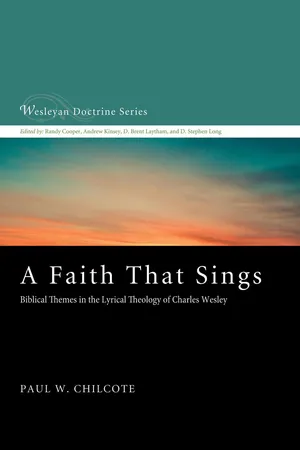
A Faith That Sings
Biblical Themes in the Lyrical Theology of Charles Wesley
- 162 pages
- English
- ePUB (mobile friendly)
- Available on iOS & Android
eBook - ePub
About this book
This book examines the primary biblical themes in the lyrical theology of Charles Wesley, the master hymn writer and cofounder of the Methodist movement. Methodism was born in song, and it is highly doubtful whether without the hymns of Charles Wesley there could have been a Methodist revival. Charles's hymns have exerted a monumental influence on Methodist doctrine and Methodist people through the years. They are essentially mosaics of biblical texts; in singing these hymns, Methodists have sung the grand narrative of redemption and restoration in the biblical witness. A summary list of key biblical texts drawn from the 1780 Collection of Hymns for the Use of the People Called Methodists serves as a summa of Charles Wesley's theology and points to the doctrinal concerns that shaped his life most fully. Intended as an exploration of Wesleyan theology through the lens of "sung doctrine," this study demonstrates the world-making and life-shaping effect of hymns, and the way in which they emanate from Charles Wesley's life of prayer and evoke a life of service.
Information
Topic
Theology & ReligionSubtopic
Christian Denominationsone
Incarnation: The Word Became Flesh
Everything in Charles Wesley’s lyrical theology revolves around the affirmation and worship of a Triune God of love, the God of truth and grace. He composed many hymns on the theme of the Trinity and published two collections devoted exclusively to this subject, the first in 1746 and the second in 1767. His concept of the Three-One God—Father, Son, and Holy Spirit—pervades both his poetry and his prose. He believed that people come to know this God not only through God’s supreme self-revelation in the Word (Jesus Christ, the Second Person of the Trinity) but also in the word (scripture), the record of God’s interaction with the world and the people God loves. He had a simple but profound vision of God and life with God: God is love; God created all that is as an extension of God’s love. Scripture testifies to the fact that “God created humanity in God’s own image, in the divine image God created them, male and female God created them” (Gen 1:27). God breathed human beings into existence, therefore, that they might receive love and share love with God and others.1
Wesley celebrates the majestic nature of the Trinity, the God who creates, redeems, and sustains all life, in a lyrical creed published in 1747.
Father, in whom we live,
In whom we are and move,
The glory, power, and praise receive
Of thy creating love.
Let all the angel-throng
Give thanks to God on high,
While earth repeats the joyful song,
And echoes to the sky.
Incarnate deity,
Let all the ransomed race
Render in thanks their lives to thee
For thy redeeming grace;
The grace to sinners showed,
Ye heavenly choirs proclaim,
And cry Salvation to our God,
Salvation to the Lamb.
Spirit of holiness,
Let all thy saints adore
Thy sacred energy, and bless
Thine heart-renewing power
Not angel-tongues can tell
Thy love’s ecstatic height,
The glorious joy unspeakable,
The beatific sight.
Eternal Triune Lord,
Let all the hosts above,
Let all the sons of men record,
And dwell upon thy love;
When heaven and earth are fled
Before thy glorious face,
Sing all the saints thy love hath made,
Thine everlasting praise. (Redemption Hymns, 44–45)
This doxological “hymn to the Trinity” elevates each Person of the Trinity in turn through the successive stanzas before concluding with the singers’ response in praise, gratitude, and adoration.2 Charles’s hymn, as S T Kimbrough has observed, puts worship at the center of life, makes life itself an act of praise, trusts in the sacred energy of God, and focuses all on God’s self-giving love.3
Wesley locates the very meaning of our existence in this understanding of God; God created humanity to celebrate the love of the Creator, to embrace the love we see in Jesus as our way of life, and to permit the Spirit to restore the image of this God in our lives. The original image of God stamped upon us in creation, and then lost in the fall, anticipates a return to perfection as the goal of life. Seeking to love as God loves defines authentic human existence. This knowledge of God, the meaning of life, and the purpose of existence only becomes real or visible, in Charles’s view, as we see the one, true God in the face of Jesus. Otherwise, God remains unknown, as one of his Nativity Hymns (1745) makes abundantly clear.
God the invisible appears,
God the blest, the great I AM
Sojourns in this vale of tears,
And Jesus is his name. (6)
The incarnation, therefore, plays a central role in Charles Wesley’s theology. It is the first biblical theme in his theology that we will explore together.
The Nature of Incarnation
When “the Word became flesh and lived among us,” he revealed the true nature and glory of God. In a hymn on “the presence of the Lord,” based on Matthew 1:23, Wesley affirms this central fact about Immanuel (“God with us”):
Celebrate Immanuel’s name,
The Prince of life and peace!
God with us our lips proclaim,
Our faithful hearts confess:
God is in our flesh revealed,
Earth and heaven in Jesus join,
Mortal with Immortal filled,
And human with Divine.
Fullness of the Deity
In Jesus’ body dwells,
Dwells in all his saints and me,
When God his Son reveals:
Father, manifest thy Son,
And conscious of the incarnate Word
In our inmost souls make known
The Presence of the Lord. (MS Matthew, 4)
God’s self-disclosure, as it were, climaxes in the wonderful yet inscrutable birth of Jesus and all that follows from it, including the suffering, death, resurrection, and ascension of Christ. Though faith, as we shall see, is much more than the affirmation of this spiritual truth, this mystery touches on every aspect of Christian faith and life.
Rather than attempting to explain the incarnation in philosophical terms as if to master the inexplicable, Wesley simply describes the lengths to which God’s love will go to reach people wherever they are. God “emptied himself of all but love,” he sings, “and died to ransom me!” (MS Hymns OT, 29). The ramifications of this divine self-emptying stagger the mind. God becomes a human being so that those redeemed through Christ might become one with God. Christ empties himself of glory and eternity, of every divine attribute save one, the essence of God, which is love. Fully divine—all love and nothing but love—he enters our world of brokenness and sin, takes on a human nature, and makes it...
Table of contents
- Title Page
- Acknowledgments
- Introduction
- Chapter 1: Incarnation: The Word Became Flesh
- Chapter 2: Redemption: The Lamb That Was Slain
- Chapter 3: Repentance: The Contrite Heart
- Chapter 4: Justification: God’s Grace and Living Faith
- Chapter 5: Sanctification: The Process of Renewal
- Chapter 6: Prayer: Abiding in Christ
- Chapter 7: Communion: Spiritual Food for the Journey
- Chapter 8: Dominion: Situated in God’s Shalom
- Chapter 9: Perfection: Abiding in God’s Love
- Bibliography
Trusted by 375,005 students
Access to over 1.5 million titles for a fair monthly price.
Study more efficiently using our study tools.
Frequently asked questions
Yes, you can cancel anytime from the Subscription tab in your account settings on the Perlego website. Your subscription will stay active until the end of your current billing period. Learn how to cancel your subscription
No, books cannot be downloaded as external files, such as PDFs, for use outside of Perlego. However, you can download books within the Perlego app for offline reading on mobile or tablet. Learn how to download books offline
Perlego offers two plans: Essential and Complete
- Essential is ideal for learners and professionals who enjoy exploring a wide range of subjects. Access the Essential Library with 800,000+ trusted titles and best-sellers across business, personal growth, and the humanities. Includes unlimited reading time and Standard Read Aloud voice.
- Complete: Perfect for advanced learners and researchers needing full, unrestricted access. Unlock 1.5M+ books across hundreds of subjects, including academic and specialized titles. The Complete Plan also includes advanced features like Premium Read Aloud and Research Assistant.
We are an online textbook subscription service, where you can get access to an entire online library for less than the price of a single book per month. With over 1.5 million books across 990+ topics, we’ve got you covered! Learn about our mission
Look out for the read-aloud symbol on your next book to see if you can listen to it. The read-aloud tool reads text aloud for you, highlighting the text as it is being read. You can pause it, speed it up and slow it down. Learn more about Read Aloud
Yes! You can use the Perlego app on both iOS and Android devices to read anytime, anywhere — even offline. Perfect for commutes or when you’re on the go.
Please note we cannot support devices running on iOS 13 and Android 7 or earlier. Learn more about using the app
Please note we cannot support devices running on iOS 13 and Android 7 or earlier. Learn more about using the app
Yes, you can access A Faith That Sings by Paul W. Chilcote in PDF and/or ePUB format, as well as other popular books in Theology & Religion & Christian Denominations. We have over 1.5 million books available in our catalogue for you to explore.