- 280 pages
- English
- ePUB (mobile friendly)
- Available on iOS & Android
eBook - ePub
About this book
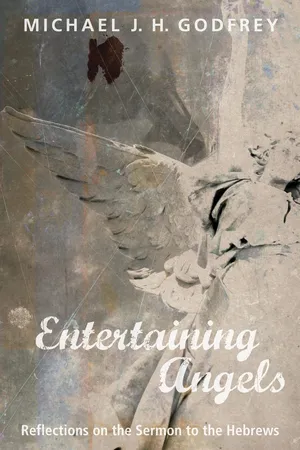
Hebrews is a sermon, and a providentially sermon for our age. This ancient text speaks to a Christ-community descending into an abyss of ennui, losing coordinates of faith and sliding through a back door or nonchalance. With glimpses across the globe and though history, this book attempts to extrapolate meaning for today from a sometimes difficult first century text.
Information
1
Introduction
Tucked away on page 488 of A New Zealand Prayer Book / He Karakia Mihinare o Aotearoa is a tiny exchange that I consider to be its greatest contribution to Anglican and indeed Christian self-understanding, not only for New Zealand, but also internationally. It is as if the writers had immersed themselves in the so-called Letter to the Hebrews (neither a letter nor, in any identifiable sense, “to the Hebrews”) and emerged with a summary:
Called to follow Christ, help us to reconcile and unite.
Called to suffer, give us hope in our calling.
This liturgical prayer captures something of Paul’s Letter to the Philippians too, but it is not surprising that themes running through Paul’s life and ministry should reappear in this other powerful writing of early Christianity. Whether directly influenced by Paul or not, this anonymous author knows her world and mission well: if we follow Christ, we follow one who is victorious. We will however, suffer (Heb 13:12–13). That is the cost of God’s eternity. (In the twenty-first century, we might add, “whatever that means,” because we are no longer attuned to the expectations of the first century. We can leave the meaning of “eternity” in the hands of God.)
Hebrews has a “high” understanding of Jesus (Christology). He is Lord, he is Savior, he is Son; all this only a few decades after an unimportant Palestinian Jew was executed by Roman soldiers. At the same time it has a “low” Christology. We might almost call this a Jesu-ology. Jesus is thoroughly human, a shepherd, an apostle (Heb 3:1), called as we are called, a builder, a minister, a pioneer, “like his brothers [and sisters] in every way.” He is a pretty outstanding, indeed perfect human being, but utterly human nevertheless. His feet are not so heavenly that we cannot reach his footprints: “Oh let me see your footprints, and in them plant my own”1 is a thoroughly Hebrews prayer.
So Hebrews also has a high expectation of us. In fact that is probably why it was written: it is, according to its own anonymous author, “a word of exhortation,” urging the audience to snap out of a period of spiritual sloth and get on with the hard athleticism of following Jesus. It has a very different view of matters to the views of Western civilization’s (or the so-called “global north’s”) twenty-first century. It is perhaps even very different to twenty-first century Christianity’s attitudes. For that reason it is very definitely a document for us today.
The Book
I have alluded to Heb 13:22, where the author describes her words as a “brief” written “word of exhortation.” This has often been taken to mean that Hebrews was a sermon, and there is no reason to doubt that in a general sense of the word. The same phrase (here in the plural as tou logou tēs paraklēseōs) is used by Luke in Acts, where Paul and Barnabas are invited to give “exhortation” to the crowd. We should, however, note Andrew McGowan’s observation that “we cannot extrapolate from the mere existence of a text like Hebrews to a whole genre of homily or sermon typical of Christian practice, but it demonstrates that there were individuals capable of sustained and sophisticated oratory, and that, by implication, there were real opportunities for composition and communal performance.”2
The word “exhortation” is notably also used at 1 Tim 4:13, where the recipient is urged to attend to reading Scripture (the public, liturgical reading of Scripture rather than personal devotional reading is implied), to exhorting, and to teaching, and at 1 Pet 5:12, where the reference is to the author’s own writing. Luke Timothy Johnson notes, “The noun paraklēsis, like the verb parakalein, has so many nuances that its precise meaning in each case must be determined by context.”3 The critical point for us at this juncture is that this is a verb applicable to tough spiritual discipline and so does not carry the notion of “to comfort” that it carries at, for example, 2 Cor 1:3. The author of Hebrews far more resembles an athletic coach exhorting athletes to supreme levels of discipline and effort4 than a benevolent dispenser of cuddles or empty promises. I am reminded of the nuggety and laconic former Rugby World Cup-winning coach Graham Henry, whose “We can’t go ahead and win the Tri-Nations unless we do the business tomorrow night” showed a similar flair for dry understatement. By contrast, consider a loquacious politician offering a rosy future sketched with empty platitudes, as when American vice president Dan Quayle infamously predicted, “The future will be better tomorrow.” Our author was no Dan Quayle.
Whoever this author was, though, they wrote to a group of people they knew and loved, and for whom they felt an abiding and urgent concern. This much should be familiar to any of us who have studied Paul’s writings, which reflect the same passionate discipline, or the book of Revelation, which leaves no room for lackadaisical compromise. Our author’s avoidance of the empty rhetoric characterized by the Dan Quayle quotation above is deliberate. The Christians were facing tough times, and the temptation to apostasy, or at best spiritual sloth (which approximated the same thing), was considerable. This was a time for hard-hitting exhortation, using all the rhetorical tools available to the writer (the Petrine author faces a similar issue with even less subtlety at 2 Pet 2:17–22).
There is, however, some difference between the Petrine and Pauline writings, for example, and Hebrews. Paul and the author of 2 Peter5 were writing letters of instruction and correction to be read aloud as the assembly gathered in meeting. The author of Hebrews is also expecting this letter to be read out loud by someone on their behalf, but it has a slightly stronger sense of liturgy—a sense that this reading is a part of an act of worship, a solemn recitation rather than Paul’s hasty, if skilled oratory. To some extent, in this respect, it more closely approximates Revelation, a “circular letter”6 designed to be read in a series of churches known to the author. Here too there is a difference, for Revelation was likely to have been circulated around several small congregations. Our text does not appear to envisage a series of audiences, but rather one particular congregation of Christians who are in danger of lapsing out of the disciplines of exemplary faith (Heb 5:11–14). Our author chooses words and sentence structures with great caution rather than with Paul’s hasty rhetorical brilliance or the author of Revelation’s flamboyant apocalyptic flourishes. Even in English translation, there is a sense of solemnity to Hebrews—see, for example, the accumulative pattern of chapter 11 and its solemn repetition of the word “faith”; in Greek it is a plosive, sibilant, and therefore solemnly emphatic pistis. To have heard this exhortation read aloud might well have been to have heard one of the great oratorical events of history, akin to Winston Churchill’s “never before in the f...
Table of contents
- Title Page
- Preface
- Chapter 1: Introduction
- Chapter 2: Establishing a Preaching Relationship
- Chapter 3: Atonement: Heb 2:17–18
- Chapter 4: A Priest Like Us and For Us: Heb 3:1–19
- Chapter 5: Take Care, Brothers and Sisters (Losing Moral Coordinates): Heb 4:1–11
- Chapter 6: The Power of God’s Command: Heb 4:12–13
- Chapter 7: Cling to One Who Knows What It’s Like
- Chapter 8: High Priest for Us: Heb 5:1–10
- Chapter 9: You Have Not Persevered, Dullard! Heb 5:11—6:8
- Chapter 10: God Is Faithful: Heb 6:13–20
- Chapter 11: Melchizedek . . . the Argument from the Lesser to the Greater: Heb 7:1–28
- Chapter 12: Priest of a New Covenant: Heb 8:1–13
- Chapter 13: The Shadow and the Reality: Heb 9:1—10:18
- Chapter 14: Endure! Heb 10:19–39
- Chapter 15: Faith Is . . . Heb 11:1–40
- Chapter 16: Chapter Other Countries: God-Breathed Histories
- Chapter 17: No Pain, No Gain . . . the End Game: Heb 12:1–17
- Chapter 18: God: That Than Which Nothing Greater Can Be Conceived! Heb 12:18–24
- Chapter 19: A Sermon Winds Up: Heb 12:25—13:25
- Chapter 20: Practical Applications: Love . . . Heb 13:1–16
- Chapter 21: Pray for Us: Heb 13:18–21
- Chapter 22: Final Thoughts
- Bibliography
Trusted by 375,005 students
Access to over 1.5 million titles for a fair monthly price.
Study more efficiently using our study tools.
Frequently asked questions
Yes, you can cancel anytime from the Subscription tab in your account settings on the Perlego website. Your subscription will stay active until the end of your current billing period. Learn how to cancel your subscription
No, books cannot be downloaded as external files, such as PDFs, for use outside of Perlego. However, you can download books within the Perlego app for offline reading on mobile or tablet. Learn how to download books offline
Perlego offers two plans: Essential and Complete
- Essential is ideal for learners and professionals who enjoy exploring a wide range of subjects. Access the Essential Library with 800,000+ trusted titles and best-sellers across business, personal growth, and the humanities. Includes unlimited reading time and Standard Read Aloud voice.
- Complete: Perfect for advanced learners and researchers needing full, unrestricted access. Unlock 1.5M+ books across hundreds of subjects, including academic and specialized titles. The Complete Plan also includes advanced features like Premium Read Aloud and Research Assistant.
We are an online textbook subscription service, where you can get access to an entire online library for less than the price of a single book per month. With over 1.5 million books across 990+ topics, we’ve got you covered! Learn about our mission
Look out for the read-aloud symbol on your next book to see if you can listen to it. The read-aloud tool reads text aloud for you, highlighting the text as it is being read. You can pause it, speed it up and slow it down. Learn more about Read Aloud
Yes! You can use the Perlego app on both iOS and Android devices to read anytime, anywhere — even offline. Perfect for commutes or when you’re on the go.
Please note we cannot support devices running on iOS 13 and Android 7 or earlier. Learn more about using the app
Please note we cannot support devices running on iOS 13 and Android 7 or earlier. Learn more about using the app
Yes, you can access Entertaining Angels by Michael J. H. Godfrey in PDF and/or ePUB format, as well as other popular books in Theology & Religion & Biblical Criticism & Interpretation. We have over 1.5 million books available in our catalogue for you to explore.