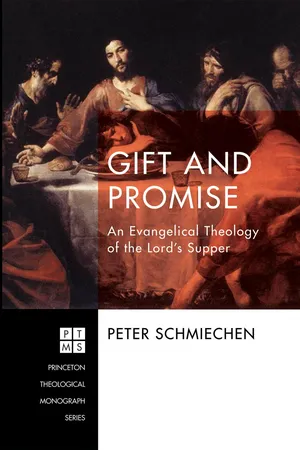
- 304 pages
- English
- ePUB (mobile friendly)
- Available on iOS & Android
eBook - ePub
About this book
What would happen if the liturgy for the Lord's Supper started with the images in the New Testament rather than the divisions of our past? It would be like going through an open door into a new world. There we would find a new Passover celebration, a new covenant, and remembrance and proclamation of Jesus' death and resurrection--all in the context of the kingdom of God. It would be an evangelical Lord's Supper.
This is a high-risk operation, given the reliance by many on transactional sacrifice and the tendency to reduce the Supper to a sacrament of penance for individuals. Ideas rejected by Luther and Calvin now reappear even among Protestants. The goal cannot be reached by subtracting a few things and adding references to eschatology and joy. The good news is that many churches have already taken steps to reform their liturgies. To support that process, here is a clear and consistent evangelical perspective, based on the theology and biblical considerations that have formed our faith and practice.
Information
Topic
Theology & ReligionSubtopic
Christian Church1
The Sixteenth Century
Reformation and Impasse
In Search of an Evangelical Reform
The Roman Catholic Heritage at 1500
To set the stage for the great debates over the sacraments in the sixteenth century, let us briefly describe the medieval heritage. By the thirteenth century the church affirmed seven sacraments: baptism, confirmation, penance, the Eucharist, marriage, ordination, and extreme unction. They were given official recognition at the Council of Florence (1438–45). These sacraments presupposed several theological traditions, each involving extensive debate and action by councils over many centuries. One was the affirmation of Trinity and Incarnation, which affirmed that God is Father, Son, and Holy Spirit, and that Jesus Christ is the Word Incarnate, one person and two natures. The other was the long and protracted debate regarding human potential and sin. While Augustine appeared to be victorious in his opposition to Pelagius, the matter was never completely settled, as witnessed by endless revisions and compromises. If Augustine was correct, then humankind has fallen victim to the power of sin, now infecting all people and social structures. The effect of the Fall, usually referred to as original sin, creates a situation where humans are unable not to sin. When one combines both of these traditions—one regarding the human potential and the other regarding God’s act in Christ—we have the structure for the gospel message in the late medieval period. Jesus Christ is the Son of God, begotten of the Father, “Who for us men and because of our salvation came down from heaven, and was incarnate by the Holy Spirit and the Virgin Mary and became human.” (Nicene Creed) By his sacrificial death on the cross he makes satisfaction for sin, reconciles us to God, restores humanity, creates newness of life, and offers the promise of eternal life.
But how shall such saving power be received across time and space separating us from the cross of Calvary? The answer was the church and its sacraments. The church is created by the Incarnation of the Word and the bestowal of the Spirit as the Body of Christ. It is both totally dependent on Christ, the Head of the church, and it is the extension of the incarnation in time and space. Thus it is declared to be One, Holy, Catholic, and Apostolic—the marks identifying it with the unity, holiness, presence and authority of Christ. Just as the cathedrals, in their astonishing grandeur symbolize the presence of heaven on earth, so the sacraments are the sacred acts where believers meet the crucified and risen Christ and receive his gifts. The central act of the Lord’s Supper gives structure to worship, allowing for the church to be nourished by the saving power of Christ in and through the presence of Christ in bread and wine. Ordination affirms the authority of the church, establishes the hierarchy of religious orders over the laity, and thereby provides that the faith and practice of the church shall be faithfully governed. The remaining five sacraments provide grace and nurture for one’s pilgrimage through life on earth. To be Christian, therefore, is to participate in the sacramental life of the church, whereby the grace of Christ is shared with believers.
The Scholastic theologians of the three centuries prior to Luther accepted Augustine’s dictum: sacraments are visible signs of an invisible grace. But there were serious tensions at work, indicating that all were not of the same mind. One had to do with how much weight could be given to the church and its practices. For example, Thomas Aquinas saw a sacrament as a “sign of a sacred thing.” This was preferred by ecclesial officials, since Thomas saw these sacred things fitting into a grand unity overseen by the church. In this sacred order, sacraments are signs joined with words authorized by the church. This meant that church, priests and sacraments were established by God, possessed authority, and were things we could see and trust. On these terms, sacraments contain and confer grace.5 But other theologians, such as Ockham and Duns Scotus, were cautious about tying God to church and sacraments. They preferred to place emphasis solely on the will of God. On these terms, sacraments are efficacious because God agrees to work through them, not because grace is necessarily mediated through the church.6 Another tension was the precarious balance between God’s primary agency in salvation and the expected or required human responses. All agreed that the sacraments conveyed grace to sinners, but how grace creates a new disposition in the believer or enables the will to do the good—these things were open to many possibilities. Thus one finds complex discussions of initiating grace and co-operating grace leading to the possibility that human beings cooperate with God’s grace and are capable of obtaining merit.7 As a result, we find an intricate balance between God as the author of our salvation and the expectation that human beings are to prepare themselves for, and participate in, the work of salvation.8 When the balance was broken and the emphasis tilted toward the human endeavor needed for salvation, then any certainty of salvation could be threatened. In fact, it might even create anxiety in an Augustinian monk.
Though the church at this time named seven sacraments, our interest lies in the sacraments of baptism, penance and The Lord’s Supper. We turn first to baptism. By the eleventh century a major shift had occurred in the understanding and practice of baptism.9 In the early period of the church, when new members were received as converts, baptism was understood primarily as the symbolic dying and rising with Christ to new life. The actual practice was associated with Easter and was clothed in the rich theology of death, resurrection, and new life in Christ expressive of the incarnational theology of Nicea and Chalcedon. The more new members were infants born of Christians, the practice moved toward infant baptism. By the twelfth century, this gradual shift had been completed, reflecting changes in theology and practice. At Rouen in 1072, infant baptism was allowed at whatever time of the year parents wished; in 1139 the Second Lateran Council condemned those who refused to accept the practice of infant baptism.10 While the older themes of Christ’s triumph over death and Satan were still present, the emphasis now turned more to two issues: the penitential theme of the forgiveness of sin and entrance into the church as the Body of Christ. The first goal reflects the impact of the Augustinian idea of the solidarity of sin. Augustine rightly saw that individual sins had social and historical consequences. This meant that infants were born into a vast network of relations weighed down by self-interest and strife among humans and alienation from God. What was unfortunate, however, in the view of many in the modern period, was that Augustine allowed the transmission of this fallen state to be identified with the procreative process. Indeed, the idea of sexual transmission became a new rationale for the virgin birth of Jesus and later the immaculate conception of Mary, thereby assuring that Jesus was conceived without sin. But if all new born infants inherited both the reality of sin and the guilt of generations past, then they were subject to the judgment of God. Baptism therefore became the remedy. By baptism children were cleansed of original sin, accepted into the church and given the hope of eternal life. Such baptism wa...
Table of contents
- Title Page
- Preface
- Introduction
- Chapter 1: The Sixteenth Century
- Chapter 2: The New Testament Accounts
- Chapter 3: Ecumenical Developments and Changes in Liturgies
- Chapter 4: Saving Sacrifice
- Chapter 5: An Evangelical Lord’s Supper
- Bibliography
Trusted by 375,005 students
Access to over 1.5 million titles for a fair monthly price.
Study more efficiently using our study tools.
Frequently asked questions
Yes, you can cancel anytime from the Subscription tab in your account settings on the Perlego website. Your subscription will stay active until the end of your current billing period. Learn how to cancel your subscription
No, books cannot be downloaded as external files, such as PDFs, for use outside of Perlego. However, you can download books within the Perlego app for offline reading on mobile or tablet. Learn how to download books offline
Perlego offers two plans: Essential and Complete
- Essential is ideal for learners and professionals who enjoy exploring a wide range of subjects. Access the Essential Library with 800,000+ trusted titles and best-sellers across business, personal growth, and the humanities. Includes unlimited reading time and Standard Read Aloud voice.
- Complete: Perfect for advanced learners and researchers needing full, unrestricted access. Unlock 1.5M+ books across hundreds of subjects, including academic and specialized titles. The Complete Plan also includes advanced features like Premium Read Aloud and Research Assistant.
We are an online textbook subscription service, where you can get access to an entire online library for less than the price of a single book per month. With over 1.5 million books across 990+ topics, we’ve got you covered! Learn about our mission
Look out for the read-aloud symbol on your next book to see if you can listen to it. The read-aloud tool reads text aloud for you, highlighting the text as it is being read. You can pause it, speed it up and slow it down. Learn more about Read Aloud
Yes! You can use the Perlego app on both iOS and Android devices to read anytime, anywhere — even offline. Perfect for commutes or when you’re on the go.
Please note we cannot support devices running on iOS 13 and Android 7 or earlier. Learn more about using the app
Please note we cannot support devices running on iOS 13 and Android 7 or earlier. Learn more about using the app
Yes, you can access Gift and Promise by Peter Schmiechen in PDF and/or ePUB format, as well as other popular books in Theology & Religion & Christian Church. We have over 1.5 million books available in our catalogue for you to explore.