eBook - ePub
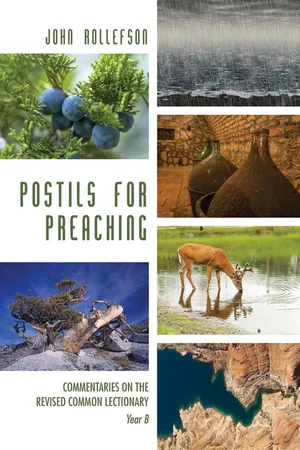
Postils for Preaching
Commentaries on the Revised Common Lectionary, Year B
- 190 pages
- English
- ePUB (mobile friendly)
- Available on iOS & Android
eBook - ePub
About this book
Postils for Preaching repristinates an old term for commentaries on the appointed texts by assisting preachers in their time-honored calling of preaching the Word. "Post illa," some think, probably refers to the reflecting "after this" (meaning upon the texts) that preachers must do in the context of the lives of their congregations and larger communities. These essays do not aim to be sermons but sermon-starters, goads and incitements to consider the assigned texts with serious imagination and good humor, all in the context of the church year and its inter-textual connections. The intention of this publication is to dip into a lifetime of that exegetical and homiletical "bag of tricks" as Jesus himself obliquely recommended when he noted how "every scribe who has been trained for the kingdom of heaven is like the master of a household who brings out of his treasure what is new and what is old" (Matt 13:52). Please consider these postils a "thesaurus" ("treasury") from which to borrow insights, references, and allusions as needed and found of value.
Information
Topic
Theology & ReligionSubtopic
Christian MinistryTIME AFTER PENTECOST, YEAR B
Holy Trinity Sunday, First Sunday after Pentecost
Psalm 29
Isaiah 6:1–8
Romans 8:12–17
John 3:1–17
Ascribe to the Lord, O heavenly beings, ascribe to the Lord glory and strength.
Ascribe to the Lord the glory of his name; worship the Lord in holy splendor.
—Psalm 29:1–2
Beyond Two Men and a Bird
Once a year we Christians find ourselves gathered to celebrate explicitly what we mostly take for granted the rest of the year: the identity of God as the three-in-one, Father, Son and Holy Spirit, or, as we say, the “Holy Trinity.” I’ve sometimes used this occasion to focus on how this day is far more than an opportunity to hack away at the mystery of God’s triunity, using tried and true analogies like the three-fold character of water (liquid, ice and steam), three forms but at the same time chemically one substance, H2O. I’ve made fun of traditionally hyper-orthodox accounts that insist on “Father, Son and Holy Spirit” as the formal “name” of God, an almost magical kind of incantation that some insist be used invariably as the words into which we must be baptized (ignoring examples of baptism into the simple name of Jesus). I personally prefer and utilize the so-called “trinitarian formula” in baptism but regret the inference that only these exact words used in “naming God” somehow validate the washing.
This has led me to often take up the neuralgic issue of God-language as a fitting topic, insisting that the Holy Trinity is something more than the patriarchal “two men and a bird” straightjacket that some insist upon, as though “Father, Son and Holy Spirit” is a name for God like all other names, implying that the Holy Trinity is a name just like mine with a corresponding social security number and driver’s license as well. For me this is a critical blinding of ourselves to God’s utter refusal to take a “name” in the revelation to Moses in the burning bush when the God of Abraham, Isaac and Jacob “revealed” godself to Moses. In effect, to Moses’ pleading for a name by which to be able to identify the voice to the folks back in Egyptian slavery, God took the anti-name of “YHWH,” saying, in effect, call me “I AM WHO I AM,” or as some translate, “I’LL BE WHO I’LL BE.” From the burning bush the voice of God declares its independence from all conventional naming, wherein knowing someone’s name was thought to give one power over the other. And so, with scripture itself, Holy Trinity Sunday should be a day when we revel in the three-in-oneness of God that obliterates our efforts to name and thereby confine God to our naming but also encourages the disciplined use of our imaginations in discovering apt metaphors and images in describing God in relationship to us humans whom God has invited to be “created co-creators,” as Philip Hefner has suggested.49
More helpful, however, have been my and others’ efforts to honor Holy Trinity Sunday by suggesting and demonstrating how God as triunity has been experienced both in my own life of faith and in that of the larger church. Sometimes, for example, when the rite of confirmation has fallen on this day I’ve resorted to a story sermon involving details from my own autobiography that bear witness to how I have experienced God as Father, Son and Holy Spirit well prior to my ever consciously reflecting on the trinitarian nature of God—that is, how God as three-in-one in our doctrine is subsequent to our own experience of God and then reflection upon it. Remember the old adage regarding how the dogma of the church is better sung than said. Therefore the liturgy of the church itself as well as its hymns are a great source for reflection as we begin in actual praise and worship of our triune God.
In a little book written well over half a century ago based on a series of radio programs he had done, C. S. Lewis said much the same in arguing for our experience of God as being the source of our dogmatizing the trinitarian nature of God. He wrote (and I’ll quote at some length):
You may ask, ‘If we cannot imagine a three-personal being, what is the good of talking about Him?’ Well there isn’t any good in talking about him. The thing that matters is being actually drawn into the 3-personal life, and that may begin any time—tonight if you like.
Lewis goes on to offer this experiential analogy:
What I mean is this: An ordinary simple Christian kneels down to say his prayers. He is trying to get into touch with God. But if he is a Christian he knows that what is prompting him to pray is also God: God, so to speak, inside of him. But he also knows that all his real knowledge of God comes through Christ, the Man who was God—that Christ is standing beside him, helping him to pray, praying for him. You see what is happening. God is the thing to which he’s praying—the goal he is trying to reach. God is also the thing inside of him which is pushing him on—the motive power. God is also the road or bridge along which he is being pushed to that goal. So that the whole three-fold way of life of the three-personal Being is actually going on in that ordinary little bedroom where an ordinary man is saying his prayers.50
And that’s how theology started, Lewis concludes. People already knew God in a vague way. Then came a man who claimed to be God and he wasn’t the kind of person you could dismiss as a lunatic. He made them believe him. They met him again after they’d seen him killed. And then, after they’d been formed into a little society or community, they found God inside them as well; directing them, making them able to do things they couldn’t do before. And when they worked it all out they found they’d arrived at the Christian definition of the three-personal God.
The doctrine of the trinity, then, is a matter of experimental, experiential knowledge. Prior to dogma, an awful-sounding word that simply means doctrine or teaching, is the experience, an experience, Lewis maintains, that “spreads from person to person like a ‘good infection.’”51
We, the church, are called to be a “contagious community,” a gathering of folks through time and space infected with the life-giving Spirit of God, called to “pass it on.” It was also Lewis, as I remember it, who once remarked that the problem with the “Christendom” mentality of the church of his day that still lingers on into our own, is that so many people have been inoculated with the weakest possible virus of Christian faith that they’ve developed an immunity of sorts and will never be in danger of coming down with a case of the real thing. And so our job as church, by the empowering Spirit, is to be viral agents spreading the trinitarian pandemic of salvation. It’s an inelegant metaphor, I know, but so is H2O. To the old standbys, like “Holy, Holy, Holy” (ELW #413) which at least is based on today’s text from Isaiah, try something both fresh and medieval as in the setting of Julian of Norwich’s “Mothering God, You Gave Me Birth” (ELW #735).
Lectionary 8, Proper 3 (See Epiphany 8, Year B)
Lectionary 9, Proper 4
Psalm 81:1–10
Deuteronomy 5:12–15
2 Corinthians 4:5–12
Mark 2:23—3:6
I am the Lord God, who brought you up out of the land of Egypt.
Open your mouth wide and I will fill it.
—Psalm 81:10
The Sabbath
Today’s Hebrew scripture reading from Deuteronomy and our Gospel reading from Mark collude in putting before us a curiously central but often ignored topic for preaching: the sabbath. Especially odd, perhaps, is to be commanded to rest—to “stop” as the Hebrew word for Sabbath literally orders—making a matter of law something we ought simply to delight in and find a wonderfully good piece of news, which it certainly is. “Six days you shall labor and do all your work,” the third commandment, by Lutheran and Roman Catholic reckoning, sa...
Table of contents
- Title Page
- Preface
- Year B
- Season of Advent
- Season of Christmas
- Time After Epiphany
- Season of Lent
- Holy Week
- Time After Pentecost, Year B
- Bibliography
Trusted by 375,005 students
Access to over 1.5 million titles for a fair monthly price.
Study more efficiently using our study tools.
Frequently asked questions
Yes, you can cancel anytime from the Subscription tab in your account settings on the Perlego website. Your subscription will stay active until the end of your current billing period. Learn how to cancel your subscription
No, books cannot be downloaded as external files, such as PDFs, for use outside of Perlego. However, you can download books within the Perlego app for offline reading on mobile or tablet. Learn how to download books offline
Perlego offers two plans: Essential and Complete
- Essential is ideal for learners and professionals who enjoy exploring a wide range of subjects. Access the Essential Library with 800,000+ trusted titles and best-sellers across business, personal growth, and the humanities. Includes unlimited reading time and Standard Read Aloud voice.
- Complete: Perfect for advanced learners and researchers needing full, unrestricted access. Unlock 1.5M+ books across hundreds of subjects, including academic and specialized titles. The Complete Plan also includes advanced features like Premium Read Aloud and Research Assistant.
We are an online textbook subscription service, where you can get access to an entire online library for less than the price of a single book per month. With over 1.5 million books across 990+ topics, we’ve got you covered! Learn about our mission
Look out for the read-aloud symbol on your next book to see if you can listen to it. The read-aloud tool reads text aloud for you, highlighting the text as it is being read. You can pause it, speed it up and slow it down. Learn more about Read Aloud
Yes! You can use the Perlego app on both iOS and Android devices to read anytime, anywhere — even offline. Perfect for commutes or when you’re on the go.
Please note we cannot support devices running on iOS 13 and Android 7 or earlier. Learn more about using the app
Please note we cannot support devices running on iOS 13 and Android 7 or earlier. Learn more about using the app
Yes, you can access Postils for Preaching by John Rollefson in PDF and/or ePUB format, as well as other popular books in Theology & Religion & Christian Ministry. We have over 1.5 million books available in our catalogue for you to explore.