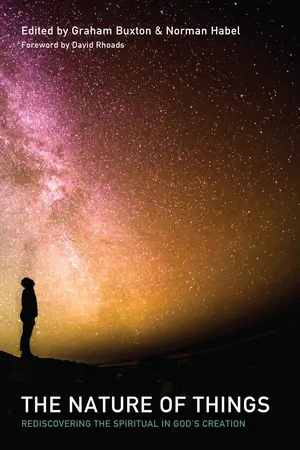
eBook - ePub
The Nature of Things
Rediscovering the Spiritual in God’s Creation
- 268 pages
- English
- ePUB (mobile friendly)
- Available on iOS & Android
eBook - ePub
The Nature of Things
Rediscovering the Spiritual in God’s Creation
About this book
In 2015 a conference on "Rediscovering the Spiritual in God's Creation" was held at the Serafino winery complex in the McLaren Vale region of South Australia. The aim of the conference was not to seek consensus but to survey the landscape with a view to intentional responsible action in caring for God's creation. Delegates were challenged to recognize their own worldviews and to widen their horizons to encompass the enormity of the transcendence and immanence of God's presence in all creation. A group of leading international scholars and experts in the fields of science, ecology, theology, and ethics participated in a multidisciplinary conversation on the spiritual in creation, with the aim of discovering fresh horizons with regard to creation care, liturgy, justice, and discipleship within the Christian community. The chapters in this volume reflect the diversity of perspectives summarized in The Serafino Declaration, which was crafted towards the end of the conference. This declaration (which opens the volume) outlines a range of views relating to the presence of the spiritual in creation, views that are both traditional and radical. This volume highlights the current concern over ecological destruction and finds sources of inspiration in the deepest roots of our traditions and forms of spirituality to sustain efforts towards custodianship of the land and care for God's creation.
Contributors:
David Rhoads
Paul Santmire
Denis Edwards
Bob White
Heather Eaton
Ernst Conradie
Vicky Balabanski
Celia Deane-Drummond
Mark Worthing
Emily Colgan
Dianne Rayson
Anne Gardner
Mark Liederbach
Patricia Fox
Anne Elvey
Mick Pope
Information
Topic
Theology & ReligionSubtopic
Christian ChurchPart 1
Presence in Creation
1
Experience of Word and Spirit in the Natural World
Do we experience God in our encounters with birds, animals, trees, forests, mountains, deserts, and beaches? Or, to focus the question of this chapter a little more precisely, does the Christian theological tradition offer support for the idea that we can experience the triune God in the natural world? Behind this question I think there are two further questions: is God the Trinity to be understood as really present in the natural world? If God is understood as present, is this presence of God something we can properly be said to experience?
I will take up these two questions with the help of two theologians of the tradition, Athanasius of Alexandria from the fourth century and Karl Rahner from the twentieth. In the first section of the essay I will explore a theology of God’s triune presence in creatures, in dialogue with Athanasius. In the second, I will seek to show that we can truly be said to experience this presence of God, building on Karl Rahner. The third section simply offers three examples of the experience of God the Trinity in the natural world.
The Presence of God in Creatures
Is God truly present in the natural world around us? When I walk on a quiet beach, can I see this beach as a place of divine presence? Can I think of a rain forest, with all its interconnected, exuberant forms of life, as filled with the presence of God? Some theologians, conscious of the costs of evolution, and the pain of many creatures, speak of the absence of God from the natural world. But I remain convinced we need to think of God as radically present, even in the loss and pain evident in biological life and in the costs of evolutionary emergence.
The Christian theological tradition has long been committed to the idea that God is radically present to all creatures, conferring on them their existence and their capacity to act within a community of creation. I will illustrate this statement by reference to Athanasius, a key figure in the full articulation of the theology of the Trinity. Reading him, there is the sense of a theology that is still young and vibrant. His view of the Trinity is radically scriptural. It is never abstract, but a theology of a God engaged with creatures, a God who acts, who creates and saves. I will focus first on his view of God’s presence to creatures, and then on his idea that creatures bear an imprint or image of holy Wisdom.
The Immediacy of God to Each Creature
Athanasius sees creation from the perspective of Jesus Christ and his life-giving cross. He sees the Word who is made flesh, the Word of the cross, as the very Word of creation. What John 1:3 says of the Word is foundational for all of his work: “All things came into being through him, and without him not one thing came into being.” The Word through whom all entities in the universe exist is the very same Word who is made flesh (John 1:14) to bring creation to its healing and transformation. The Word of creation is the Word of salvation.
Like others in the fourth century, Athanasius sees Christ not only as the Word of God but also as the Wisdom of God. He uses these expressions interchangeably, and interprets biblical references to the Word and the Wisdom of God intertextually. Athanasius is like many others in his own time in seeing God as creating through God’s Wisdom/Word. Where Athanasius differs from many of his contemporaries is in his conviction of the full divinity of both the Wisdom/Word and the Spirit. In fourth century-philosophical and theological culture, permeated as it was by Platonic thought, it was natural to suppose that there is a vast distance between finite creatures and the infinite God, and that some kind of intermediary is needed to bridge this distance. The tendency was to think of creatures as participating in an intermediary, and of the intermediary as participating in the all holy God. For the Christian community this intermediary was the Wisdom/Word. Behind this tendency there was a conviction of God’s complete otherness from creatures. There was an assumption that the all-holy God is not to be contaminated or demeaned by immediate contact with creatures. In any case, finite and vulnerable creatures might not be able to withstand exposure to the fire of the divinity. Some kind of buffer was needed.1
It is understandable, then, that the Alexandrian priest Arius was convinced not only that the Word is an intermediary between God and creatures, but also that the Word is not to be identified with the all-holy God. In his view, there was a time when the Word was not. This means that the Word is ultimately a creature and that the true and eternal God is beyond the Word. Such a view was shared by many Christians, including influential bishop-theologians. The transcendent otherness of God seemed to rule out an immediate relationship between God and created entities.
Basing himself on his reading of the Scriptures and the Christian tradition, Athanasius completely rejects the notion of a created intermediary between God and creatures. For him there is no buffer. God is immediately present to the creatures that God creates. Athanasius shares fully in his opponents’ conviction of the radical otherness of the Creator. He has a highly developed theology of creation ex nihilo. Creatures have in themselves no reason for their existence. They exist only because the Creator confers existence on them at every point. For Athanasius, too, there is an infinite difference, an ontological gulf, between creatures and their Creator.
How is this gulf bridged? Not, for him, by a hierarchical chain of being linking Creator and creatures; and not, for him, by a created intermediary. He insists that the gulf is bridged only by the fully divine Word coming down to be present to creatures in the fully divine Spirit. Only God can bridge the gap. For Athanasius, the eternally divine Word of God is “present in all things” and “gives life and protection to everything, everywhere, to each individually and to all together.”2 From the creaturely side, creation is an ongoing relation of participation, by which creatures exist securely only because they partake of this Word of God so profoundly present to them in the Spirit. Athanasius speaks of the Word of God as “governing,” “establishing,” “leading,” “providing for,” and “ordering” creation.3
Athanasius writes of divine Wisdom as enabling all the diverse creatures and the elements of the natural world to work together in balance and harmony. Like a gifted musician, divine Wisdom brings the whole universe into a beautiful interrelationsh...
Table of contents
- Title Page
- Foreword
- Preface: The Serafino Declaration
- Contributors
- Introduction
- Part One: Presence in Creation
- Part Two: Spirituality in Creation
- Part Three: Suffering in Creation
- Part Four: Wisdom in Creation
- Part Five: Eco-Readings In Creation
- Epilogue: A Spirituality of the Earth
Trusted by 375,005 students
Access to over 1.5 million titles for a fair monthly price.
Study more efficiently using our study tools.
Frequently asked questions
Yes, you can cancel anytime from the Subscription tab in your account settings on the Perlego website. Your subscription will stay active until the end of your current billing period. Learn how to cancel your subscription
No, books cannot be downloaded as external files, such as PDFs, for use outside of Perlego. However, you can download books within the Perlego app for offline reading on mobile or tablet. Learn how to download books offline
Perlego offers two plans: Essential and Complete
- Essential is ideal for learners and professionals who enjoy exploring a wide range of subjects. Access the Essential Library with 800,000+ trusted titles and best-sellers across business, personal growth, and the humanities. Includes unlimited reading time and Standard Read Aloud voice.
- Complete: Perfect for advanced learners and researchers needing full, unrestricted access. Unlock 1.5M+ books across hundreds of subjects, including academic and specialized titles. The Complete Plan also includes advanced features like Premium Read Aloud and Research Assistant.
We are an online textbook subscription service, where you can get access to an entire online library for less than the price of a single book per month. With over 1.5 million books across 990+ topics, we’ve got you covered! Learn about our mission
Look out for the read-aloud symbol on your next book to see if you can listen to it. The read-aloud tool reads text aloud for you, highlighting the text as it is being read. You can pause it, speed it up and slow it down. Learn more about Read Aloud
Yes! You can use the Perlego app on both iOS and Android devices to read anytime, anywhere — even offline. Perfect for commutes or when you’re on the go.
Please note we cannot support devices running on iOS 13 and Android 7 or earlier. Learn more about using the app
Please note we cannot support devices running on iOS 13 and Android 7 or earlier. Learn more about using the app
Yes, you can access The Nature of Things by Graham Buxton, Norman C. Habel, Graham Buxton,Norman C. Habel, Buxton, Habel in PDF and/or ePUB format, as well as other popular books in Theology & Religion & Christian Church. We have over 1.5 million books available in our catalogue for you to explore.