eBook - ePub
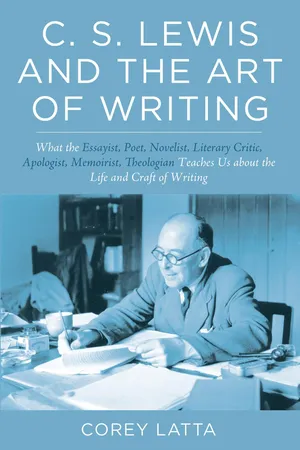
C. S. Lewis and the Art of Writing
What the Essayist, Poet, Novelist, Literary Critic, Apologist, Memoirist, Theologian Teaches Us about the Life and Craft of Writing
- 250 pages
- English
- ePUB (mobile friendly)
- Available on iOS & Android
eBook - ePub
C. S. Lewis and the Art of Writing
What the Essayist, Poet, Novelist, Literary Critic, Apologist, Memoirist, Theologian Teaches Us about the Life and Craft of Writing
About this book
C. S. Lewis and the Art of Writing is written for readers interested in C. S. Lewis, the writing life, and in becoming better writers. Lewis stands as one of the most prolific and influential writers in modern history. His life in letters offers writers invaluable encouragement and instruction in the writing craft. In Lewis, writers don't just learn how to write, they also learn something about how to live. This volume explores Lewis's life in, as well as his practice of, writing. From his avid reading life, to his adolescent dreams to be a great poet, through his creative failures, to his brilliant successes, to his constant encouragement of other writers, C. S. Lewis and the Art of Writing celebrates one of the twentieth-century's greatest authors.
Information
1
How Reading Made a Writer
Lewis, once described as the “best-read man of his generation” and “one who read everything and remembered everything he read,” wrote from the overflow of a life saturated in reading.1 From the beginning of Lewis’s creative life there existed a literary fountainhead from which ran a fast current of story, imaginative ideas, and other worlds and words that would flow through the entirety of his life. To appreciate Lewis as a writer—and preeminently as a writer whose philosophy and practice of writing stands as example to other writers—we do well to begin where his craft began, in a habitual life of reading.
Lewis, to whom the craft of writing came naturally and from whom it flowed powerfully, read himself into the writing life. When we meet the man behind his many books, we find a writer whose indelible induction into the creative life came early. It is telling that in his spiritual autobiography Surprised by Joy Lewis introduces the reader to his parents through what they read. About his mother Lewis tells us,
she was a voracious reader of good novels, and I think the Merediths and Tolstoys which I have inherited were bought for her.2
And of his father,
“he was fond of poetry . . . ; I think Othello was his favorite Shakespearean play” and “he greatly enjoyed nearly all humorous authors, from Dickens to W. W. Jacobs.”3
Providence, it seems, placed Lewis in a home ideally nurturing for a future writer. Lewis inherited his parents’ love for literature, but not their exact tastes. The mythic and romantic literary affinities Lewis would hold as an adolescent and adult—stories that rang with the “horns of elfland” and the poetry of Keats and Shelley—were not passed along by his parents. But an absence of faerie and romantic verse did little to deprive Lewis of a richly formative literary childhood. The influence of writers and words suffused his young years. In describing his lettered childhood, Lewis has quite a lot to say about the presence and importance of books:
I am a product of long corridors, empty sunlit rooms, upstairs indoor silences, attics explored in solitude, distant noises of gurgling cisterns and pipes, and the noise of wind under the tiles. Also, of endless books. My father bought all the books he read and never got rid of any of them. There were books in the study, books in the drawing room, books, books in the cloakroom, books (two deep) in the great bookcase on the landing, books in a bedroom, books piled as high as my shoulder in the cistern attic, books of all kinds reflecting every transient stage of my parents’ interest, books readable and unreadable, books suitable for a child and books most emphatically not. Nothing was forbidden me. In the seemingly endless rainy afternoons I took volume after volume from the shelves. I had always the same certainty of finding a book that was new to me as a man who walks into a field has of finding a new blade of grass . . . .4
Lewis’s early life bears witness that a good writer is first a good reader. How telling that the author whose body of writing would so widely range from the philosophical non-fiction to the poetic to the fantastical children’s story should spend his earliest years in a readerly panopticon. All manner of imaginative world and literary genre were available to him. Decades later, in An Experiment in Criticism published near the end of his life, Lewis would write of reading’s power to provide new ways to see the world, saying simply that “we demand windows.”5 As Lewis learned early, escape lies within good reading. Down the halls and stacked two deep on the shelves were windows that opened to young Jack—a self-appointed nickname from early childhood that Lewis kept through adulthood—cosmoses of written creation.
Lewis spent hours in a seemingly omnipresent solitude, which he writes, was always at his command.6 The quiet attic made an apt workshop for a burgeoning brilliant mind. There in the silence of his childhood home, with its corridors of countless volumes, quaint hours reading and writing foreshadowed a life in letters. The more connections between his reading life and his craft—how, for example, his reading certain books directly influenced certain writings—will become more evident, but we should first go a bit further up and further into reading’s systemic effect on Lewis’s creative development.
“Alone in a big house full of books. I suppose that fixed a literary bent. I drew a lot, but soon began to write more.”7 For Lewis, reading and writing flourished simultaneously. He began to call the quiet attic his “study,” a space lined with drawings and magazine cutouts, furnished with “Jack’s desk,” and stocked with “pen and inkpot and writing books and paintbox.”8 There young Jack began his writing life. In recounting the beginning of his writing life, Lewis quotes a line from Edmund Spenser, “What more felicity can fall to creature, than to enjoy delight with liberty.”9 Finding meaning in a passage he read then quoting that passage to describe his initiation into writing: how like Lewis! The Spenser quote is apt. Writing for Jack was pure cheer. His deft use of quotes, a move Lewis constantly makes throughout his non-fiction works, shows a writer on whom nothing read was lost.
For the writer
Lewis’s literary history began with a childhood among books. His story tells a universal truth: writers are born from reading. The writer learns creativity by reading creative works. The writer’s imagination widens through exposure to imaginative stories. The writer develops an intuitive feel for language by spending time with the written word. To start writing, start reading.
When did you first start reading? What was the literary culture in your home like as a child? How did your childhood reading life affect your entry into writing?
Do try: In at least 500 words, write about your first memorable experience with books. Talk about the role early reading played in your imaginative life. Be personal, insightful, and creative.
1. James Como attributes this line to William Empson in Remembering C. S. Lewis, 35.
2. Lewis, Surprised by Joy, 4.
3. Ibid., 4–5.
4. Ibid., 10.
5. Lewis, An Experiment in C...
Table of contents
- Title Page
- Acknowledgements
- Ink to Cure All Human Ills
- Chapter 1: How Reading Made a Writer
- Chapter 2: The Glories of Childhood
- Chapter 3: Entirely in the Imagination
- Chapter 4: Engulfed
- Chapter 5: I Myself Have Been Reading
- Chapter 6: What? You Too?
- Chapter 7: Tell Me More about John Silence
- Chapter 8: Avoid Nearly All Magazines
- Chapter 9: Phantastes
- Chapter 10: Like a Thunderclap
- Chapter 11: A Great Reading Event
- Chapter 12: Conscious of Style
- Chapter 13: Imagination and Mere Fancy
- Chapter 14: Pleased to Find Keats
- Chapter 15: Less and Less That I Can Share
- Chapter 16: I Myself Always Index a Good Book
- Chapter 17: We Demand Windows
- Chapter 18: More with a Castle in a Story
- Chapter 19: I Have to Do It for Myself
- Chapter 20: To Those Early Little Essays in the Old Days
- Chapter 21: With Greeves and Loki
- Chapter 22: Practice, Practice, Practice
- Chapter 23: Lewis Proposes an Edit
- Chapter 24: Bleheris is Dead
- Chapter 25: If Only I Could Get My Book Accepted
- Chapter 26: There It Is By Itself and Done
- Chapter 27: My Imagination Seems to Have Died
- Chapter 28: Pen to Paper
- Chapter 29: Sooner or Later You Will Have to Write
- Chapter 30: Kill the Part of You That Wants Success
- Chapter 31: The Perfect Circle is Made
- Chapter 32: Bad by Any Theory of Style
- Chapter 33: Form Is Soul
- Chapter 34: Crisp as Grape Nuts, Hard as a Hammer, Clear as Glass
- Chapter 35: Not a Vestige of Real Creativity
- Chapter 36: An Idea and Then an Itch
- Chapter 37: One Never Knows What One’s in For
- Chapter 38: A Thing Inside Him Pawing to Get Out
- Chapter 39: Forgiven for Writing Only Two Kinds of Books
- Chapter 40: Like a Nightmare on My Chest
- Chapter 41: An Absolute Corker
- Chapter 42: The Muscles of Language
- Chapter 43: Use the Talent We Have
- Chapter 44: It Is Like Bereavement in This Way
- Chapter 45: Of Loathing and Letter Writing
- Chapter 46: Make Quite Clear What You Mean
- Chapter 47: Prefer The Plain
- Chapter 48: Concrete Ones Will Do
- Chapter 49: Instead of Telling Us a Thing . . . Describe It
- Chapter 50: Words Too Big for the Subject
- Bibliography
Trusted by 375,005 students
Access to over 1.5 million titles for a fair monthly price.
Study more efficiently using our study tools.
Frequently asked questions
Yes, you can cancel anytime from the Subscription tab in your account settings on the Perlego website. Your subscription will stay active until the end of your current billing period. Learn how to cancel your subscription
No, books cannot be downloaded as external files, such as PDFs, for use outside of Perlego. However, you can download books within the Perlego app for offline reading on mobile or tablet. Learn how to download books offline
Perlego offers two plans: Essential and Complete
- Essential is ideal for learners and professionals who enjoy exploring a wide range of subjects. Access the Essential Library with 800,000+ trusted titles and best-sellers across business, personal growth, and the humanities. Includes unlimited reading time and Standard Read Aloud voice.
- Complete: Perfect for advanced learners and researchers needing full, unrestricted access. Unlock 1.5M+ books across hundreds of subjects, including academic and specialized titles. The Complete Plan also includes advanced features like Premium Read Aloud and Research Assistant.
We are an online textbook subscription service, where you can get access to an entire online library for less than the price of a single book per month. With over 1.5 million books across 990+ topics, we’ve got you covered! Learn about our mission
Look out for the read-aloud symbol on your next book to see if you can listen to it. The read-aloud tool reads text aloud for you, highlighting the text as it is being read. You can pause it, speed it up and slow it down. Learn more about Read Aloud
Yes! You can use the Perlego app on both iOS and Android devices to read anytime, anywhere — even offline. Perfect for commutes or when you’re on the go.
Please note we cannot support devices running on iOS 13 and Android 7 or earlier. Learn more about using the app
Please note we cannot support devices running on iOS 13 and Android 7 or earlier. Learn more about using the app
Yes, you can access C. S. Lewis and the Art of Writing by Corey Latta in PDF and/or ePUB format, as well as other popular books in Languages & Linguistics & Creative Writing. We have over 1.5 million books available in our catalogue for you to explore.