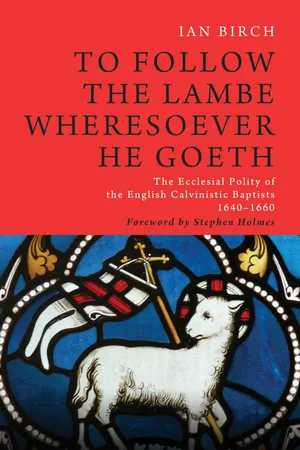
eBook - ePub
To Follow the Lambe Wheresoever He Goeth
The Ecclesial Polity of the English Calvinistic Baptists 1640–1660
- 248 pages
- English
- ePUB (mobile friendly)
- Available on iOS & Android
eBook - ePub
To Follow the Lambe Wheresoever He Goeth
The Ecclesial Polity of the English Calvinistic Baptists 1640–1660
About this book
This book explores the doctrine of the church among English Calvinistic Baptists between 1640 and 1660. It examines the emergence of Calvinistic Baptists against the background of the demise of the Episcopal Church of England, the establishment by Act of Parliament of the Westminster Assembly of Divines, and the attempted foundation of a Presbyterian Church of England. Ecclesiology was one of the most important doctrines under consideration in this phase of English history, and this book is a contribution to understanding alternative forms of ecclesiology outside of the mainstream National Church settlement.
It argues that the development of Calvinistic Baptist ecclesiology was a natural development of one stream of Puritan theology, the tradition associated with Robert Brown, and the English separatist movement. This tradition was refined and made experimental in the work of Henry Jacob, who founded a congregation in London in 1616 from which Calvinistic Baptists emerged. Central to Jacob's ideology was the belief that a rightly ordered church acknowledged Christ as King over his people. The christological priority of early Calvinistic Baptist ecclesiology will constitute the primary contribution of this study to the investigation of dissenting theology in the period.
Information
Topic
Theology & ReligionSubtopic
Christian Theology1
“Casting Balls of Wildfire into the bosom of the Church”1
The Emergence of English Particular Baptists to 1660
Introduction
English Particular Baptists appear as an identifiable collective organization in the mid seventeenth century. The date by which it can be stated certainly that there existed a group of at least seven Independent churches practicing believer’s baptism and holding to Calvinistic tenets of theology is October 1644, the occasion of the publication of the First London Confession.2 The unity of these churches is expressed in the preface to the Confession where they stated,
though wee be distinct in respect of our particular bodies, . . . yet are all One in Communion, holding Jesus Christ to be our head and Lord.3
Prior to 1644 it is only with caution that we can speak of the English Particular Baptists as a collective entity.4 Murray Tolmie has suggested that the concept of “proto-denomination” be employed to describe a group of churches fully evolved ideologically, but organizationally incomplete.5
In this chapter I will draw on near contemporary documents6 to trace the emergence of English Particular Baptists from the mother church founded by Henry Jacob to the restoration of the monarchy, in order to provide the necessary context to examine the doctrine of the church among these believers.
1.1 From Jacob to Jessey
The emergence of English Particular Baptists may be traced back to the congregation of Independent Puritans7 founded by Henry Jacob in Southwark,8 London, in 1616.9 The formation of the church is recorded in a document known as Stinton Numb: 1, where it states:
The Church Anno 1616 was gathered
Hereupon ye said Henry Jacob wth Sabine Staismore, Rich Browne, David Prior, Andrew Almey, Wm Throughton, Jno Allen, Mr Gibs, Edwd Farre, Hen Goodall, & divers others well-informed Saints haveing appointed a day to seek ye Face of ye Lord in fasting & Prayer, wherein that particular of their Union togeather as a Church was mainly commended to ye Lord: in ye ending of ye Day they were United, Thus, Those who minded this present Union & so joyning togeather joined both hands each wth other Brother and stood in a Ringwise: their intent being declared, H Jacob and each of the Rest made some confession or Profession of their Faith & Repentance, some, ware longer some ware briefer, Then they Covenanted togeather to walk in all Gods Ways as he had revealed or should make known to them.
Thus was the beginning of that Church of which proceed, they within a few Days gave notice to the Brethren here of the Antient Church.
After this Hen Jacob was Chosen & Ordained Pastor to that Church, & many Saints ware joined to them.10
The Confession affirmed Jacob’s willingness to submit to all civil authority,11 both godly magistrate and government. He did not advocate separation of church and state, but sought freedom and toleration to be an independent congregation, that is, “Christs visible politicall Church under the Gospell.”12 What Jacob desired was an end to human tradition in the church, and liberation from the authority of priests and bishops.13
The basis on which Jacob’s pioneering “independent” church14 formed was clearly covenantal, the members committing themselves as a gathered congregation. It is less clear to what extent it was their intention to be a separatist conventicle. The argument for separatism derives from the detail that a few days following the first gathering of the church Jacob consulted with “the Brethren here of the Antient Church,”15 a strictly Separatist congregation with Barrowist convictions.16 Jacob’s approach may suggest he desired friendly relations, and possibly hoped that they would join with him, but they did not.17 This implies that the Ancient Church did not recognize Jacob’s ecclesiastical polity as commensurate with their own separatism, for even as late as 1624 they regarded “Mr Iakobs people [as] Idolators in their going to the parish assemblies.”18 Furthermore, on the formation of his ow...
Table of contents
- Title Page
- Acknowledgments
- Abbreviations
- Introduction
- Foreword
- Chapter 1: “Casting Balls of Wildfire into the bosom of the Church”
- Chapter 2: “A True Visible Church of Christ”
- Chapter 3: “To follow the Lambe wheresoever he goeth”
- Chapter 4: “A Holy and Orderly Communion”
- Chapter 5: “An Intolerable Usurpation”
- Chapter 6: “The Counsel and Help of One Another”
- Conclusions
- Bibliography
Trusted by 375,005 students
Access to over 1.5 million titles for a fair monthly price.
Study more efficiently using our study tools.
Frequently asked questions
Yes, you can cancel anytime from the Subscription tab in your account settings on the Perlego website. Your subscription will stay active until the end of your current billing period. Learn how to cancel your subscription
No, books cannot be downloaded as external files, such as PDFs, for use outside of Perlego. However, you can download books within the Perlego app for offline reading on mobile or tablet. Learn how to download books offline
Perlego offers two plans: Essential and Complete
- Essential is ideal for learners and professionals who enjoy exploring a wide range of subjects. Access the Essential Library with 800,000+ trusted titles and best-sellers across business, personal growth, and the humanities. Includes unlimited reading time and Standard Read Aloud voice.
- Complete: Perfect for advanced learners and researchers needing full, unrestricted access. Unlock 1.5M+ books across hundreds of subjects, including academic and specialized titles. The Complete Plan also includes advanced features like Premium Read Aloud and Research Assistant.
We are an online textbook subscription service, where you can get access to an entire online library for less than the price of a single book per month. With over 1.5 million books across 990+ topics, we’ve got you covered! Learn about our mission
Look out for the read-aloud symbol on your next book to see if you can listen to it. The read-aloud tool reads text aloud for you, highlighting the text as it is being read. You can pause it, speed it up and slow it down. Learn more about Read Aloud
Yes! You can use the Perlego app on both iOS and Android devices to read anytime, anywhere — even offline. Perfect for commutes or when you’re on the go.
Please note we cannot support devices running on iOS 13 and Android 7 or earlier. Learn more about using the app
Please note we cannot support devices running on iOS 13 and Android 7 or earlier. Learn more about using the app
Yes, you can access To Follow the Lambe Wheresoever He Goeth by Ian Birch in PDF and/or ePUB format, as well as other popular books in Theology & Religion & Christian Theology. We have over 1.5 million books available in our catalogue for you to explore.