eBook - ePub
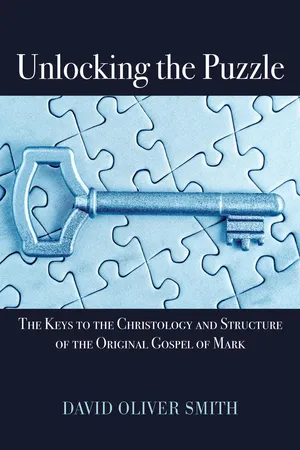
Unlocking the Puzzle
The Keys to the Christology and Structure of the Original Gospel of Mark
- 324 pages
- English
- ePUB (mobile friendly)
- Available on iOS & Android
eBook - ePub
Unlocking the Puzzle
The Keys to the Christology and Structure of the Original Gospel of Mark
About this book
A shorter, simpler first draft of the Gospel of Mark has been theorized by New Testament scholars for almost two hundred years. Using literary tools, David Oliver Smith strips away interpolation and redaction from the canonical Gospel to reveal that long-sought first draft--the Original Gospel of Mark. Original Mark, shorter than the canonical version and with several large blocks of text replaced in their original locations, reveals a coherent structure and a different picture of who Jesus is. But it is anything other than simple. The Original Gospel also presents puzzles for the curious reader of Mark to solve, and Smith has found the keys to their solution. Analysis of the text that was interpolated into Mark reveals who that redactor might have been. Evidence is presented that it was the author of the Gospel of Luke who redacted the first-written Gospel, jumbled its structure, and changed its Christology. Follow the analysis of literary structures created by the genius who wrote Mark's Gospel and discover the astounding design of the Original Gospel of Mark.
Information
Part I
Literary Structures
1
Introduction
The Gospel of Mark is a puzzle. Reading it, especially for the first time, one gets the impression that it is disjointed. The narrative proceeds from baptism to controversies with the authorities, to the killing of John the Baptizer, to teaching the multitude, to trekking to Jerusalem, to a plot against Jesus, to arrest, to trials, to crucifixion, to an empty tomb, in an orderly fashion. But around that narrative there are teachings, miracles, boat trips, and journeys happening “immediately” one upon another. It can be quite confusing.
Until scholars generally recognized that Mark was the first written Gospel, the usual opinion among New Testament (NT) scholars was that Mark was a pedestrian work merely setting out the basic story of Jesus’s ministry and crucifixion. Mark was criticized because the Greek was poor, the ideas simple, and there were a number of mistakes. During the twentieth century Mark has become more and more appreciated by scholars as they plumb the depths of the first written Gospel.
Literary Structures
Herein three techniques are used to detect interpolations into the Original Gospel. The first consists of identifying large chiastic and parallel literary structures created by the author that extend over several pericopae and containing up to twenty stiches. These terms are defined in chapter 2. A break or gap in a chiastic structure alerts the investigator to a possible interpolation or repositioning of pericopae. The second consists of utilizing Mark’s penchant for creating triplets. Over eighty triplets (words or phrases used only three times in the Gospel) and sextets (words or phrases used only six times in the Gospel) are identified in Appendix 2 and there are probably more. In a Markan triplet there are, of course, three elements, but the middle element differs slightly from the first and third elements. For example, Mark uses the Roman monetary unit “denarius” three times, at Mark 6:37, 12:15, and 14:5. The first and third times he uses the plural “denarii” but in the middle element at 12:15 he uses the singular, “denarius.” Knowing this pattern allows the investigator to identify interpolated text that may have inadvertently destroyed the Markan triplet pattern. It can also suggest in a gross fashion when a pericope may have been moved. The third technique consists of qualitatively analyzing the style of writing in a suspected interpolation to determine if it comports with Mark’s sparse style. In other words, if a suspected interpolation gives colorful details or repeats facts, it bears scrutiny.
The question naturally arises as to why Mark would create long chiastic structures that readers would have trouble discerning because of the literary distance between the matching elements. Further, few people could read nineteen hundred years ago, and most people would have only heard the Gospel read aloud. It would have been virtually impossible for listeners of Mark’s Gospel to have picked up on the long structures, especially those structures where words or concepts in the beginning of the Gospel matches words or concepts at the end of the Gospel.
There are two possible answers to this. The first is that some of Mark’s literary constructions may have had the purpose of foiling attempts to redact or interpolate into the Original Gospel. Unfortunately, either Mark was too subtle for the redactor, or the redactor did not care, or the redactor thought no one would notice. It is clear that ancient authors feared that their works would be redacted or interpolated. The author of Revelation testifies to this at Rev 22:18–19:
18 I warn everyone who hears the words of the prophecy of this book: if anyone adds to them, God will add to that person the plagues described in this book; 19 if anyone takes away from the words of the book of this prophecy, God will take away that person’s share in the tree of life and in the holy city, which are described in this book.
In his Gos...
Table of contents
- Title Page
- Preface
- Acknowledgments
- Abbreviations
- Part One: Literary Structures
- Part Two: Style, Plot, Purpose, Sources, and Structure of the Original Gospel of Mark
- Appendix 1: The Original Gospel of Mark
- Appendix 2: Triplets in the Original Gospel of Mark
- Appendix 3: Pericopae of the Original Gospel of Mark
- Appendix 4: Pericopae of Canonical Mark
- Appendix 5: Luke Edits of Mark
- Bibliography
Trusted by 375,005 students
Access to over 1.5 million titles for a fair monthly price.
Study more efficiently using our study tools.
Frequently asked questions
Yes, you can cancel anytime from the Subscription tab in your account settings on the Perlego website. Your subscription will stay active until the end of your current billing period. Learn how to cancel your subscription
No, books cannot be downloaded as external files, such as PDFs, for use outside of Perlego. However, you can download books within the Perlego app for offline reading on mobile or tablet. Learn how to download books offline
Perlego offers two plans: Essential and Complete
- Essential is ideal for learners and professionals who enjoy exploring a wide range of subjects. Access the Essential Library with 800,000+ trusted titles and best-sellers across business, personal growth, and the humanities. Includes unlimited reading time and Standard Read Aloud voice.
- Complete: Perfect for advanced learners and researchers needing full, unrestricted access. Unlock 1.5M+ books across hundreds of subjects, including academic and specialized titles. The Complete Plan also includes advanced features like Premium Read Aloud and Research Assistant.
We are an online textbook subscription service, where you can get access to an entire online library for less than the price of a single book per month. With over 1.5 million books across 990+ topics, we’ve got you covered! Learn about our mission
Look out for the read-aloud symbol on your next book to see if you can listen to it. The read-aloud tool reads text aloud for you, highlighting the text as it is being read. You can pause it, speed it up and slow it down. Learn more about Read Aloud
Yes! You can use the Perlego app on both iOS and Android devices to read anytime, anywhere — even offline. Perfect for commutes or when you’re on the go.
Please note we cannot support devices running on iOS 13 and Android 7 or earlier. Learn more about using the app
Please note we cannot support devices running on iOS 13 and Android 7 or earlier. Learn more about using the app
Yes, you can access Unlocking the Puzzle by David Oliver Smith in PDF and/or ePUB format, as well as other popular books in Teologia e religione & Critica e interpretazione biblica. We have over 1.5 million books available in our catalogue for you to explore.