- 252 pages
- English
- ePUB (mobile friendly)
- Available on iOS & Android
eBook - ePub
About this book
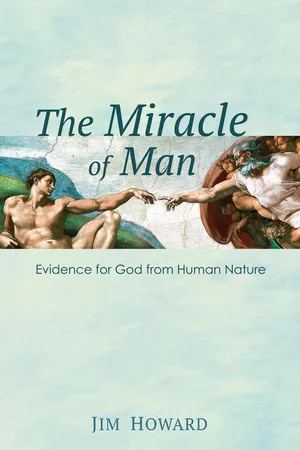
What Is a Man? Biologically, we are animals--homo sapiens. But men are different, born with consciousness, reason, free will, notions of morality, and other characteristics of what we call "human nature." Why are we different? Were we created by God or are we just accidents of nature? Are you a child of the King or just a child of King Kong? This is a book of apologetics for laypeople. It looks at arguments for the existence of God and especially at those arguments that can be drawn from human nature. It argues in plain language, with illustrations and humor, that we cannot explain human nature without God, that men are miracles.
Information
Topic
PhilosophieSubtopic
Éthique et philosophie moraleChapter 1
“Men Are Different”
Eight Things I Know About You
“Men are different. They propound mathematical theorems in beleaguered cities, conduct metaphysical arguments in condemned cells, make jokes on scaffolds, discuss the last new poem while advancing to the walls of Quebec, and comb their hair at Thermopylae. This is not panache; it is our nature.”
—C. S. Lewis20
You and I are human beings, men and women. But what is a man?21 On the biological level, we are animals—homo sapiens. We share with other animals all our basic biological systems, including our brains and nervous systems, hearts and circulatory systems, skeletons, digestive systems, and sexual function. Even our cells and DNA have the same basic structure. But men are different. From consciousness and reason to free will and notions of morality, from symbolic language to romantic love, from science and technology to art or music, the differences between man and the other animals are at least as great as the similarities.
What makes us different? Our twenty-first century culture says that the difference is only one of degree—our brains are just more developed than those of other animals. Traditional Western culture taught that we are different in our very nature—we are made in the image of God. Which view is correct? Are we just physical beings—“trousered apes”22 or “grown-up germs”23—or are we also spiritual beings? Are we the accidental products of nature, or were we created by God for a purpose? Are you a child of The King or just a child of King Kong?24
What is a man? The modern answer was stated by the atheist philosopher, Jean-Paul Sartre: “You are your life and nothing else.”25 In other words, all you have is yourself and you will last no longer than the uncertain span of your earthly life. This conclusion is unavoidable if you are only a product of nature. But some 2800 years ago, the Psalmist asked the same question and got a very different answer:
“What is man, that You are mindful of him,
And the son of man, that You visit him?
For You have made him a little lower than the angels,
And You have crowned him with glory and honor.”26
I want to look at human beings and see what we can observe about ourselves, and then ask what conclusions we can draw from these characteristics about the big questions of life—especially, is there a God and if so, what is He like? In the end, I am going to argue that we cannot explain human nature without God. I am going to propose something which is quite radical in our culture, that men are miracles. We are not only natural beings, related horizontally to the rest of nature. We are also supernatural beings, related vertically to a Creator God.
Self-Evident Truths
I do not know you, but I believe I know at least eight things about you. If you are reading this book, you are human, and these eight facts are true of all human beings. They are part of human nature. In fact, I believe they are “self-evident.” By this I mean that they are obvious to anyone who takes the time to think about them, and we can safely assume them to be true, without requiring proof. Thomas Jefferson wrote, in the American Declaration of Independence:
“We hold these truths to be self-evident: that all men are created equal, that they are endowed by their Creator with certain inalienable rights, among these are life, liberty and the pursuit of happiness.”
In believing in self-evident truth, Jefferson represented the mainstream of human thought, going back at least as far as the Greek philosopher, Aristotle, in the fourth century, BC. Aristotle taught that we must accept some truths as self-evident if we are going to think at all,27 and he was right. You cannot reason your way to any conclusion if you do not start from some assumption.
I will suggest that we can reasonably accept as starting points for our thinking several self-evident truths about human beings, because these truths have been obvious to most all men throughout history. They are part of the general understanding of reality that we sometimes call “common sense,” and that I will call “universal human experience.”28
I am not very interested in any belief system which requires me to say that our universal human experience is an illusion, whether that belief system is secular or religious. The “Christian Scientist” movement, so far as I can understand it, teaches that human sickness is not a physical reality, but is only in the mind. I would suggest that the appropriate response to this idea is the joke about the Christian Scientist who met a friend and asked, “How is your father?” The friend answered, “Not well. He has cancer.” The Christian Scientist responded, “He’s not really sick. He just thinks he is.” A few weeks later, they met again. The Christian Scientist again asked, “How is your father?” The friend replied, “Not well. Now he thinks he’s dead.”29 Please forgive me if I am being flippant, or if I misunderstand the Christian Scientists. But the idea that physical illness is only in the mind violates our universal human experience. Therefore, it is ver...
Table of contents
- Title Page
- Introduction
- Chapter 1: “Men Are Different”
- Chapter 2: “I Yam What I Yam”
- Chapter 3: “Elementary, My Dear Watson”
- Chapter 4: “When You Come to a Fork in the Road, Take It!”
- Chapter 5: “If There Is No God, Everything Is Lawful”
- Chapter 6: “We Have Met the Enemy and He Is Us!”
- Chapter 7: “I Can’t Get No Satisfaction”
- Chapter 8: “The Most Urgent Wish of Mankind”
- Chapter 9: “The Good, the True, and the Beautiful”
- Chapter 10: Nothing Comes from Nothing
- Chapter 11: The Miracle of Life
- Chapter 12: “A Creator as well as a Creature”
- Chapter 13: “A Cosmos rather than a Chaos”
- Chapter 14: Why, Lord?
- Chapter 15: Old Answers to an Old Question
- Chapter 16: Don’t All Roads Lead to God?
- Chapter 17: “How Should We Then Live?”
- Chapter 18: Cross Examination
- Bibliography
- Name and Subject Index
- Scripture Index
Trusted by 375,005 students
Access to over 1.5 million titles for a fair monthly price.
Study more efficiently using our study tools.
Frequently asked questions
Yes, you can cancel anytime from the Subscription tab in your account settings on the Perlego website. Your subscription will stay active until the end of your current billing period. Learn how to cancel your subscription
No, books cannot be downloaded as external files, such as PDFs, for use outside of Perlego. However, you can download books within the Perlego app for offline reading on mobile or tablet. Learn how to download books offline
Perlego offers two plans: Essential and Complete
- Essential is ideal for learners and professionals who enjoy exploring a wide range of subjects. Access the Essential Library with 800,000+ trusted titles and best-sellers across business, personal growth, and the humanities. Includes unlimited reading time and Standard Read Aloud voice.
- Complete: Perfect for advanced learners and researchers needing full, unrestricted access. Unlock 1.5M+ books across hundreds of subjects, including academic and specialized titles. The Complete Plan also includes advanced features like Premium Read Aloud and Research Assistant.
We are an online textbook subscription service, where you can get access to an entire online library for less than the price of a single book per month. With over 1.5 million books across 990+ topics, we’ve got you covered! Learn about our mission
Look out for the read-aloud symbol on your next book to see if you can listen to it. The read-aloud tool reads text aloud for you, highlighting the text as it is being read. You can pause it, speed it up and slow it down. Learn more about Read Aloud
Yes! You can use the Perlego app on both iOS and Android devices to read anytime, anywhere — even offline. Perfect for commutes or when you’re on the go.
Please note we cannot support devices running on iOS 13 and Android 7 or earlier. Learn more about using the app
Please note we cannot support devices running on iOS 13 and Android 7 or earlier. Learn more about using the app
Yes, you can access The Miracle of Man by Jim Howard in PDF and/or ePUB format, as well as other popular books in Philosophie & Éthique et philosophie morale. We have over 1.5 million books available in our catalogue for you to explore.