eBook - ePub
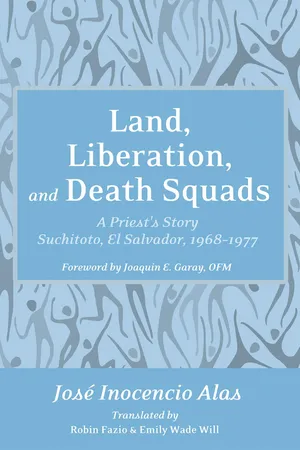
Land, Liberation, and Death Squads
A Priest's Story, Suchitoto, El Salvador, 1968–1977
- 204 pages
- English
- ePUB (mobile friendly)
- Available on iOS & Android
eBook - ePub
Land, Liberation, and Death Squads
A Priest's Story, Suchitoto, El Salvador, 1968–1977
About this book
Jose "Chencho" Alas was one of the first priests in El Salvador to found Christian Base Communities and sensitize campesinos along the lines of Medellin. This work was done in Suchitoto parish, which was subsequently hit hard during the armed conflict. Unfortunately, little has been written so far about this very important period in El Salvador.
In his book, Chencho writes about historical events of great importance in which he took a direct part, such as the first Agrarian Reform Congress; the founding of the Monsignor Luis Chavez y Gonzalez School of Agriculture; protests against construction of the Cerron Grande Dam; the creation of the first coalition of grassroots organizations, the Unified Popular Action Front (FAPU); and the first occupation of the Metropolitan Cathedral.
He recounts the conflicts he had with local and national authorities due to his defense of campesinos' rights, for which he was kidnapped and tortured.
He also relates little-known details about the martyrs Father Rutilio Grande, Father Alfonso Navarro, and the beloved Monsignor Romero.
He tells these stories with the characteristic humor of the Salvadoran people and with details only an eyewitness can remember. This makes for stimulating and enjoyable reading, besides helping readers better understand El Salvador's history, delving into the events of the 1970s, before the unfortunate armed conflict.
Information
Topic
Theology & ReligionSubtopic
Christian ChurchChapter 1
The Beginning of a Struggle
It was two o’clock in the afternoon on the first Sunday of April 1969. I was resting, taking a nap. Sundays are overwhelming in a town parish, where the first mass starts at five o’clock in the morning. I was not used to such a pace because I had spent my life in seminaries, universities, and parishes in the capital.
At that hour, someone knocked on the door, and I got up to open it. Five campesinos from San Juan canton were waiting at the entrance. With little introduction, Don Moncho said, “They have taken away our land. This year we are not going to be able to plant our corn. Dr. Miguel Ángel Quiñónez, owner of Aguas Calientes Hacienda, has thrown us off his property. This year my family, my friends and their families, and I will starve. There are five of us without land. We overcame many difficulties to prepare it and now it is ready for the May planting.”
I asked him why they had lost it and he replied, “We had signed a lease with Dr. Quiñónez giving us the right to use the land for a year. According to the contract, we had to clear the land and leave it clean so he could plant grass next year. We have done that, except for removing some tree trunks that are so thick and heavy we cannot pull them out even with a team of oxen. A tractor is needed, and we do not have one.”
In El Salvador, landowners grant the use of land in different ways. Don Moncho and his four partners had signed a contract, a simple way in which the user pays a fee for the work he wants to do on the land or per land area. “Halves” is another method. As the name suggests, expenses and earnings are split in half. Another way is for tenant farmers to cultivate plots within a farm or hacienda. This arrangement most resembles what existed during colonial times: the tenant farmer is basically a servant whose unconditional labor was purchased by the landowner giving him a place to live and grow food crops as well as a meager wage.
I asked Moncho if the five heads of households had spoken with the doctor, and he said that they had, without favorable results. The reality was that customarily the doctor rented land to peasants, always for a one-year period. When the land was ready for planting, he took it away from some of the peasants, claiming different reasons. If the tenants refused, he went to the local court, where he was powerful enough to do what he pleased. Not for nothing was he the richest man in town. In this way he had been clearing his hacienda to plant pasture to expand the area he dedicated to cattle raising.
Dr. Quiñónez, who has since died, had a long family history. He was the nephew of Alfonso Quiñónez Molina, a physician from Suchitoto who was El Salvador’s president from 1923 to 1927. His election was due to his affiliation with the conservative and criminal Meléndez dynasty. According to the New York Times Magazine, the Quiñónezes were members of the legendary Fourteen Families, who had dominated the country politically and economically.1 This explains the power Dr. Quiñónez held in Suchitoto. He was very well connected with the powerful groups in San Salvador.
I listened carefully to Moncho. His words were sincere, and they illuminated a reality, the relationship between landowners and peasants, I did not know. Many times it would fall to me to listen to the campesinos, hear their complaints, their concerns, learn of their aspirations. They were my best school for getting to know my country’s reality. The campesino’s speech is simple and heartfelt, born of life and reality, and his or her ambitions are few. Campesinos want food for their children, education, health, land to grow their corn and beans, and a little house to shelter them.
The system, the existing structure, denies them these few things. To change it is not communism, it is simple humanism; to be able to count oneself among human beings is fundamental, basic, “the vital minimum,” as the great Salvadoran essayist Alberto Masferrer said. According to Masferrer, a program offering safe and honest work; sufficient, varied, and nutritious food; adequate housing; health care and medical attention; prompt and honest justice; decent education; and rest and recreation are sufficient to guarantee the population’s welfare. To these points he added the necessity of redistributing the land or agrarian reform.2
At five that afternoon, I said the last Sunday mass. I tried to root my preaching in the lectionary, the liturgical season, and current events published by the national press. That Sunday lent itself to denouncing Dr. Quinónez’s evictions from his land and the system’s legalized injustices. I specifically mentioned, without naming, the judge who with his verdicts had benefited the city’s wealthy. One basic way of maintaining the status quo is the corruption of the judicial system. Judges easily sell themselves or simply rule in favor of those with political or economic power to avoid creating problems for themselves.
Because I was very new in Suchitoto at that time, I did not know the doctor’s wife or the magistrate. After the liturgy, I greeted some people in the atrium. I realized there was a lady who was reluctant to approach me. Well-dressed and demure, she looked like a high-society woman with a svelte, dignified appearance. I approached her, and she said, “I listened to your sermon carefully. You referred to my husband when you mentioned the land issue. My husband is not a bad man nor is he interested in expanding his cattle grazing. He can do so without involving the peasants who reported him to you. What happens is that the peasants do not like him and do not fulfill the obligations they have incurred. They want everything the easy way.” I tried to explain to the lady the campesinos’ need to raise their corn and beans and the consequences for their families if they did not do so. She did not listen and walked away from me upset.
Judge Cotto Opens a New Trial
I realized that an older man, very bald and cheerful, was listening to my conversation with the lady. After she moved away, he came over and said, “I am the justice of the peace, my name is Alfonso Cotto, and I am at your service.” He extended his hand to me. “I have not committed any violation of the law in favoring Dr. Quiñónez. The campesinos did not comply with the agreement and I had to rule against them.
“However, so that you see I am an honest and fair man, I will reopen the case in two weeks. You will receive a notice from the court appointing you as the campesinos’ ‘good man’ and I will name one for Dr. Quiñónez as well.” The term “good man,” homo bonus, was coined by Roman law. It refers to the person who during a trial intervenes with arguments in support of the accused. The judge evaluates both parties’ arguments and then decides in favor of one of them. I immediately accepted his proposal.
The two weeks prior to the new trial were ones of intense activity for me. Immediately I told the affected peasants that the case would be opened again. They thanked me. Not knowing what to do, because of lack of experience in that field, I called Francisco Díaz, in his last year of law school, so he could advise me. Francisco had participated in the cursillos de Cristiandad3 that I had founded in El Salvador during the period I worked with the Salvadoran upper class. He was always a man of social conscience, a just man, and a great gentleman.
Francisco came to Suchitoto and together we toured the doctor’s estate, located on the banks of the Quezalapa River, a few kilometers from the city. A campesino accompanied us to check the status of the land they had cleared for cultivation. Francisco had suggested I bring a camera and take some photos and I had and did. The land had been burned in the way it was customarily done in the country; all that remained were tree trunks that, being freshly cut, had not burned. They were immense. A good tractor was needed to pull them out of the ground. As we examined the place, Francisco explained my role in the trial and let me know he was coming as a consultant, not a lawyer, and would not intervene much. Primarily, this was because he had not yet graduated.
Two weeks later, a Sunday, at two in the afternoon, the trial began in a room of the Suchitoto town hall. In the morning, I realized few campesino men had come to mass. Mainly women were at church. Toward noon, the city was flooded with men with serious faces, carrying their hats. The air in the city was hot, suffocating. Soon the rains would begin, perhaps in two weeks. The May rains bring freshness, flowers, and hope for a good harvest and bread for our poor people’s tables. The rich always have their bread.
I arrived at the town hall at two on the dot; I always arrive on time in order to carry out my responsibilities. Francisco, who gave me the impression of being very nervous, accompanied me. He was still just a kid. The five peasants awaited me in the building’s hallway. The judge invited us into a poorly furnished room where he had his office. There awaited his secretary, whom some might say was in a permanent state of alcoholic preservation. A calendar hung on the wall and a few chairs were scattered in the room.
We were about to sit when Dr. Miguel Ángel Quiñónez, accompanied by his son, who studied law, and his “good man,” Mr. Carlos Henríquez, also a landowner, arrived. The doctor was a tall man, well on in years, slightly stooped, dressed in white, and leaning on a lavishly carved cane. He appeared to me a tired man. In town, he was known as “Macho Prieto,” because of his dark skin. He had served as the physician for generations of Suchitoto residents and the shadow under which most town politicians had found shelter.
The judge opened the trial with a short speech. In it, he asserted that his previous ruling was fair, but that, due to my public complaint in my sermon, he graciously saw fit to give a new opportunity to the peasants to have their “good man”—he pointed to me—defend their cause. He told us the rules of the game. The campesinos and the doctor had no right to speak, unless the judge asked them to. The “good men,” who should already know their party’s case, would present arguments in favor or against. This was my first time participating in something like this, the first time I found myself before a judge.
The judge asked me to begin with my statement because I was the most interested in the matter. I started by thanking the judge for showing interest in justice and for his kindness in bringing the case to a new trial. I spoke of the land’s importance to the peasant farmers and about their having complied with the contract’s clauses, insofar as was possible. I claimed that they deserved the opportunity to farm their plots. Mr. Henríquez did not know how to respond, and Dr. Quiñónez intervened, violating the rule established by the judge. He explained that he was not a bad or unfair man, that to avoid problems he always required his land lessees to sign a contract with clear and precise clauses about the rights and obligations of both parties. I asked him to explain which clauses the renters had violated.
The doctor told me there were basically two. First, they arrived to prepare the land using the hacienda’s roads, when they could have gone around and come in through other neighboring streets. Secondly, they had not cleared the land. Tree trunks remained that had not been burned or pulled out. As he reported this, he smiled in a way that reminded me of his nickname—the Dark Man—which was a reflection of his sarcastic and hard attitude. His words had no mercy, they did not know human solidarity, and were full of the arrogance characteristic of the large landowner.
Francisco could not take this calmly, and he asked me to show the photos. I let the doctor know that I had visited the rented hacienda plots with Francisco and one of the peasants and that I could see that the tenants had done everything in their power to comply with the contract. I was giving my speech when we heard from the street, on one side ...
Table of contents
- Title Page
- Foreword
- Acknowledgments
- Introduction
- Chapter 1: The Beginning of a Struggle
- Chapter 2: Theological Sources of the Suchitoto Ministry
- Chapter 3: A Demonstration in San Salvador
- Chapter 4: Forging Community Leaders
- Chapter 5: Land for the Campesinos and Genuine Christian Conversion
- Chapter 6: Kidnapped
- Chapter 7: The Monsignor Luis Chávez y González School of Agriculture
- Chapter 8: The Capture of Thirty-Seven ANDES Teachers
- Chapter 9: Presidential Elections
- Chapter 10: The Cerrón Grande Dam
- Chapter 11: 1974 Elections
- Chapter 12: The Unified Popular Action Front
- Chapter 13: Suchitoto: Cradle of Emerging Values
- Chapter 14: Repression Intensifies throughout the Whole Country
- Chapter 15: Monsignor Romero
- Chapter 16: My Last Days in El Salvador
- Chapter 17: Thirty Years Later
- Bibliography
Trusted by 375,005 students
Access to over 1.5 million titles for a fair monthly price.
Study more efficiently using our study tools.
Frequently asked questions
Yes, you can cancel anytime from the Subscription tab in your account settings on the Perlego website. Your subscription will stay active until the end of your current billing period. Learn how to cancel your subscription
No, books cannot be downloaded as external files, such as PDFs, for use outside of Perlego. However, you can download books within the Perlego app for offline reading on mobile or tablet. Learn how to download books offline
Perlego offers two plans: Essential and Complete
- Essential is ideal for learners and professionals who enjoy exploring a wide range of subjects. Access the Essential Library with 800,000+ trusted titles and best-sellers across business, personal growth, and the humanities. Includes unlimited reading time and Standard Read Aloud voice.
- Complete: Perfect for advanced learners and researchers needing full, unrestricted access. Unlock 1.5M+ books across hundreds of subjects, including academic and specialized titles. The Complete Plan also includes advanced features like Premium Read Aloud and Research Assistant.
We are an online textbook subscription service, where you can get access to an entire online library for less than the price of a single book per month. With over 1.5 million books across 990+ topics, we’ve got you covered! Learn about our mission
Look out for the read-aloud symbol on your next book to see if you can listen to it. The read-aloud tool reads text aloud for you, highlighting the text as it is being read. You can pause it, speed it up and slow it down. Learn more about Read Aloud
Yes! You can use the Perlego app on both iOS and Android devices to read anytime, anywhere — even offline. Perfect for commutes or when you’re on the go.
Please note we cannot support devices running on iOS 13 and Android 7 or earlier. Learn more about using the app
Please note we cannot support devices running on iOS 13 and Android 7 or earlier. Learn more about using the app
Yes, you can access Land, Liberation, and Death Squads by Jose Inocencio Alas, Fazio, Robin Fazio,Emily Wade Will in PDF and/or ePUB format, as well as other popular books in Theology & Religion & Christian Church. We have over 1.5 million books available in our catalogue for you to explore.