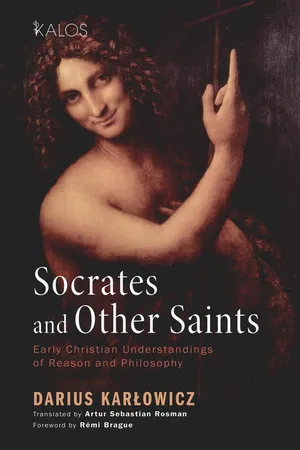
eBook - ePub
Socrates and Other Saints
Early Christian Understandings of Reason and Philosophy
- 116 pages
- English
- ePUB (mobile friendly)
- Available on iOS & Android
eBook - ePub
Socrates and Other Saints
Early Christian Understandings of Reason and Philosophy
About this book
Many contemporary writers misunderstand early Christian views on philosophy because they identify the critical stances of the ante-Nicene fathers toward specific pagan philosophical schools with a general negative stance toward reason itself. Dariusz Kar?owicz's Socrates and Other Saints demonstrates why this identification is false.
The question of the extent of humanity's natural knowledge cannot be reduced to the question of faith's relationship to the historical manifestations of philosophy among the Ancients. Kar?owicz closely reads the writings of Justin Martyr, Tertullian, Clement of Alexandria, and others to demonstrate this point. He also builds upon Pierre Hadot's thesis that ancient philosophy is not primarily theory but a "way of life" taught by sages, which aimed at happiness through participation in the divine.
The fact that pagan philosophers falsely described humanity's telos did not mean that the spiritual practices they developed could not be helpful in the Christian pilgrimage. As it turns out, the ancient Christian writers traditionally considered to be enemies of philosophy actually borrowed from her much more than we think--and perhaps more than they admitted.
Information
Topic
Theology & ReligionSubtopic
Ancient & Classical Philosophy1
Whose Athens, Which Jerusalem?
Neither Damned, Nor Saints
Dante gave the ancient philosophers their own place in the afterlife according to his own set of criteria. Limbo is a strange quasi-hell, a comfortable ante-chamber, “an opening luminous and lofty,”1 where the philosophers stroll upon a green meadow along with the souls of prophets, ancient heroes, and innocent unbaptized children. Even if they lived sinless lives and achieved much deserved fame, the unbaptized state of the philosophers prevents them from crossing the threshold of heaven and so they spend their ambivalent afterlives in a hellish Arcadia.2 The positive valuation of philosophy, if it wants to remain Christian, cannot go any further without difficulty. If we do not want to usurp the prerogative of dispensing divine mercy then an empty hell can only be an object of our hope, but never a certainty of our faith. Dante and Erasmus both knew this well, especially since the latter built a fence of reservations around his famous beatification of Socrates.3 Christ is the principle of Christian identity and that is why the problem of salvation outside of Christ, outside of his teaching and sacrifice, is a critical boundary for Christian theology.
However, we should remember that not all Christian thinkers perceived the problem of the salvation of ancient philosophers as something that made them lose sleep. The contempt showered upon pagan sages by thinkers of the caliber of Peter Damian aptly illustrates the range of stances toward philosophy. The picture of noble pagans who march through Elysian Fields to the rhythm of a Dantesque terza rima is just one of the many possible answers to the problem of how philosophy relates to revelation. Yet, as suggested by its peculiarity, this might be an especially telling sign of the complicated relations between Athens and Jerusalem, a problem which too often falls prey to tempting oversimplifications.
Juliusz Domański is correct in warning against forcing Christian attitudes toward philosophy into simple binaries.4 Too often the descriptions of patristic attitudes toward Greek wisdom all too willingly apply the schema of, on the one hand, the party of the sworn enemies of philosophy, and on the other hand, the party of the faithful friends of philosophy. The work of Marcel Simon can serve as one example, out of many, of this tendency. He sets up Justin Martyr as a symbol of the tendency to harmonize, whereas Tertullian is labeled as a representative of anti-philosophical radicalism.5 But are not such categories wrongheaded? Actually, there is a grain of truth to them. Therefore, the task of the historian who would attempt to precisely delineate the exact principles for discriminating the relationship between theology and philosophy is truly unenviable! Should the guiding principle be the extent and number of Greek quotations, or official declarations of affinity, or the actual fervor for utilizing the heritage of the pagans? Are hidden sympathies more important than involuntary borrowings? We should also ask why the masked Stoicism of Tertullian is less “philosophical” than the ostentatious Platonism of Justin? It would be easy to multiply these types of questions without end. That is not all, the confusion will only multiply if a scholar wants to utilize this dichotomy to demonstrate an “inevitable antagonism” between faith and reason—understood as a supra-historical conflict, that is, independent of the concepts specific to late antiquity.6
The Problem of a Pure Christianity
The debate is much more heated than what one would expect given the amount of time separating us from the early church fathers. Is it any wonder? The debate is not about moldy ideas when salvation is at stake. The debate is about whether ties with philosophy poisoned the wells of the Christian tradition. Can we say the diseases of Hellenism were deadly to the life-giving truths of Christ’s teaching? These questions cannot be indifferent to Christians. Searching for their resolution directs us into the stream of history. But can we really answer them while using historical tools? We should remember that certain ways of addressing these questions have a way of pigeonholing the historian into the stance of a theologian, if not a prophet, of the revelation that they encounter through their studies.
At the very least since the Reformation laymen have looked with suspicion upon the philosophical robes of Rome. The waning influence of the ancients caused the following questions to emerge: Did the fathers betray revelation when in Chalcedon, or perhaps as early as Constantinople, they expressed the Christian faith with categories borrowed from Greek philosophy, categories not present in the Gospels? Was revelation betrayed by philosophers who only passed for Christians? It is enough to listen to what Martin Luther thinks about it to understand that this debate is about the relevance of the tradition of the ancients.7
The name of Adolf Harnack is synonymous with twentieth-century debates about the relationship of philosophy to Christianity. In his seminal work, What is Christianity?, Harnack argued that the Christian tradition was effectively Hellenized, and he understood this as a falsification of revelation’s core.8 According to Harnack, the categories of ancient philosophers became the constitutive elements of Catholic dogmatics to the detriment of revealed truth’s purity.9 The biggest controversies surrounding Harnack’s position did not exclusively concentrate upon the influence of Greek thought in the shaping of Christian tradition. They also concentrated around Harnack’s somewhat arbitrary boundary of how much Hellenization is permissible for revelation. It seems that his historical discussion came to be defined by certain a priori categories that were unjustifiable on purely historical grounds, even though Harnack appeared to be only concerned with the field of history. It seems that the fervor of his discussion obscured the boundary between historical description and its theological or philosophical interpretation.
It is obvious that revelation, at least to a certain degree, is relativized by the language and culture in which it is expressed. Even the radical other-worldliness of Christianity cannot become a supra-cultural phenomenon. In order to understand the difficulty of establishing restrictive boundaries for the tradition it is enough to recall the choice of the term logos as a Johannine theological category, or that the good news was delivered to the world in the native Greek of the philosophers.10 What historical instruments are available to permit us to establish a clear boundary separating the Hellenization undertaken by Saints Paul and John from those of Justin Martyr?
It would do us well to remember that the first step toward the Hellenization of Christianity was taken long before Christ came into the world, that is, in the work of Hellenization undertaken by the Alexandrian diaspora. After all, the Alexandrian translation of the Pentateuch into the language of Zeno and Plato could not avoid utilizing terminology that had a long history of philosophical usage. The historian can point to the sources and changes of meanings, but we must remember that these tools cannot verify the fact of divine inspiration. The legend about the independent and identical translation of the Bible by seventy-two scholars, which sanctions and baptizes the terminological decisions taken by the translators of the Pentateuch, is beyond the reach of historical criticism. History and literary criticism are obviously very important aids in the study of the Scriptures and revelation. History can equip the theologian with very important information, however, the question of faith’s veracity, or, an evaluation of faith’s sources, lies beyond its competence. Christian dogmatics have always considered tradition, besides the Scriptures, to be just such a source, one that comes into being through the inspiration of the Holy Spirit. All who desire to undermine the authenticity of tradition with the help of historical tools take up an entirely vain and cumbersome labor. One cannot derive the criteria of judgment from outside the texts themselves without the risk of falling into a vicious hermeneutic circle. This is why even though Harnack’s contribution brought many lively elements into the discussion about the historical dimensions of Christian doctrine, it also led to the insight that the tools of the historian can aid theology, but cannot replace it.11 The historian is not called to unravel dogmatic questions, because those who speak about orthodoxy are no longer historians, they are theologians. It is obvious that a Christianit...
Table of contents
- Title Page
- Foreword
- Primary Source Abbreviations
- Introduction
- Chapter 1: Whose Athens, Which Jerusalem?
- Chapter 2: What do Athens and Jerusalem Have in Common?
- Chapter 3: How Much Wisdom Is There in Philosophy?
- Chapter 4: Selection and Adaptation
- Conclusion
- Bibliography
Trusted by 375,005 students
Access to over 1.5 million titles for a fair monthly price.
Study more efficiently using our study tools.
Frequently asked questions
Yes, you can cancel anytime from the Subscription tab in your account settings on the Perlego website. Your subscription will stay active until the end of your current billing period. Learn how to cancel your subscription
No, books cannot be downloaded as external files, such as PDFs, for use outside of Perlego. However, you can download books within the Perlego app for offline reading on mobile or tablet. Learn how to download books offline
Perlego offers two plans: Essential and Complete
- Essential is ideal for learners and professionals who enjoy exploring a wide range of subjects. Access the Essential Library with 800,000+ trusted titles and best-sellers across business, personal growth, and the humanities. Includes unlimited reading time and Standard Read Aloud voice.
- Complete: Perfect for advanced learners and researchers needing full, unrestricted access. Unlock 1.5M+ books across hundreds of subjects, including academic and specialized titles. The Complete Plan also includes advanced features like Premium Read Aloud and Research Assistant.
We are an online textbook subscription service, where you can get access to an entire online library for less than the price of a single book per month. With over 1.5 million books across 990+ topics, we’ve got you covered! Learn about our mission
Look out for the read-aloud symbol on your next book to see if you can listen to it. The read-aloud tool reads text aloud for you, highlighting the text as it is being read. You can pause it, speed it up and slow it down. Learn more about Read Aloud
Yes! You can use the Perlego app on both iOS and Android devices to read anytime, anywhere — even offline. Perfect for commutes or when you’re on the go.
Please note we cannot support devices running on iOS 13 and Android 7 or earlier. Learn more about using the app
Please note we cannot support devices running on iOS 13 and Android 7 or earlier. Learn more about using the app
Yes, you can access Socrates and Other Saints by Dariusz Karlowicz, Rosman, Artur Sebastian Rosman in PDF and/or ePUB format, as well as other popular books in Theology & Religion & Ancient & Classical Philosophy. We have over 1.5 million books available in our catalogue for you to explore.