eBook - ePub
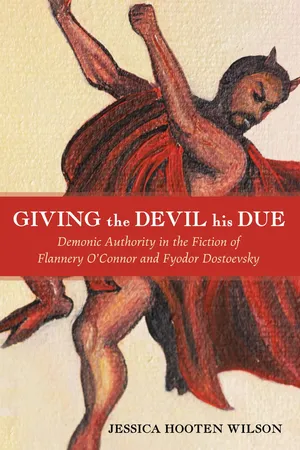
Giving the Devil His Due
Demonic Authority in the Fiction of Flannery O’Connor and Fyodor Dostoevsky
- 156 pages
- English
- ePUB (mobile friendly)
- Available on iOS & Android
eBook - ePub
Giving the Devil His Due
Demonic Authority in the Fiction of Flannery O’Connor and Fyodor Dostoevsky
About this book
Flannery O'Connor and Fyodor Dostoevsky shared a deep faith in Christ, which compelled them to tell stories that force readers to choose between eternal life and demonic possession. Their either-or extremism has not become more popular in the last fifty to a hundred years since these stories were first published, but it has become more relevant to a twenty-firstt-century culture in which the lukewarm middle ground seems the most comfortable place to dwell. Giving the Devil His Due walks through all of O'Connor's stories and looks closely at Dostoevsky's magnum opus The Brothers Karamazov to show that when the devil rules, all hell breaks loose. Instead of this kingdom of violence, O'Connor and Dostoevsky propose a kingdom of love, one that is only possible when the Lord again is king.
Information
Topic
LetteraturaSubtopic
Critica letterariaChapter 1
Using Suffering to Protest God’s Authority
Flannery O’Connor privileges her 1961 introduction to A Memoir of Mary Ann as possessing secrets for unlocking her fiction: “In the future, anybody who writes anything about me is going to have to read everything that I have written in order to make legitimate criticism, even and particularly the Mary Ann piece.”82 The memoir is a collection of anecdotes by Dominican nuns that recounts the short life of Mary Ann, a child with terminal cancer. While O’Connor’s claim may seem too large for such a small piece, in this introduction, she establishes the crux of her thoughts on suffering and the mercy of God. The scandal of her piece lies in her contention that those most vehement against violence may be the very perpetuators of it. In the only direct allusion to Dostoevsky in her published work, O’Connor marks Ivan Karamazov as the rebel who, on the basis of human justice, dethrones God:
One of the tendencies of our age is to use the suffering of children to discredit the goodness of God, and once you have discredited His goodness, you are done with Him. . . . Ivan Karamazov cannot believe, as long as one child is in torment. . . . In the absence of this faith now, we govern by tenderness. It is a tenderness which, long since cut off from the person of Christ, is wrapped in theory. When tenderness is detached from the source of tenderness, its logical outcome is terror. It ends in forced labor camps and in the fumes of the gas chamber.83
In this brief paragraph, O’Connor denounces the foundation of Ivan’s protest, his love for suffering children, as theoretical and insubstantial. She uses him as a prototype of those who rationalize away God’s existence, and thus leave us without a source for genuine love. In God’s absence, we create our own versions of love, what Dostoevsky’s Father Zosima calls “love in dreams” and what O’Connor labels tenderness “wrapped in theory.” Establishing himself by default as the paragon of goodness, Ivan unwittingly opens the door to further immorality. This paragraph is packed with complicated ideas about O’Connor’s theodicy, which she attempts to unveil in the character of Rayber, her own version of Ivan Karamazov, in her second novel The Violent Bear It Away. By comparing the two characters, we can trace how O’Connor may draw a line from Ivan’s atheistic dissent from God to the horrors of the Holocaust.
While Dostoevsky may not be conflated with his character, Ivan does present the argument that Dostoevsky believed was the greatest against God’s goodness. “My hero chooses a theme I consider irrefutable: the senselessness of children’s suffering,” Dostoevsky writes. However, they differ in that Ivan “develops from it the absurdity of all historical reality.”84 In contrast to Ivan, Dostoevsky hoped to show how to live as a Christian in the face of suffering.85 Yet, his motivation was not drawn from some abstract place apart from the reality of pain and sadness but from experiencing it himself. In 1878, shortly before Dostoevsky began to write The Brothers Karamazov, his three-year-old son Alyosha died in an epileptic fit. Following the funeral, Dostoevsky retreated to Optina Pustyn monastery. This was the second child that Dostoevsky had lost, but this death caused him greater suffering than he had previously known.86 His wife Anna Grigoryevna writes, “My husband was crushed by this death. He had loved Alyosha somehow in a special way, with an almost morbid love. . . . What racked him particularly was the fact that the child had died of epilepsy—a disease inherited from him.”87 Weighted by sorrow and emotional guilt over his child’s death, Dostoevsky commenced writing The Brothers Karamazov. Rather than composing a novel that glosses over suffering or presents an easy answer to the problem, Dostoevsky lends the stage to Ivan and allows him to dispute God’s goodness.
Likewise, O’Connor could have used her suffering to object to the design of God’s world. Diagnosed with lupus at age twenty-five, O’Connor returned to her mother’s home in Georgia to spend the next fourteen years on crutches and constantly in the hospital or undergoing surgery. As the disease began to set in, she quips (March 17, 1953), “I can with one eye squinted take it all as a blessing.”88 But, near the end of her life, she laments (May 28, 1964), “I am sick of being sick.”89 Although she must strain to see the good, O’Connor does not reject God’s goodness. She came to affirm her ironic blessing, as she writes (June 28, 1956): “Sickness before death is a very appropriate thing and I think those who don’t have it miss one of God’s mercies.”90 O’Connor does not sugarcoat the suffering that she went through, nor does she sanitize the problem of violence in her work. In her fiction, she confronts difficult passages from the Bible, such as Herod’s slaying of hundreds of newborns, and recent examples of violence that are completely irrational, such as Auschwitz. With an “unsentimental eye of acceptance,” she still chooses faith in Christ.91
Protest on Behalf of the Suffering Innocent
Ivan Karamazov is famous for his rebellion against God. In The Brothers Karamazov, Ivan is a sulky man in his early twenties who has said very little, though much has been said about him. His ideas, which will be further explicated later on, have caused quite a stir among the intelligentsia. The narrator calls him a “genius” who has a notable “unusual and brilliant aptitude for learning”92 and exhibits “practical and intellectual superiority over that eternally needy and miserable mass of our students.”93 The irony in this tone hints at Ivan’s perception of his intellectual gifts, perhaps to a fault. From his youth, Ivan receives high marks in school, and, at university, he publishes articles in journals. He gains a reputation for his learning, esteeming himself for his intellectual accomplishments as much as the outside world does.
In her second novel, O...
Table of contents
- Title Page
- Acknowledgements
- Introduction
- Chapter 1: Using Suffering to Protest God’s Authority
- Chapter 2: The Death of God and the Kingdom of Violence
- Chapter 3: The Demonic Authority of the Autonomous Self
- Conclusion: Imitating the Son and the Kingdom of Love
- Bibliography
Trusted by 375,005 students
Access to over 1.5 million titles for a fair monthly price.
Study more efficiently using our study tools.
Frequently asked questions
Yes, you can cancel anytime from the Subscription tab in your account settings on the Perlego website. Your subscription will stay active until the end of your current billing period. Learn how to cancel your subscription
No, books cannot be downloaded as external files, such as PDFs, for use outside of Perlego. However, you can download books within the Perlego app for offline reading on mobile or tablet. Learn how to download books offline
Perlego offers two plans: Essential and Complete
- Essential is ideal for learners and professionals who enjoy exploring a wide range of subjects. Access the Essential Library with 800,000+ trusted titles and best-sellers across business, personal growth, and the humanities. Includes unlimited reading time and Standard Read Aloud voice.
- Complete: Perfect for advanced learners and researchers needing full, unrestricted access. Unlock 1.5M+ books across hundreds of subjects, including academic and specialized titles. The Complete Plan also includes advanced features like Premium Read Aloud and Research Assistant.
We are an online textbook subscription service, where you can get access to an entire online library for less than the price of a single book per month. With over 1.5 million books across 990+ topics, we’ve got you covered! Learn about our mission
Look out for the read-aloud symbol on your next book to see if you can listen to it. The read-aloud tool reads text aloud for you, highlighting the text as it is being read. You can pause it, speed it up and slow it down. Learn more about Read Aloud
Yes! You can use the Perlego app on both iOS and Android devices to read anytime, anywhere — even offline. Perfect for commutes or when you’re on the go.
Please note we cannot support devices running on iOS 13 and Android 7 or earlier. Learn more about using the app
Please note we cannot support devices running on iOS 13 and Android 7 or earlier. Learn more about using the app
Yes, you can access Giving the Devil His Due by Jessica Hooten Wilson in PDF and/or ePUB format, as well as other popular books in Letteratura & Critica letteraria. We have over 1.5 million books available in our catalogue for you to explore.