eBook - ePub
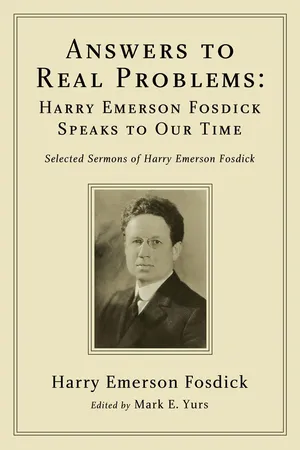
Answers to Real Problems: Harry Emerson Fosdick Speaks to Our Time
Selected Sermons of Harry Emerson Fosdick
- 234 pages
- English
- ePUB (mobile friendly)
- Available on iOS & Android
eBook - ePub
Answers to Real Problems: Harry Emerson Fosdick Speaks to Our Time
Selected Sermons of Harry Emerson Fosdick
About this book
Harry Emerson Fosdick (1878-1969) was one of the most influential preachers in the twentieth century. He believed every sermon ought ask and answer some question that genuinely troubles individuals or the societies of which they are a part.
Answers to Real Problems gathers several significant sermons from Fosdick's long ministry. The selection is rooted in current needs. This collection presents him asking and answering questions that still weigh--or ought to weigh--on the minds of people today. Here is one of America's finest preachers talking about war, nationalism, the relationship between liberals and conservatives, the plight of the church, public ethics, private morality, and more.
Information
Topic
Theology & ReligionSubtopic
Christian Ministry1
The Hope of the World in Its Minorities1
One of the most arresting statements recently made by a public man was made by Mr. Einstein when he said that if two per cent of our population should take a personal, resolute stand against the sanction and support of another war, that would end war. Whether or not this estimate of Mr. Einstein’s is as accurate as his cosmic mathematics, I presume no one of us can say, but there is no doubt about the historical evidence on which the principle of his judgment rests.
The creative ideas destined to remake society have always been the possession of the minority. History has depended, not on the ninety-eight per cent, but on the two per cent. Far from being a matter of sociological and political interest alone, this principle gave Christianity its start. When the Master in Palestine began calling out his first disciples from the mass of their countrymen, he was interested not in quantity but in quality—in seed, though but a few kernels, which, if carefully sown, might multiply itself. He was thinking not primarily of the ninety-eight per cent but of a germinal two per cent. To use his own figure in the thirteenth chapter of Matthew’s Gospel: “The kingdom of heaven is like unto leaven, which a woman took, and hid in three measures of meal, till it was all leavened.” Quantitatively small, vitally active leaven—that is a true simile of the method of Christianity’s transformation of the world.
But is Christianity working like that now? Take the measure of our American churches. Are we the germinal two per cent on which the future of mankind depends? Are we the little group of forward-looking men and women on whom, as on the first disciples of our Lord, has fallen the vision of a new world-order so that we are custodians of prophetic principles that shall remake society? Are we the minority ready to sacrifice fame or fortune or life itself for those ideas which shall some day permeate mankind with their healing and their truth?
You see, we do not answer to that description. Too frequently forgetting the mission that the Master left us and the way of working he committed to us, we have become a majority movement standing for the status quo, so that many are even startled when they hear a man like Mr. Einstein say that if two per cent should take a personal, resolute stand against war it would mean the end of war. What if, however, something like that is true? What if the future of mankind is in the hands of a minority? What if a little leaven hid in three measures of meal can leaven the whole?
There is no need of elaborating the historical evidence regarding this matter. In every realm the pathfinders have been few and the truths that at last triumphed were at first the possession of a minority. We all know that, but in our thought and life are certain factors which frequently prevent the full force of it from reaching us.
For one thing, we live in a democracy, where the only way of carrying on public business is to accept the voice of the majority. In consequence, the notion naturally prevails that the majority in the end probably is right and that, anyway, the majority rules. But neither of those ideas is true. The majority is almost certain to be wrong on any matter of fine taste or sound judgment, and, whether or not the majority is right, it certainly does not rule. The dominant influence in every situation is a militant minority. The decision of public policy in this country now is largely determined by resolute, militant, compact, closely organized minorities that want something and get it.
Look at this city. Is Tammany Hall a majority? Upon the contrary, it is a self-seeking, highly organized minority and it runs the metropolis. The majority are apathetic, careless, attending to their own business, not the city’s, with no very strong convictions one way or the other, and that gives a resolute minority its chance. There is no use fooling ourselves that the majority rules. The United States today is ruled by organized minorities.
If, therefore, at first some were inclined to think that the doctrine of the two per cent is impractical idealism, let us disabuse our minds of that supposition. The serious truth is that the controlling power of the minority, so far from being impractical idealism, is most practical politics. Even in a democracy the minority rules.
The full force of this truth which Jesus puts into his figure of the meal and the leaven is deflected from many modern minds also by our inveterate habit of romanticizing history. When we start in to glorify our ancestors for some outstanding achievement, such as, for example, the winning of the American Revolution, we make a thorough job of it and glorify all our ancestors. What a splendid outpouring of cooperative and unanimous zeal it was, we think, that all those colonists put their lives, their fortunes, their sacred honor at the disposal of the cause! That sounds splendid but there is not a word of truth in it. There were probably more Tories than Revolutionists among the colonists and more than either were the men who see-sawed back and forth, who stood first on one side, then on the other, who had no strong convictions either way, and only hoped they were betting right on who was going to win. I venture that more than one family is represented here this morning who wanted to join the Sons or Daughters of the Revolution and so looked up their ancestors—and have kept still about it ever since.
The Revolutionary War was won, the government established, and the Constitution put in force by a compact, highly intelligent, loyal minority. Do you remember John Adams’ apostrophe to his posterity? “Posterity! you will never know how much it cost the present generation to preserve your freedom! I hope you will make a good use of it. If you do not, I shall repent it in heaven that I ever took half the pains to preserve it.”
Such is the situation with every gain humanity ever made. It was the two per cent who fought for popular education, for religious liberty, for freedom of scientific research, against the majority. Always the majority has been dough, the few have been leaven; so that out of history there rises an admonition—in any cause that concerns the progress of mankind, put your faith in the creative minorities!
Again, this truth of Jesus is deflected from many modern minds because of our worship of bigness. One of my friends calls it “Jumboism.” Especially in this country many people are impressed by nothing that is not big—big cities, big buildings, big corporations. We all are tempted to worship size. But size is an utterly fallacious standard when we are trying to estimate power. Could any one, at the height of Rome’s colossal power, have thought of anything much smaller than Paul in a Roman prison writing his few letters? But the result! Whoever would have dreamed that that little man with his brief epistles would dig down so deeply, take hold so strongly, penetrate so powerfully the thoughts and motives of men? The things that are big are utterly misleading as to the location of the ideas that are powerful.
We have in our modern time a vivid illustration of this truth. Whatever else we may think about it, there are few more dramatic incidents in mankind’s history than Gandhi confronting the British Empire. The greatest empire in history stands over against one man trying to make terms with him, while he will not fight with outward weapons, is ready to die if his followers use violence, and employs nothing but the ideas of a minority and a certain quality of soul to set them aflame. There are few things that we American Christians need much more to learn than the lesson of that. Bigness is not power. Power is in the ideas to which the future belongs, and they always have been the possession, not of the ninety-eight per cent, but of the two per cent.
Looked at from one angle, this truth is encouraging. When one thinks of the causes that are on our hearts today,—peace rather than war, industrial welfare rather than this desperate situation we are in, better education for the nation’s children, or whatever it may be,—we should welcome the good news that we do not have to wait for the majority. Whenever a true idea is born and a creative minority rallies around it, there is the beginning of victory. That is encouraging and it is true. It is not, however, a truth to go to sleep on. We Christians were intended to be that minority. We were to be the salt of the earth, said Jesus. We were to be the light of the world. We were to be the leaven in the lump of the race. There is no possibility of misunderstanding his meaning, my friends. When a man becomes a real Christian he is supposed to move over into that small, creative, sacrificial minority seized upon by visions of a better world and standing for them until they shall permeate mankind with their truth. That does make being Christian serious business! That is more than believing in a creed. That is more than partaking of the sacraments. That is more than the comfort of worship or the use of beauty as a road to God. That is joining the real church in the original Greek meaning of the word “church,” ecclesia—called out—a minority selected from the majority to be leaven.
Only as we succeed in getting more Christians like that will power return to the Christian movement. When was Christianity the most powerful? Shall we select some scene like that at Canossa, when the Pope bestrode Europe with his rule and even an emperor waited three days in the snow at his doorsill begging for audience and pardon? That seems powerful, yet even a scene like that, when time has worn its meaning off, loses its glamour. There was a time, however, when Christianity was very powerful. Little groups of men and women were scattered through the Roman Empire—“not many mighty,” said Paul, “not many noble.” They were far less than two per cent and the heel of persecution was often on them, but they flamed with a conviction that they represented truths to which the future belonged.
Do you remember what Paul called them in his letter to the Philippians? “We are a colony of heaven,” he said. The Philippian Christians would understand that figure, for their city of Philippi was a Roman colony. When Rome wanted to Romanize a new province, it took Roman people and planted them as a colony in the midst of it. There, as a powerful minority, they stood for Roman law, Roman justice, Roman faith, and Roman custom, leaven in the lump of the province, until the whole province was leavened. Rome understood the art of government. When, therefore, Paul said to that little group of Philippian Christians, “We are a colony of heaven,” they understood. They were a minority thrown out, as pioneers, in the midst of an unchristian world to represent the ideals, faiths, and way of living of a nobler realm until the earth should be the Lord’s and the fulness thereof.
In those days Christianity was very powerful. It stopped ancient curses like infanticide. It put an end to the bloody shambles of the gladiatorial shows. It laid hold on an old polytheism that had been glorified in literature, extolled in art, established in custom, and supported by government, and ended it in the interests of one God revealed in Christ. Then Christianity was very powerful. It was a minority movement with nothing to lose, with everything to gain, joining which a man pledged his very life as a forfeit. At last it became so powerful that it captured the Empire, entrenched itself in wealth and worldly prestige, stopped challenging the world, began compromising with the world, and never again, I fear, on so vast a scale has exhibited such creative, superhuman power.
Let us, therefore, for our own sakes and for the sake of our generation, see if we can recover even a little the meaning of that saying of Jesus, “The kingdom of heaven is like unto leaven, which a woman took, and hid in three measures of meal, till it was all leavened.”
In the first place, this clearly applies to our churches themselves. Not infrequently one is asked in these days whether or not one believes in the church. Just what is meant by the “church” in that question? These sectarian organizations that carry over from old political quarrels and theological debates denominational divisions that have no pertinency to modern life—are they the church? These sects so often splitting and overlapping their labor in our American communities, absorbed in their self-maintenance until they hardly think of the real issues on which the future of mankind depends, so that the best citizens often feel that they must pull up the church rather than be pulled up by it—are they the church? And by having faith in the church does one mean that he stakes his hope of the future of the race upon this inherited network of denominational organizations? Then let an honest answer be given: How can a man believe in the church?
My own faith is not in these formal organizations. Personally, I think most of them will have to die. Their lines of division and their points of emphasis have no just claim upon contemporaneous interest even, much less on permanency. My faith is in the church within the churches, the two per cent, the spiritual leaven, the inner group of men and women who have been genuinely kindled by Christ’s spirit and are today living and thinking above the average and ahead of the time. Always the real church has been not the dough of the mass but the leaven of the few.
As for these formal organizations, let not the lesson of Russia be forgotten. The Greek Church in Russia allied itself with the status quo. It surrendered its prophetic mission and became the religious right arm of the most despotic government on earth and, becoming thus the defender and ally of a political and social régime that could not last, it went out with the system it was tied to. Religion is not dead in Russia. It will not die. Though it seems to die, it will have its resurrection day. But the church as a whole could not save it. Once more in Russia history will have to repeat itself—a little leaven beginning again to work in three measures of meal. My friends, whether by violence or by slow starvation, that is the fate of every ecclesiastica...
Table of contents
- Title Page
- Introduction
- Chapter 1: The Hope of the World in Its Minorities
- Chapter 2: Christianity at Home in Chaos
- Chapter 3: Handling Life’s Second-Bests
- Chapter 4: The Peril of Worshiping Jesus
- Chapter 5: Making the Best of a Bad Mess
- Chapter 6: The Use and Misuse of Power
- Chapter 7: The Unknown Soldier
- Chapter 8: Let’s All Be Realistic
- Chapter 9: The Ghost of a Chance
- Chapter 10: Every Man’s Religion His Own
- Chapter 11: What Is Our Religion Doing to Our Characters?
- Chapter 12: On Being Christians Unashamed
- Chapter 13: The Church Must Go Beyond Modernism
- Chapter 14: Why Worship?
- Chapter 15: An Appeal from the Present to the Future
- Chapter 16: Giving the Highest a Hearing
- Chapter 17: The Modern World’s Rediscovery of Sin
- Chapter 18: The God Who Made Us and the Gods We Make
- Chapter 19: God Talks to a Dictator
- Chapter 20: The Return to Discipline
- Chapter 21: The Decisive Babies of the World
- Chapter 22: A Great Time to Be Alive
- Chapter 23: On Being Fit To Live With
- Chapter 24: Standing by the Best in an Evil Time
- Chapter 25: Finding God in Unlikely Places
- Chapter 26: Conservative and Liberal Temperaments in Religion
- Chapter 27: A Religion to Support Democracy
Trusted by 375,005 students
Access to over 1.5 million titles for a fair monthly price.
Study more efficiently using our study tools.
Frequently asked questions
Yes, you can cancel anytime from the Subscription tab in your account settings on the Perlego website. Your subscription will stay active until the end of your current billing period. Learn how to cancel your subscription
No, books cannot be downloaded as external files, such as PDFs, for use outside of Perlego. However, you can download books within the Perlego app for offline reading on mobile or tablet. Learn how to download books offline
Perlego offers two plans: Essential and Complete
- Essential is ideal for learners and professionals who enjoy exploring a wide range of subjects. Access the Essential Library with 800,000+ trusted titles and best-sellers across business, personal growth, and the humanities. Includes unlimited reading time and Standard Read Aloud voice.
- Complete: Perfect for advanced learners and researchers needing full, unrestricted access. Unlock 1.5M+ books across hundreds of subjects, including academic and specialized titles. The Complete Plan also includes advanced features like Premium Read Aloud and Research Assistant.
We are an online textbook subscription service, where you can get access to an entire online library for less than the price of a single book per month. With over 1.5 million books across 990+ topics, we’ve got you covered! Learn about our mission
Look out for the read-aloud symbol on your next book to see if you can listen to it. The read-aloud tool reads text aloud for you, highlighting the text as it is being read. You can pause it, speed it up and slow it down. Learn more about Read Aloud
Yes! You can use the Perlego app on both iOS and Android devices to read anytime, anywhere — even offline. Perfect for commutes or when you’re on the go.
Please note we cannot support devices running on iOS 13 and Android 7 or earlier. Learn more about using the app
Please note we cannot support devices running on iOS 13 and Android 7 or earlier. Learn more about using the app
Yes, you can access Answers to Real Problems: Harry Emerson Fosdick Speaks to Our Time by Harry Emerson Fosdick, Mark E. Yurs, Yurs in PDF and/or ePUB format, as well as other popular books in Theology & Religion & Christian Ministry. We have over 1.5 million books available in our catalogue for you to explore.