- 146 pages
- English
- ePUB (mobile friendly)
- Available on iOS & Android
eBook - ePub
About this book
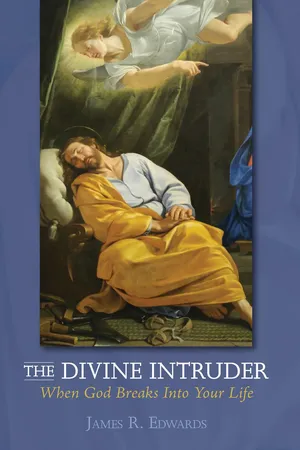
James Edwards believes God is in the business of interrupting lives and changing them forever. He shows how the stories of eight biblical characters are paradigms for the ways God intrudes in our lives today, leading us to do His will and become the people He wants us to be.
Through creatively told Bible stories and intriguing anecdotes of personal experiences, Edwards creates an interplay between the historical and the contemporary that allows you to discover God afresh. You'll observe how God interrupts people's lives in times of disillusionment, inadequacy, grief, and even opposition. As you join these conversations, you'll understand God's character in a new, intimate way. And, you may see clues to God's interruptions in your own life.
Trusted by 375,005 students
Access to over 1.5 million titles for a fair monthly price.
Study more efficiently using our study tools.
Information
Topic
Theology & ReligionSubtopic
Biblical Studies1
Disillusionment with God
The Lord appeared to Abraham near the great trees of Mamre while he was sitting at the entrance to his tent in the heat of the day. Abraham looked up and saw three men standing nearby. When he saw them, he hurried from the entrance of his tent to meet them and bowed low to the ground.
He said, “If I have found favor in your eyes, my lord, do not pass your servant by. Let a little water be brought, and then you may all wash your feet and rest under this tree. Let me get you something to eat, so you can be refreshed and then go on your way—now that you have come to your servant.”
“Very well,” they answered, “do as you say.”
So Abraham hurried into the tent to Sarah. “Quick,” he said, “get three seahs of fine flour and knead it and bake some bread.”
Then he ran to the herd and selected a choice, tender calf and gave it to a servant, who hurried to prepare it. He then brought some curds and milk and the calf that had been prepared, and set these before them. While they ate, he stood near them under a tree.
“Where is your wife Sarah?” they asked him.
“There, in the tent,” he said.
Then the Lord said, “I will surely return to you about this time next year, and Sarah your wife will have a son.”
Now Sarah was listening at the entrance to the tent, which was behind him. Abraham and Sarah were already old and well advanced in years, and Sarah was past the age of childbearing. So Sarah laughed to herself as she thought, “After I am worn out and my master is old, will I now have this pleasure?”
Then the Lord said to Abraham, “Why did Sarah laugh and say, ‘Will I really have a child, now that I am old?’ Is anything too hard for the Lord? I will return to you at the appointed time next year and Sarah will have a son.”
Sarah was afraid, so she lied and said, “I did not laugh.”
But he said, “Yes, you did laugh.”
—Genesis 18:1-15

Abraham is sitting in the doorway of his tent at midday, thinking. He wishes his life had turned out differently. A sinking disillusionment settles in his stomach as he realizes that he is old. The ideals and hopes of earlier years have passed him by.
According to custom older than memory itself, he has positioned his tent a few paces away from the trade route. The place is Hebron, a caravan junction where a few oaks huddle near the west side of a plain surrounded by a semicircle of hills. Northward, in the direction of Damascus, is Abraham’s birthplace, Ur of the Chaldees. To the south lie Beersheba and the Sinai desert. Abraham is looking not to the north or south, however, but to a point not found on the compass: he is looking to the past.
For the ten-thousandth time, he is pondering the ways of the Almighty. Abraham had become a wanderer late in life—not because he was a nomad in the true sense of the word, but because he believed God had called him to such a life. Compared to cosmopolitan Ur, the places he now frequented—Hebron, Ziph, Gerar—were as nothing. Never would he have chosen such a desolate existence had he not a burning conviction that his migration to Canaan was God’s will. In his younger years, perhaps, the prospect of sojourning in Canaan might have held a certain fascination for him. But in his mature years, his wanderings were the result of obedience to a divine imperative rather than a choice on his part. For reasons that were no longer clear—if they ever had been—Abraham’s life had taken turns quite at odds from what he had once been, from what he would have chosen. To receive a great name, to become a great people, to inherit a great land—this was his and Sarah’s destiny.
Or rather, that had been their destiny, withered now by long years of unfulfillment. In bitter moments, Abraham doubted whether the Almighty had called him at all, perhaps even whether the Almighty existed. But whenever he replayed his life’s story as he now did from the doorway of his tent, the presence of God was there. Undeniably, his destiny was not his choice but God’s promise, made before he ever set foot on the mountains and valleys, the crags and oases of Canaan. Still, the terrible dilemma of faith remained. Could Abraham trust the promise of God that kept repeating itself in his existence, or would he succumb to the obvious evidence of his own advancing age and Sarah’s inability to bear children?
His experience was a riddle. It was like coming to an impasse in a maze, or groping in the dark for something that could not be found. The riddle was the more perplexing because in everything the Almighty had been faithful . . . except in the one thing that mattered most: the birth of a son, an heir to the promise. Abraham and Sarah could surely be forgiven if on occasion they had resorted to scheming in order to help God make good on his promise. Sometimes it seemed that they, mere mortals, might be more effective in fulfilling the promise than the Almighty. What could be wrong with meeting God halfway? With proposing Eliezer, steward of Abraham’s house, to fulfill the role of a son, for example? Or with Abraham’s fathering a child through Sarah’s maid, Hagar? But all their stratagems failed, for God was intractable and would accept no surrogate sons. The impasse of God’s unfulfilled promise loomed ever before Abraham and pushed his faith to the brink of despair. From the doorway of his tent, how perilously close faith and despair seemed.
It was to a man with such thoughts that something extraordinary happened: “The Lord appeared to Abraham near the great trees of Mamre while he was sitting at the entrance to his tent in the heat of the day.” To Abraham, it appears that he must resolve the bitter ironies of life on his own. But there is more to faith than is apparent to Abraham’s mind. He is not alone. A visitor is at hand, even if the exact identity of that visitor at first escapes him.
To be sure, it was God who appeared to Abraham. God’s appearance, however, has nothing to do with Abraham’s hospitality. Nor is Abraham’s meeting with God something he has conjured up; it is not the result of a momentous resolve on his part, much less a scaling of the ladder of mysticism. He is simply an elderly man with an elderly wife who has tried as best as he could to be obedient to his understanding of God’s will.
But it is not God whom Abraham recognizes. Looking up, he simply sees “three men standing nearby.” Where had they come from? Has Abraham been so lost in thought that their approach across the lonely expanse has escaped him? It is not normal—or safe—for a Bedouin to be taken by surprise. Before he knows it, they are standing before him, expecting to be received. And nearly as suddenly, Abraham is on his feet, as much from consternation as from hospitality, bowing low in honor and defenselessness before his guests, allaying any suspicions of hostility on his part. “If I have found favor in your eyes, my lord, do not pass your servant by,” responds the patriarch. No sooner said, he arouses the camp in a fever of errands—the fetching of water, curds, and milk, the preparing of cakes and bread, and the slaughter of a young calf from the herd.
God’s appearance in the form of Three Strangers raises the curtain on the greatest act of the divine drama—the incarnation, or enfleshment, of God in human form. The act will reach its climax in Jesus of Nazareth, but from the outset of the biblical record there are hints or foreshadows of it. From time to time we are told that the Director steps onto stage himself, although seldom in a leading role. More typically it is a quite insignificant part—here, three unnamed strangers; much later, a carpenter from Galilee. God incognito—God in disguise—is one of the recurrent surprises and mysteries of biblical faith.
At age fifty-one, well after he had become a renowned novelist, Leo Tolstoy was converted to a simple, practical form of Christianity. Following his conversion, Tolstoy plumbed the essence of the teachings of Jesus in a number of short stories. One of the best known, “What Men Live By,” is the story of a hard-luck Russian couple who, quite against their will, take a naked stranger into their primitive dwelling in the dead of winter as a last resort against his freezing to death. The money the husband Semyon earns as a cobbler scarcely provides for their needs, no matter how sparing his wife Matriona is. Another mouth to feed is the last thing Matriona needs.
Surprisingly, however, the circumstances of the couple begin to change. The stranger becomes Semyon’s apprentice, and the fame of the new apprentice spreads quickly, as people come from great distances to have shoes and boots made by him. Indeed, the stranger brings more than prosperity to the impoverished dwelling. What began as a reluctant duty on the part of the couple to save a man from freezing becomes to them a blessing. They receive more from the stranger than they have given to him. They have learned “what men live by”—not by material goods, but by the love of God. Suddenly, a flash fills the room and, like Abraham, Semyon sees that the stranger is not a mere mortal after all. The one whom he and Matriona have taken in and clothed and fed is, in fact, an angel sent from God.
Like Semyon, Abraham is at first unaware of the nature of his guests. To be sure, in most translations Abraham addresses the Three as “my lord,” as though he recognizes God in them. But this overinterprets the Hebrew adonai, which often is—and certainly is here—a simple honorary epithet, “sirs,” or “gentlemen.” Nevertheless, from the outset it is apparent that the Three are no ordinary wayfarers. “Where is your wife Sarah?” they ask. “There, in the tent,” Abraham replies. Then the strangers say, “I will surely return to you about this time next year, and Sarah your wife will have a son.” The veil of Abraham’s ignorance is beginning to fall, for the strangers know too much. How do they know Sarah’s name, or that she is childless and that she and Abraham wait in vain for a son? Abraham and Sarah stand not on holy ground, but in holy company. Indeed, together they are part of the holy company, for what God has to tell them they cannot hear separately. God’s word to Abraham includes Sarah, and God’s word to Sarah includes Abraham. Each needs the other to hear the word.
The word that comes to them, however, stretches their faith to the limits of absurdity. “I will surely return to you about this time next year,” says the spokesman of the Three, “and Sarah your wife will have a son.” This exceeds the realm of human possibilities, and Sarah erupts in laughter from behind the tent flap. How can she and Abraham expect to give birth at their age? The future is closed to them, determined by the hard facts of biology. That much is clear to Sarah, who knows well enough when women are past childbearing age. And yet it is precisely the impossible that they are asked to believe. The word of God comes to this aging couple as anything but a reasonable act.
In July of 1988, I stood on an elevated platform at Potsdamerplatz overlooking the Berlin Wall. I had just returned from my sixth visit to churches in East Germany. My first visit to East Germany had been in 1965, just four years after the Wall was erected, and my visits in the intervening years had established and deepened friendships with pastors and congregations throughout the Communist-dominated eastern sector. Never had I met more vital believers or engaged in more intense and satisfying conversations than I had with Christians in East Germany. But in July of 1988, my heart was sullen and ...
Table of contents
- Title Page
- Preface
- Introduction
- Chapter 1: Disillusionment with God
- Chapter 2: Contending with God
- Chapter 3: Fear of Inadequacy
- Chapter 4: Faith to Act
- Chapter 5: Grieved by Grace
- Chapter 6: God of the Impossible
- Chapter 7: Supreme Obedience
- Chapter 8: Converting the Converted
- Notes
- About the Author
Frequently asked questions
Yes, you can cancel anytime from the Subscription tab in your account settings on the Perlego website. Your subscription will stay active until the end of your current billing period. Learn how to cancel your subscription
No, books cannot be downloaded as external files, such as PDFs, for use outside of Perlego. However, you can download books within the Perlego app for offline reading on mobile or tablet. Learn how to download books offline
Perlego offers two plans: Essential and Complete
- Essential is ideal for learners and professionals who enjoy exploring a wide range of subjects. Access the Essential Library with 800,000+ trusted titles and best-sellers across business, personal growth, and the humanities. Includes unlimited reading time and Standard Read Aloud voice.
- Complete: Perfect for advanced learners and researchers needing full, unrestricted access. Unlock 1.5M+ books across hundreds of subjects, including academic and specialized titles. The Complete Plan also includes advanced features like Premium Read Aloud and Research Assistant.
We are an online textbook subscription service, where you can get access to an entire online library for less than the price of a single book per month. With over 1.5 million books across 990+ topics, we’ve got you covered! Learn about our mission
Look out for the read-aloud symbol on your next book to see if you can listen to it. The read-aloud tool reads text aloud for you, highlighting the text as it is being read. You can pause it, speed it up and slow it down. Learn more about Read Aloud
Yes! You can use the Perlego app on both iOS and Android devices to read anytime, anywhere — even offline. Perfect for commutes or when you’re on the go.
Please note we cannot support devices running on iOS 13 and Android 7 or earlier. Learn more about using the app
Please note we cannot support devices running on iOS 13 and Android 7 or earlier. Learn more about using the app
Yes, you can access The Divine Intruder by James R. Edwards in PDF and/or ePUB format, as well as other popular books in Theology & Religion & Biblical Studies. We have over 1.5 million books available in our catalogue for you to explore.