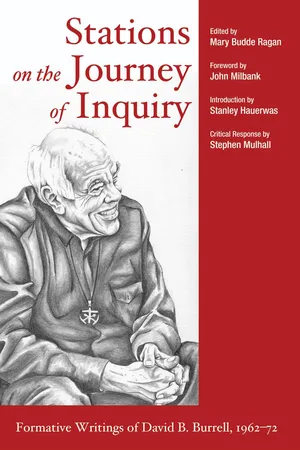
eBook - ePub
Stations on the Journey of Inquiry
Formative Writings of David B. Burrell, 1962–72
- 296 pages
- English
- ePUB (mobile friendly)
- Available on iOS & Android
eBook - ePub
Stations on the Journey of Inquiry
Formative Writings of David B. Burrell, 1962–72
About this book
In this collection, Stations on the Journey of Inquiry, David Burrell launches a revolutionary reinterpretation of how any inquiry proceeds, boldly critiquing presumptuous theories of knowledge, language, and ethics. While his later publications, Analogy and Philosophical Language (1973) and Aquinas: God and Action (1979), elucidate Aquinas's linguistic theology, these early writings show what often escapes articulation: how one comes to understanding and "takes" a judgment. Although Aquinas serves as an axial figure for Burrell's expansive corpus of scholarship spanning more than fifty years, this selection of essays presents other positions and counterpositions to whom his own philosophical theology is beholden: Plato, Aristotle, Cajetan, Kant, Peirce, Moore, Wittgenstein, Sellars, Weiss, Ross, McInerny, and Lonergan. With renewed interest in philosophy of language by postmodern thinkers as well as in the wake of Mulhall's Stanton Lectures on Wittgenstein and "Grammatical Thomism," the publication of these formative writings proves timely for the academy at large. Burrell invites us to reconsider not only the way in which we conduct an inquiry, but what it is we take language to be and how we take responsibility for what we say.
Information
Topic
PhilosophySubtopic
Philosophy History & TheoryChapter 1
Substance
A Performatory Account
This essay offers an interpretation of Aristotle. My aim in so interpreting him is to show how useful a guide he can be in unraveling issues surrounding meaning and reference, and in displaying the role which language plays in our understanding the world. More specifically, the manner in which we lay language out bespeaks our way of laying out the world. I shall focus on substance and argue against a misunderstanding, showing how it is linked to a misconception of the structure and function of the statement-making sentence. Getting back to Aristotle in this fashion has the purpose of getting down to issues. One test of success will be the extent to which I can also clarify disputed questions in Aristotle. Many of the arguments will have to be designed to help us see through some of our pet predilections to get ahold of the issues in a fresh way. The following preliminary distinctions serve that end.
Some Preliminary Remarks
An element is an element of a whole. Hence the sense of “one” at work in discriminating an element will depend on that sense of “one” which picked out one of the wholes of which this item is said to be a component. Lead, for example, is a component of the steel used for automobile bodies, but steel is a component of the bodies; carbon is a component of the plastics used to construct a car, but specific plastics in definite shapes are components of the car. The units, the definite shapes, are shaped to the design of the car. And while plastic is not infinitely malleable, whatever constraints its use would have on the design of the car itself would be due not to any predetermined shapes, but to its consistency. Those constraints would stem from its being plastic, not from its being a unit—more from the components of plastic than from plastic used as a component.
Most of us are schooled to respect this shifting sense of “unit” (or of “object”). Yet we are tempted to resist its penetrating to affect our use of “element” (or of “component”) as well. We cannot accept the shifting character of “unit,” however, and fail to recognize that same shiftiness in any identifying phrase using the particle “a” or “an.” This amounts, of course, to the venerable reminder that “one” is an analogous term. It is one of those four or five peculiarly pervasive notions that is present in every categorical division and appears indispensable to any language we might want to use. But all that reminder need come to for us at this point is a warning: be sure to specify the context when speaking of an anything. And the context of an element is the unit-whole of which it is an element.
What seems to work against our logical good sense here is some demand to locate units that are more basic than others. Or perhaps on closer examination we can detect such a demand already at work in the very way we use expressions so utterly analogous as “one,” so that understanding that very demand would form part of our logical good sense.1 We can look more closely at this as we proceed. One feature of logical good sense shows up already, however. That is that it will prove fruitless to look for the most basic (or elementary) unit, for we would have to locate something without elements. For the elements of a particular kind of unit would of course have to be considered more elementary than the unit itself, yet all the while owing the fact that they were elements to the unit. The language which picks out elements, however, is one shaped to the wholes of which they are elements, and it is a language fashioned to things composed of elements. Hence even what is most basic must be in some fashion composed if we are to be able to talk about it. What is without any composition whatsoever could not even be expressed.
It is these ambiguities in “one,” “basic,” and “elementary” which Aristotle was forced to negotiate in asserting substance to be primary. For all the difficulties he left us, however, he saw clearly what I have outlined so far, and did not flinch from taking on the seeming paradoxes involved. I want to look again at his accounts with this reciprocal sense of part/whole in hand, showing how the shifting sense of unit can prove a powerful key in interpreting the role substance played for him. And delineating that role more clearly can have a cleansing effect on some contemporary discussions of ontology.2
Aristotle on Substance
It is no secret that Aristotle’s presentation of substance derives from logico-grammatical reflections on the statement-making sentence. So understanding Aristotle’s account of the sentence will go a long way towards our grasping what he intended by substance, and why it plays the role it does for him. My contention will be that substance is primary just as a statement-making sentence is primary. Neither is primary because it is without elements, but each displays its respective claim to be the basic unit (of the world or of discourse) in its manner of composition. The elements pertaining to these units are not themselves units of this most basic type, hence it becomes more proper to speak of matter/form and name/verb as principles rather than elements.3
This interpretation apparently contradicts some straightforward statements of Aristotle about the significant parts of a sentence, and certainly runs counter to a fairly common predilection for names as the basic units of discourse. I shall show that the contradiction is only apparent by noting how the context of the statements in question fixes an appropriate meaning of “unit” without claiming any further extension.
The accumulating arguments in favor of this interpretation should display a battery of relevant reasons for preferring sentence to name as the basic unit of discourse. The advantages lie not only in a more coherent understanding of Aristotle, but in exposing misleading uses of “substance” (Locke) as well as definitively avoiding metaphysical embarrassments like bare particulars.
This interpretation was inspired by a remark of Aquinas likening the noun to matter and the verb to form in the unit which is a sentence.4 It has been guided by that medieval spirit which took logical grammar so seriously: whatever cannot be said should be able to be displayed from the structure of the statement itself. What sets off metaphysicians from dialecticians, Aquinas remarked, is neither intuition nor method, but simply the power of showing something forth.5
Plan of Exposition and of Argument
Substance forms the focus of many issues in Aristotle, notably of a theory of inquiry, and by implication, a metaphysics. I shall try to show how the issues which arise in the Metaphysics are rooted in the de Interpretatione and can be illuminated effectively from the Posterior Analytics, Aristotle’s methodology. I shall show how the treatment of substance is itself an elaboration of the subject-predicate form of the sentence, but not in the ways that we might expect. Furthermore, the individuality of substance cannot be elucidated in any formal way, so something else is required. I shall argue that the “something else” is strictly correlative to that act whereby we assert what we have articulated, where we state what we have considered to be the case. Among the results should be a more sophisticated appreciation of Aristotle as well as a somewhat keener sense of our investment in the language which we speak, especially of the subtleties of the “subject-predicate” form of discourse, and of the indispensability of the speaker as an agent and user of language.
Philosophy as Elucidation: Elements of Discourse
We have in Ackrill’s translation of the Categories and the Peri Hermeneias (de Interpretatione) an exquisite guide into this early attempt to do philosophy by elucidating logical grammar. Ackrill duly notes how often Aristotle failed to distinguish logical from grammatical form and kinds of sentences from kinds of speech-acts (120, 128).6 Yet the very simplicity of his translation shows how useful were Aristotle’s failures to distinguish. We are presented with a simple and direct example of elucidation. Beginning with the fact of speech, Aristotle searches for those patterns which allow it to do its job.
Speech is a significant sound. The de Interpretatione begins where Socrates did. The elements of speech are many: names, verbs, negations, affirmations, statements (αποφανσις), and sentences (λογος). Besides saying something about each of them it behooves us to order them, for much will depend on that. Aristotle is not explicit about ordering the elements, but he is clear about how to do it. He is interested here in one of the jobs that speech does: the statement-making job (17a5). The operative element here is the sentence, for it alone can be used to affirm or deny, that is, to state that something is or is not the case. Names and verbs, on this ordering, would qualify as elements of speech—become significant sounds—only insofar as they are constitutive parts of sentences.
The ordering so far is clear and thoroughly Aristotelian: as it is the purpose embodied in living, growing things which is the key to discovering the order in their make-up, so the stated aim of an inquiry orders what it perceives to be the relevant factors or elements that must be discussed. The aim of the de Interpretatione is at once universal and pointed: to elucidate some invariant structures of significant sound with special attention to what makes a statement work. What is significant is speech. Socrates provides the background here: what is significant is what a man says and does. Aristotle focuses on what we say and specifically what is done when we say something of something.
The analysis at this point is formal . . . by way of elucidation. The text refers to de Anima (III. 3–8) for what could be called an operational or causal analysis. The focus here is rather on the form of the sentence (λογος) and especially that kind of sentence most appropriate for making statements (αποφανσις) or for saying something of something. Sentences have many other roles. They can be used to invoke, command, cajole, commend, condemn, etc. All of these activities are significant because they belong to human speech. Aristotle does not single out one sort of speech activity—statement-making—as though it were a paradigm of significant sound, but rather takes it up because of its role in inquiry.
The pressure to isolate statement-making comes from the basic question form: What is it? Any answer to the question will have to say something about that. Coming to know what anything is involves learning a number of things about it, and these items are held fast in statements which purpose to assert or deny something of the thing in question (17a20). Although Aristotle did not use this language, what is known about the object in ...
Table of contents
- Title Page
- Acknowledgments
- Editorial Note
- Aquinas Abbreviations
- Foreword
- Preface
- Introduction
- Critical Response
- Chapter 1: Substance
- Chapter 2: Aristotle and “Future Contingencies”
- Chapter 3: Entailment
- Chapter 4: How God Achieves His Ends according to Saint Thomas Aquinas
- Chapter 5: What the Dialogues Show about Inquiry
- Chapter 6: C. S. Peirce
- Chapter 7: Classification, Mathematics, and Metaphysics
- Chapter 8: How Complete Can Intelligibility Be?
- Chapter 9: Truth and Historicity
- Chapter 10: Religious Language and the Logic of Analogy
- Chapter 11: Beyond a Theory of Analogy
- Chapter 12: Reading The Confessions of Augustine
- Chapter 13: Religious Life and Understanding
- Bibliography
Trusted by 375,005 students
Access to over 1.5 million titles for a fair monthly price.
Study more efficiently using our study tools.
Frequently asked questions
Yes, you can cancel anytime from the Subscription tab in your account settings on the Perlego website. Your subscription will stay active until the end of your current billing period. Learn how to cancel your subscription
No, books cannot be downloaded as external files, such as PDFs, for use outside of Perlego. However, you can download books within the Perlego app for offline reading on mobile or tablet. Learn how to download books offline
Perlego offers two plans: Essential and Complete
- Essential is ideal for learners and professionals who enjoy exploring a wide range of subjects. Access the Essential Library with 800,000+ trusted titles and best-sellers across business, personal growth, and the humanities. Includes unlimited reading time and Standard Read Aloud voice.
- Complete: Perfect for advanced learners and researchers needing full, unrestricted access. Unlock 1.5M+ books across hundreds of subjects, including academic and specialized titles. The Complete Plan also includes advanced features like Premium Read Aloud and Research Assistant.
We are an online textbook subscription service, where you can get access to an entire online library for less than the price of a single book per month. With over 1.5 million books across 990+ topics, we’ve got you covered! Learn about our mission
Look out for the read-aloud symbol on your next book to see if you can listen to it. The read-aloud tool reads text aloud for you, highlighting the text as it is being read. You can pause it, speed it up and slow it down. Learn more about Read Aloud
Yes! You can use the Perlego app on both iOS and Android devices to read anytime, anywhere — even offline. Perfect for commutes or when you’re on the go.
Please note we cannot support devices running on iOS 13 and Android 7 or earlier. Learn more about using the app
Please note we cannot support devices running on iOS 13 and Android 7 or earlier. Learn more about using the app
Yes, you can access Stations on the Journey of Inquiry by Mary Budde Ragan, Ragan in PDF and/or ePUB format, as well as other popular books in Philosophy & Philosophy History & Theory. We have over 1.5 million books available in our catalogue for you to explore.