- 134 pages
- English
- ePUB (mobile friendly)
- Available on iOS & Android
eBook - ePub
About this book
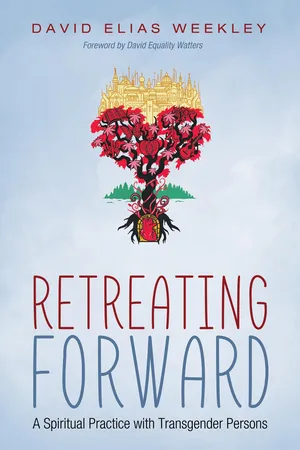
Transgender people are among the most marginalized and vulnerable populations in the world. Misinformation, lack of education, and lack of experience among cis-gendered persons often result in forms of violence and abuse directed towards those perceived as transgender or gender non-conforming. Such violence and abuse are not restricted to secular culture but expand into faith communities and essential forms of spiritual care and support. When transgender people of faith share the reality of their gender identity they often experience rejection by the very communities that should provide support, encouragement, and practical ministries of hospitality. Retreating Forward: A Spiritual Practice with Transgender Persons is an educational and practical resource for individuals, spiritual leaders, and faith communities seeking to provide practical and spiritual sustenance. The retreat model included in this text proved transformational for those involved.
Information
Topic
Theology & ReligionSubtopic
Christian Theology1
Invitation to Hospitality
Transgender and gender non-conforming persons often suffer spiritual alienation, isolation, and desolation. Many in this community express a sense of alienation from institutional religion and a struggle to find spiritual community. Indeed, they face discrimination at every turn.1 Events such as the dramatic rise in hate crimes following recent elections in the United States underscore the need for a supportive, responsive ministry on the part of faith communities who seek to stand in solidarity with transgender persons. The following pages are an invitation into a conversation about the theological foundations and existing need for such a practice. The text presents some historical background and resource literature, and describes Christian-based hospitality through the example of a spiritual retreat model for and with transgender and gender non-conforming persons. The retreat that evolved through theological reflection, conversation, and research is based upon participatory action research, a methodology that worked well within my theological framework of seeking to give voice to marginalized populations.
Theologian Elizabeth Conde-Frazier describes participatory action research as one way to accompany others in their suffering and struggles and to work together in responding to challenges and issues in their lives and community.2 While this text does not focus on this methodology, it is important to note it was the operating method engaged when building the retreat with participants. Conde-Frazier describes it as incarnational research, involving people in formulating solutions for their problems, setting agendas, reflecting theologically, and acting.3 In this text, transgender and gender non-conforming people are engaged in reflecting on their lives, identifying their problems and concerns, setting goals, reflecting theologically, and developing strategies for future action. In a time when transgender persons are experiencing increased push-back from some religious organizations as well as segments of secular society, this type of process and experience may be significant for both the retreatants and those who facilitate it, including faith communities that develop and support such a ministry.
The theological grounding of this work is Jesus’ “Parable of the Good Samaritan,” found in the gospel of Luke 10:25–37. The Christian life is one committed to following the example and teaching of Jesus, drawing upon discernment and the Spirit for direction in life. Regardless of theological differences or preferred translation of sacred Scriptures, one essential mandate preceding all others is love of God and neighbor. This directive is found in several places in both the Hebrew Scriptures and the gospel, but the story told by Jesus in this parable powerfully underscores this directive. Above all else, this is a story of radical love and hospitality that precedes religious tradition or dogma:
Just then a lawyer stood up to test Jesus. “Teacher,” he said, “what must I do to inherit eternal life?” He said to him, “What is written in the law? What do you read there?” He answered, “You shall love the Lord your God with all your heart, and with all your soul, and with all your strength, and with all your mind; and your neighbor as yourself.” And he said to him, “You have given the right answer; do this, and you will live.”
But wanting to justify himself, he asked Jesus, “And who is my neighbor?” Jesus replied, “A man was going down from Jerusalem to Jericho, and fell into the hands of robbers, who stripped him, beat him, and went away, leaving him half dead. Now by chance a priest was going down that road; and when he saw him, he passed by on the other side. So likewise, a Levite, when he came to the place and saw him, passed by on the other side. But a Samaritan while traveling came near him; and when he saw him, he was moved with pity. He went to him and bandaged his wounds, having poured oil and wine on them. Then he put him on his own animal, brought him to an inn, and took care of him. The next day he took out two denarii, gave them to the innkeeper, and said, ‘Take care of him; and when I come back, I will repay you whatever more you spend.’ Which of these three, do you think, was a neighbor to the man who fell into the hands of the robbers?” He said, “The one who showed him mercy.” Jesus said to him, “Go and do likewise.”
This core story and teaching of Jesus relates directly to the invitation made in this text, and it was operative from the beginning as I envisioned a spiritual place of healing for both a population that often feels beaten, robbed, and abandoned by society; and faith communities isolated from their transgender siblings in faith as the result of unfamiliarity, fear, lack of information, or restricted theological education.
Like Samaritans and the dead in the time of Jesus, transgender and gender non-conforming persons today are one of the most marginalized populations on earth. This has been illustrated repeatedly by surveys such as, “Injustice at Every Turn” and the rising numbers of deaths reported each year during Transgender Day of Remembrance observances.4 Despite such a clear example in the teaching of Jesus concerning right relationship between God and neighbor, many denominations and local congregations continue to either ignore or vilify the existence of this entire community. They are like those in Jesus’ parable who, driven by fear of contamination and social rejection themselves, evade contact with the wounded victim, even crossing the road to avoid being proximate to one viewed as unclean. Such behaviors are not limited to individuals or even faith communities. Promises to “roll back” legal protections for transgender persons is among one of the campaign promises of the newly elected Trump administration. Proposals to allow discrimination against transgender persons by physicians, hospitals, and businesses are already under consideration through what is known as, “The Religious Freedom Act.”
It is important to clarify that transgender persons do not always fall into the role of victim. The parable invites cis-gender and transgender persons to explore how they represent one role or another at various points over a lifetime. For example, at the age of fifteen when I first told an adult my story and transgender experience I felt very much like a victim. I felt fearful and vulnerable. Some of this was from the bullying and stigma I had already experienced in social life, especially school. Some of this was simply part of being an adolescent. Over time and with intentional acts of healing I moved from this perspective.
Like others, I have sometimes been among those who see someone in need but, due to lack of courage, a sense of mistrust, frustration that I can do so little, or something else entirely, instead of stopping to assist I “pass by” as it were, “on the other side of the road.” In hindsight, these are not my best moments or memories, even when I understand that the personal risk involved appeared overwhelming at the time.
Whether transgender or cis-gender, becoming the Good Samaritan Jesus describes involves a lifetime commitment to a set of values that includes recognizing the innate worth and interconnectedness of every person. These values command the response to act and practice these values in life. The parable reveals the responsibility and potential contained in loving God and neighbor, as new relationships are formed between persons who, in a different paradigm, would be enemies. In Jesus’ story the pattern changes, as the fallen victim and the Samaritan are both disdained, though for different reasons; one because he was believed to be ritually unclean, and the other because of cultural and religious practices. Like others, at my best moments I have embraced the stranger, offered hospitality, and broadened the circle of human relationships. On rarer occasions, I have filled a role like the innkeeper, providing a safe space, basic needs, and whatever healing I may offer to another traveling life’s road.5 Transgender persons, no less than cis-gender, are more than one-dimensional; and while it is true that too often transgender persons are victims, we are also resilient and just as likely to fit the other characters in Jesus’ story.
Jesus describes authentic human relationship through the roles depicted in this parable. This provides an image and model for faith-based hospitality and the creation of authentic community today. The social and spiritual wounds of transgender and gender non-conforming people are addressed by collaborative and participatory ministries that foster spiritual companionship and renewal. I say this following decades of experience in parish ministry, specialized coursework in spirituality studies, and personal experience as a transgender man. Therefore, the text focuses on spiritual renewal and spiritual companionship ministry with transgender and gender non-conforming persons. Such ministry moves beyond abstract theological debate to acts of solidarity with a highly-marginalized population; the exact subject of Jesus’ Parable of the Good Samaritan.
I come to this work after more than three decades of ordained ministry in the United Methodist Church, including the last nine years as an “out” transgender United Methodist clergy in Portland, Oregon, currently serving a pastorate in Hull, Massachusetts. These experiences led to meetings and conversations with literally hundreds of transgender and gender non-conforming persons of faith that continue to expand and unfold. One common element that stands out for man...
Table of contents
- Title Page
- Foreword
- Preface
- Acknowledgments
- List of Abbreviations
- Glossary
- Chapter 1: Invitation to Hospitality
- Chapter 2: Who is My Neighbor?
- Chapter 3: A Theology and Practice of Radical Love
- Chapter 4: Retreating Forward
- Chapter 5: The Retreat
- Chapter 6: More Than the Sum of Parts
- Appendix A: Prayer Weaving Tutorial: Membering, Dismembering, & Re-Membering Reflection Through Paper Weaving
- Appendix B: Participant Survey
- Appendix C: Evaluation Form
- Appendix D: Follow-Up Interview Questions
- Appendix E: Annotated Sources
- Addendum: A Suitable Methodology
- Bibliography
Trusted by 375,005 students
Access to over 1.5 million titles for a fair monthly price.
Study more efficiently using our study tools.
Frequently asked questions
Yes, you can cancel anytime from the Subscription tab in your account settings on the Perlego website. Your subscription will stay active until the end of your current billing period. Learn how to cancel your subscription
No, books cannot be downloaded as external files, such as PDFs, for use outside of Perlego. However, you can download books within the Perlego app for offline reading on mobile or tablet. Learn how to download books offline
Perlego offers two plans: Essential and Complete
- Essential is ideal for learners and professionals who enjoy exploring a wide range of subjects. Access the Essential Library with 800,000+ trusted titles and best-sellers across business, personal growth, and the humanities. Includes unlimited reading time and Standard Read Aloud voice.
- Complete: Perfect for advanced learners and researchers needing full, unrestricted access. Unlock 1.5M+ books across hundreds of subjects, including academic and specialized titles. The Complete Plan also includes advanced features like Premium Read Aloud and Research Assistant.
We are an online textbook subscription service, where you can get access to an entire online library for less than the price of a single book per month. With over 1.5 million books across 990+ topics, we’ve got you covered! Learn about our mission
Look out for the read-aloud symbol on your next book to see if you can listen to it. The read-aloud tool reads text aloud for you, highlighting the text as it is being read. You can pause it, speed it up and slow it down. Learn more about Read Aloud
Yes! You can use the Perlego app on both iOS and Android devices to read anytime, anywhere — even offline. Perfect for commutes or when you’re on the go.
Please note we cannot support devices running on iOS 13 and Android 7 or earlier. Learn more about using the app
Please note we cannot support devices running on iOS 13 and Android 7 or earlier. Learn more about using the app
Yes, you can access Retreating Forward by David Elias Weekley in PDF and/or ePUB format, as well as other popular books in Theology & Religion & Christian Theology. We have over 1.5 million books available in our catalogue for you to explore.