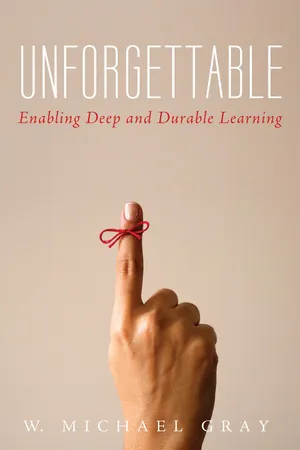
- 302 pages
- English
- ePUB (mobile friendly)
- Available on iOS & Android
eBook - ePub
About this book
We have an uneasy relationship with the relentless deluge of information gushing out of academia and our media outlets. To turn it off is escapist, but to attempt to cognitively grapple with it is overwhelming.
In Unforgettable: Enabling Deep and Durable Learning, a nationally recognized master teacher gives professors and their students the means to chart a clear path through this information explosion. Humans crave explanatory patterns, and this book enables teachers to think deeply about their academic disciplines to find and articulate their core explanatory principles and to engage their students in a compelling way of thinking. An alternative title for this book could be Why the Best College Teachers Do What They Do because the author articulates a compelling rationale that will equip faculty to create and deliver transformative courses. Students in transformative courses grapple with essential questions and gain mental muscle that equips them for real world challenges.
Information
Topic
Theology & ReligionSubtopic
Education GeneralChapter 1
Teaching for Transformation
Truly effective teaching changes students. “[It] reminds us of the primacy of learning, not teaching, in education. Learning is the end, teaching is a means to that end.”1
Donald L. Finkel
Teaching and learning are necessarily interdependent and interwoven actions. Teaching may be done without learning occurring, and learning may sometimes be self-taught; but a very normal expectation is that teaching will increase learning. The fate of teachers is all wrapped up with the success of pupils. By success I mean not just producing a satisfied customer at the end of the semester—but transforming the customer.
Transformation is thorough and lasting. Students who are transformed by learning get more than they pay for. Their eyes are opened to new vistas with new possibilities. The life trajectory of transformed students is permanently altered. Life-long learning is the natural result of the pursuit of joy through the process of learning.
If you permit yourself reflection on your teaching, the hard question eventually comes, “To what extent does my teaching transform my students?” Asking the question requires humility before the evidence. We are all prone to cherry-pick. If you teach long enough, some of your students will excel in their professional lives. To what extent did you contribute to the success of a gifted student? A better benchmark would be found in your average students. Is it typical that they are transformed by being in your class? Perhaps your pool of evidence isn’t encouraging. For many faculty sober reflection on their teaching effectiveness is the first step on a journey that opens their eyes to new vistas and undreamed-of fulfillment as a teacher.
Transformative learning is not mere fact acquisition; it is not even the ability of the student to recall in detail the pearls of your scholarship. Paul Ramsden points us to learning as “alter[ing] students’ understanding, so that they begin to conceptualise phenomena and ideas in the way . . . experts conceptualise them.”2 Ramsden zeroes in on what is typically called higher-order learning as the thing that makes teachers indispensable. This is learning focused on not just knowing what but, more importantly, why. Such learning aims for deep understanding.
Ken Bain in his influential book, What the Best College Teachers Do, identified truly excellent teachers in two dozen universities across America. Bain’s major criterion was that they “had achieved remarkable success in helping their students learn in ways that made a sustained, substantial and positive influence on how those students think, act, and feel. . . . We sought people . . . who constantly help their students do far better than anyone else expects. . . . Some students talked about courses that ‘transformed their lives,’ ‘changed everything,’ and even ‘messed with their heads.’”3
Why the Best College Teachers Do What They Do
Bain’s book is helpful because excellent teachers appear to almost reflexively do certain things that work, regardless of the academic discipline. As an admirer of Bain’s work, I’d like to take it a step further and ask why certain mindsets and practices are characteristic of excellent teaching. Why do they work? By asking the question, we’re trying to explore the logical foundations of the practices. We’re trying to do higher-order learning of the process of higher-order learning. We’re engaging in the “scholarship of teaching.”4 Those in higher education love the identifier of professor but avoid the label teacher, feeling it diminishes them. Yet, what the next generation needs most is teachers—doctors, to use an old term of honor that has been hijacked by physicians who, at best, give five-minute lessons to their patients.5
In higher education the Ph.D. is the credential that supposedly qualifies one to teach; students and their parents recognize this, and administrators insist on it. The assumption is that you don’t have to have any formal training in how to teach at the college level. Teaching is what happens when you get up to share your expertise with your students. No wonder higher education is in crisis! The reality is that effective teaching at the college level requires both subject matter expertise and a deep understanding of how students learn to think in domain-specific ways.
To become a scholar of teaching and learning is going to take serious study and commitment. I’ve done a lot of study in this area over the past twenty-five years, and I’ll help you go to the high-value thinkers in higher education through the footnotes in every chapter. Education is often dominated by jargon with a very short half-life. I’m a firm believer in holding vocabulary to the minimum necessary for clear communication. My argument in this book is not dependent on jargon. On this journey there will be deep satisfaction that what works actually works for sound reasons. You’ll find here a logically connected causal narrative.
Education often seems to have a life of its own, independent of subject matter. The story in this book of how to maximize transformative learning will collaborate with what you know about your academic discipline. Indeed chapter 2 “Becoming a Clear Thinking Teacher” will start you on a quest that will improve the depth of your personal understanding of what you already know well. As you work to clarify and expose your expert thinking processes, you’ll gain powerful insights that will enable your students to go farther than you thought possible.
Finding Mentors
Critical reflection on your teaching is intellectually difficult and can be dangerous. It can cause you to doubt without providing direction, and that can lead to disillusionment. The journey I’m inviting you on is always better when you have the fellowship and counsel of friends. I hope you can find such a circle on your campus, but I want you to make friends with some fellow travelers who have been candid about their struggles and who can point us to some solutions.
Richard R. Hake was a member of the physics faculty at Indiana University in the fall of 1980 when he began teaching a physics course for elementary education majors. “I gave the first examination. The results showed quite clearly that my brilliant lectures and exciting demonstrations on Newtonian mechanics had passed through the students’ minds leaving no measurable trace. To make matters worse, in a student evaluation given shortly after the exam, some students rated me as among the worst instructors they had ever experienced at our university.”6 Hake’s candor shows us a teacher who was facing painfully discordant data and was becoming critically reflective about the lack of effectiveness in his teaching. His response was to talk to other physicists he knew, and he ended up being directed to Arnold Arons, who taught physics to elementary education majors at the University of Washington. Arons had published multiple papers about his approach to teaching physics. “Arons . . . recommended that I abandon the standard passive student lecture.”7 Hake ended up adapting Arons’ methods to his course at IU and became an enthusiastic supporter as indicated by the title of his paper “My Conversion to the Arons-Advocated Method of Science Education.”
This curious terminology is not unique to Hake and represents the magnitude of change required to move out of the reflexive “Teaching as Telling” methodology. Critical thinking authority Richard Paul puts it this way: “We must make a paradigm shift from a didactic to a critical model of education to make higher order thinking a classroom reality. This shift is like a global shift in our eating habits and lifestyle. It cannot be achieved in a one-day inservice or by any other short-term strategy. It must come over an extended period of time and be experienced as something of a conversion, as a new way of thinking about every dimension of schooling.”8
Physicist Carl Wieman is an unusual exemplar of the ideal professor in higher education. Recipient of the 2001 Nobel Prize in Physics with Eric Cornell for his production of the Bose-Einstein condensate in 1995, Wieman was also the Carnegie Foundation’s U.S. University Professor of the Year in 2004. This second award was among all professors (not just those in physics) in U.S. doctoral and research universities. Wieman started science education initiatives at both the University of Colorado at Boulder and at the University of British Columbia. He is also currently the Chair of the Board on Science Education for the National Academy of Sciences.9 Wieman recounts his journey as a science educator:
When I first taught physics as a young assistant professor, I used the approach that is all too common when someone is called upon to teach something. First I thought very hard about the topic and got it clear in my own mind. Then I explained it to my students so that they would understand it with the same clarity I had.
At least that was the theory. But I am a devout believer in the experimental method, so I always measure results. And whenever I made any serious attempt to determine what my students were learning, it was clear that this approach just didn’t work. An occasional student here and there might have understood my beautifully clear and clever explanations, but the vast majority of students weren’t getting them at all.
For many years, this failure of students to learn from my explanations remained a frustrating puzzle to me, as I think it is for many diligent faculty members.10
So what does Wieman recommend as a replacement for this failed approach? “A lot of educational and cognitive research can be reduced to this basic principle: People learn by creating their own understanding. But that does not mean they must or even can do it without assistance. Effective teaching facilitates that creation by getting students engaged in thinking deeply about the subject at an appropriate level and then monitoring that thinking and guiding it to be more expert-like.”11
Getting Inside Your Head
Most academics gravitated to a particular domain of academia because of innate (and uncommon) intellectual gifts. I’m not flattering you when I observe that you probably did not struggle to identify your expertise. To be sure, you had to work long and hard to perfect it, but you had definite advantages over the average learner. To serve the average learners in your classroom, you are going to have to “get inside your head.” This process is sometimes called metacognition—thinking about your thinking. If this sounds hopelessly cerebral, the intellectual equivalent of navel gazing, please stick with me. It is doubtless hard work, but it is the only path ...
Table of contents
- Title Page
- Preface
- Acknowledgments
- Introduction
- Chapter 1: Teaching for Transformation
- Chapter 2: Becoming a Clear-Thinking Teacher
- Chapter 3: Thinking Like an Expert
- Chapter 4: Developing and Clarifying Your Ideas
- Chapter 5: Explanatory Power
- Chapter 6: This Is the Way: Designing the Optimal Learning Path
- Chapter 7: Student Flourishing
- Chapter 8: Ask, Don’t Tell
- Chapter 9: Speaking Truth in Love: Assessment as Communication
- Chapter 10: Averting Disaster
- Appendix 1: The Logic of a Chef
- Appendix 2: Richard Paul’s eight elements of thought compared with my approach
- Appendix 3: Gowin’s Knowledge Vee
- Appendix 4: Socratic GPS
- Appendix 5: Assessment in Course Design
- Bibliography
Trusted by 375,005 students
Access to over 1.5 million titles for a fair monthly price.
Study more efficiently using our study tools.
Frequently asked questions
Yes, you can cancel anytime from the Subscription tab in your account settings on the Perlego website. Your subscription will stay active until the end of your current billing period. Learn how to cancel your subscription
No, books cannot be downloaded as external files, such as PDFs, for use outside of Perlego. However, you can download books within the Perlego app for offline reading on mobile or tablet. Learn how to download books offline
Perlego offers two plans: Essential and Complete
- Essential is ideal for learners and professionals who enjoy exploring a wide range of subjects. Access the Essential Library with 800,000+ trusted titles and best-sellers across business, personal growth, and the humanities. Includes unlimited reading time and Standard Read Aloud voice.
- Complete: Perfect for advanced learners and researchers needing full, unrestricted access. Unlock 1.5M+ books across hundreds of subjects, including academic and specialized titles. The Complete Plan also includes advanced features like Premium Read Aloud and Research Assistant.
We are an online textbook subscription service, where you can get access to an entire online library for less than the price of a single book per month. With over 1.5 million books across 990+ topics, we’ve got you covered! Learn about our mission
Look out for the read-aloud symbol on your next book to see if you can listen to it. The read-aloud tool reads text aloud for you, highlighting the text as it is being read. You can pause it, speed it up and slow it down. Learn more about Read Aloud
Yes! You can use the Perlego app on both iOS and Android devices to read anytime, anywhere — even offline. Perfect for commutes or when you’re on the go.
Please note we cannot support devices running on iOS 13 and Android 7 or earlier. Learn more about using the app
Please note we cannot support devices running on iOS 13 and Android 7 or earlier. Learn more about using the app
Yes, you can access Unforgettable by W. Michael Gray in PDF and/or ePUB format, as well as other popular books in Theology & Religion & Education General. We have over 1.5 million books available in our catalogue for you to explore.