- 276 pages
- English
- ePUB (mobile friendly)
- Available on iOS & Android
eBook - ePub
About this book
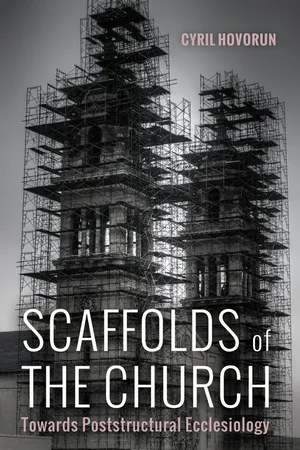
Unity is the categorical imperative of the church. It is not just the church's bene esse, but its esse. In addition to being a theological concept, unity has become a raison d'etre of various structures that the church has established and developed. All of these structures are supposed to serve the end of unity. However, from time to time some of them deviate from their initial purpose and contribute to disunity. This happens because the structures of the church are not a part of its nature and can therefore turn against it. They are like scaffolding, which facilitates the construction and maintenance of a building without actually being part of it. Likewise, ecclesial structures help the church function in accordance with its nature but should not be identified with the church proper. This book considers the evolution of some of these church structures and evaluates their correspondence to their initial rationale. It focuses on particular structures that have developed in the eastern part of the Christian oecumene, such as patriarchates, canonical territory, and autocephaly, all of which are explored in the more general frame of hierarchy and primacy. They were selected because they are most neuralgic in the life of the Orthodox churches today and bear in them the greatest potential to divide.
Information
Topic
Theology & ReligionSubtopic
Christian Theology1
Fine Pencil Lines: Distinctions
There are borderlines within the church, which are purely imagined, not real. They are drawn by theologians with a pencil on the pages of ecclesiological treatises. This kind of distinction is similar to the distinction between Christ’s divinity and humanity in Christology. Cyril of Alexandria distinguished the humanity and divinity of Christ only “in thought” (τῇ θεωρίᾳ μόνῃ).13 This distinction stressed the idea of the inseparable oneness of Christ as a single being. The same distinction, when applied to the church, stresses that the church is one single reality. There are aspects of the church that can be distinguished only theoretically.
The Church as an historical phenomenon and as an object of faith
The distinction that is the most difficult to explore is the one between the church as an historical phenomenon and the church as it is believed to be. There are big gaps between the church in theory and in reality. Theologians have applied various languages to describe this distinction. Hans Küng, for instance, distinguishes between “an ideal Church situated in the abstract celestial spheres of theological theory” and the “real Church,” which “is first and foremost a happening, a fact, an historical event.”14 For Edward Schillebeeckx, the single reality of the church can be described in two irreducible languages. The one is theological language, which conceptualizes the church as it is related to God. The other language consists of historical and sociological morphemes.15 Daniel Ott in his unpublished doctoral dissertation explores the difference between the real and the conceptualized church by engaging the “process theology” of Alfred North Whitehead and the critical ecclesiology of Hans Küng. He has borrowed from Whitehead the idea that God is dynamic and always at work in the world.16 The way that God works in the world as it is described in “process theology” also applies to the church. Ott dwells on Küng’s concept of “real church” and the distinction between “what the church IS [capitalized by Ott] and what the church can be.”17 This combination of Whitehead’s process ecclesiology and Küng’s ecclesiological realism creates a picture of the church that is called to change in order to correspond more truly in its human and historical dimension to what God wants it to be:
God can and does work through both continuity and change. God works to preserve and deepen the good in the church’s tradition while at the same time creatively transforming the church toward ever-deeper forms of inclusive love and justice. This model avoids both a fear of change that leads to stagnation and a blind affirmation of change that disregards the value of tradition and continuity.18
Neil Ormerod, following the nineteenth century’s schemata, describes the difference between theoretical and realistic approaches to the church by employing an analogy between Platonic and Aristotelian philosophical methods:
One might characterise the difference between these two possibilities as one between an Aristotelian and a Platonic (idealist) approach to ecclesiology. The Aristotelian (realist) approach takes as its starting point the historical data of the Church, a Church of historically constituted communities which develop and change over time. It will then seek to draw historical lessons for the current life of the Church, often by reflecting on some golden age, perhaps the communities of the New Testament, the patristic era, or the high middle ages. The Platonic approach will usually take as its starting point a highly charged theological symbol of the Church, such as the Church as a body of Christ, the people of God or a divine communion. It will then seek to draw conclusions from these religious symbols for the concrete operation of the Church we all live in.19
Roger Haight thinks that “the historical church will not yield to theory”20 and therefore “there will always be a tension between the ideal and the real in ecclesiology.”21 Haight articulates the distinction between theory and the reality of the church in the terms of the ecclesiologies “from above” and “from below” correspondingly. The essential difference between them is that the former is “abstract, idealist, and a-historical,” while the latter is “concrete, realist, and historically conscious.”22 Haight lists features of both ecclesiologies and compares them. Ecclesiology “from above,” for him, tends
to transcend any given historical context;
to remain confined within the limits of one given tradition;
to build its self-understanding on authority;
to increase the distance between the church and the world;
to keep the doctrine about the church separated from the church’s history;
to be Christocentric;
to ground its ministry on hierarchical principles.23
The last feature is fundamental for the ecclesiology “from above.” It implies that
the levels of power and authority have their foundation in God, and they descend. . . . This structure in some measure reflects or corresponds to the monarchical structure of the universe, or reality itself . . . .
A hierarchical structure such as this is concomitant with a hierarchical imagination. . . . The church as institution is willed by God, informed by God in Christ and as Spirit, so that the church is holy in its institutional forms. The institutions of the church enjoy a certain sacrality: scripture is holy, sacraments are holy, but so too are the bishops and priests who administer them. The word of God is holy, but so too is the sacred authority with which the leaders of the church speak. One objective state or way of life may be considered holier than another.24
An approach to the church from above, in Haight’s description, corresponds to a theoretical and idealistic outlook, which is often confronted by empirical and historical data about the church. Haight suggests an approach that embraces the full historical reality of the church as “from below.” He has identified four aspects of ecclesiology “from below”:
1. Such ecclesiology has to be “concrete, existential, and historical”;
2. it goes “back to Jesus to find the origins of the church”;
3. it should take seriously sociological and historical realities, without which one cannot properly understand church’s “full reality”;
4. at the same time, ecclesiology should not be reduced to sociology or history—it remains a theological discipline.25
Haight prefers ecclesiology “from below” to ecclesiology “from above” and explains why. In his judgment,
1. It is more suitable for the contemporary mentality. Unlike ecclesiol...
Table of contents
- Title Page
- Acknowledgments
- List of Abbreviations
- Introduction
- Chapter 1: Fine Pencil Lines: Distinctions
- Chapter 2: Partition Walls: Territory and Administration
- Chapter 3: Ditches: Sovereignty
- Chapter 4: Strongholds: Autocephaly
- Chapter 5: Pyramids: Primacy
- Chapter 6: Strata: Ministry
- Chapter 7: Frontiers: The Boundaries of the Church
- Conclusions: From Structuralism to Poststructuralism and Beyond
- Appendix 1: The Structure of the Roman Empire in the Fourth Century
- Appendix 2: Rulers
- Appendix 3: Bishops of Constantinople
- Appendix 4: Bishops of Rome
- Bibliography
Trusted by 375,005 students
Access to over 1.5 million titles for a fair monthly price.
Study more efficiently using our study tools.
Frequently asked questions
Yes, you can cancel anytime from the Subscription tab in your account settings on the Perlego website. Your subscription will stay active until the end of your current billing period. Learn how to cancel your subscription
No, books cannot be downloaded as external files, such as PDFs, for use outside of Perlego. However, you can download books within the Perlego app for offline reading on mobile or tablet. Learn how to download books offline
Perlego offers two plans: Essential and Complete
- Essential is ideal for learners and professionals who enjoy exploring a wide range of subjects. Access the Essential Library with 800,000+ trusted titles and best-sellers across business, personal growth, and the humanities. Includes unlimited reading time and Standard Read Aloud voice.
- Complete: Perfect for advanced learners and researchers needing full, unrestricted access. Unlock 1.5M+ books across hundreds of subjects, including academic and specialized titles. The Complete Plan also includes advanced features like Premium Read Aloud and Research Assistant.
We are an online textbook subscription service, where you can get access to an entire online library for less than the price of a single book per month. With over 1.5 million books across 990+ topics, we’ve got you covered! Learn about our mission
Look out for the read-aloud symbol on your next book to see if you can listen to it. The read-aloud tool reads text aloud for you, highlighting the text as it is being read. You can pause it, speed it up and slow it down. Learn more about Read Aloud
Yes! You can use the Perlego app on both iOS and Android devices to read anytime, anywhere — even offline. Perfect for commutes or when you’re on the go.
Please note we cannot support devices running on iOS 13 and Android 7 or earlier. Learn more about using the app
Please note we cannot support devices running on iOS 13 and Android 7 or earlier. Learn more about using the app
Yes, you can access Scaffolds of the Church by Cyril Hovorun in PDF and/or ePUB format, as well as other popular books in Theology & Religion & Christian Theology. We have over 1.5 million books available in our catalogue for you to explore.