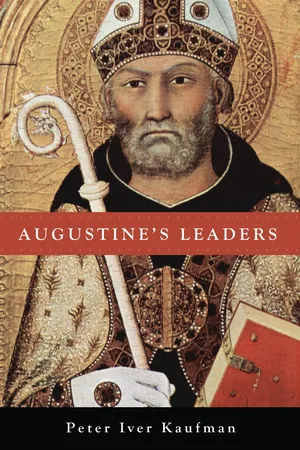
- 194 pages
- English
- ePUB (mobile friendly)
- Available on iOS & Android
eBook - ePub
Augustine’s Leaders
About this book
In Augustine's Leaders, Peter Iver Kaufman works from the premise that appropriations of Augustine endorsing contemporary liberal efforts to mix piety and politics are mistaken--that Augustine was skeptical about the prospects for involving Christianity in meaningful political change. His skepticism raises several questions for historians. What roles did one of the most influential Christian theologians set for religious and political leaders? What expectations did he have for emperors, statesmen, bishops, and pastors? What obstacles did he presume they would face? And what pastoral, polemical, and political challenges shaped Augustine's expectations--and frustrations? Augustine's Leaders answers those questions and underscores the leadership its subject provided as he continued to commend humility and compassion in religious and political cultures that seemed to him to reward, above all, celebrity and self-interest.
Information
Topic
Theology & ReligionSubtopic
Christian Theology1
Augustine’s Emperors
Wealth, Glory, and Domination
Several of the Old Testament’s leaders were known to sin scandalously. King David’s lust for another’s wife and his plan to eliminate her husband were perhaps the most memorable instances. Augustine’s attention, however, had been drawn to the allegations against Moses made by the Manichees, with whom he was closely associated for nearly ten years in the late fourth century (until the mid-380s) and who claimed the Hebrews’ liberator had sinned by pilfering the Egyptians’ properties before leading his enslaved people to freedom. Augustine answered that God commanded Moses to relieve the idolaters on the Nile of the gold they were using to gild their idols. Yet Augustine’s reply to the Manichees quickly got more involved, and one gets the impression that he was trying out alternative explanations for the theft. Might God have simply permitted rather than commanded the Hebrews to grab and go? Was Moses only relaying their license to steal? And “steal” might be too strong a word, Augustine went on, for God may have had the Jews appropriate the Egyptians’ wealth as wages for the work they had done in bondage. Of course, had the authorization originated with Moses, departing with the Egyptian gold would have been sinful. And there was no exonerating the Hebrews for greed stirred by their leader’s revelation that God would not have them leave empty-handed. They were no exceptions to the rule that was all too familiar to Augustine, who formulated it influentially: inordinate desires to acquire—cupidity or concupiscence—were stronger than restraints that conscience alone could impose. But Moses was exceptional; neither guile nor greed tainted his leadership. He had not coveted what his followers took from the Egyptians’ coffers. Most important for Augustine, Moses had not disputed God’s authority to punish the Egyptians and to provision the Hebrews they enslaved. The Manichees’ mockery of the Old Testament’s stories and protagonists betrayed a pernicious incredulity. Augustine left their company, in part, because they refused to accept what he subsequently would, without blinking, namely, that God’s will was always to be obeyed, even if divine intent was not instantaneously comprehensible.20
Leaders in the New Testament were cut from different cloth. They were fishermen and tax collectors following a carpenter from Galilee, whereas Moses and David were to the manor bred. Augustine imagined that God assembled apostles from among the powerless to shame the powerful. That worked; several centuries later, princes came to Rome, believing they could learn something significant for their souls’ salvation at the apostles’ and martyrs’ tombs.21 Jesus could have circulated the good news to the Jews as an affluent, polished orator—as one of the temple’s elite, Augustine continued; Jesus could have summoned celebrated, erudite teachers to retell his truths. Yet the fact that messengers and their messiah appeared so humbly left no doubt that God worked through the otherwise unimpressive to gain a victory vastly different from those accomplished by this world’s powers. But by the early fourth century, God had given the persuasive and powerful—even emperors—critical parts in Christianity’s mission. In effect, those elites conceded that God had first commissioned humble legates (and that humility and contempt for worldly honors was commendable) by setting aside their crowns (deposito diademate) as they came to Rome to repent at a fisherman’s tomb.22
Their repentance signaled to Augustine—more keenly than to the princely penitents themselves, one may suppose—that the glory associated with conquest and imperial expansion was specious and far inferior to God’s glory. Augustine featured that contrast between political achievement and God’s performances in the early books of his compendious City of God, which he wrote after Alaric had sacked the empire’s old capital in 410—and featured it in subsequent books for the next fifteen years. He recalled that Rome’s history started with fratricide. Its gods turned a blind eye to the carnage that attended the pursuit of honor and political power.23 Augustine conceded that virtuous people must have recoiled from the atrocities committed during the wars that turned their city, republic, and then empire into a sprawling leviathan. But leaders and chroniclers claimed that Rome’s reaching for more territory was always a reaction to its neighbors’ aggressions; others’ provocations led to Rome’s expansions. It attacked to defend or to deter attack.24 But, to Augustine, Rome’s wars exhibited its leaders’ lust to dominate. And that lust, along with the destruction and panic that resulted from it, could not be contained on the frontiers. Factions ruthlessly pursued power in Rome. Early in the first century BCE statesmanship gave way to savagery, which Augustine reported in considerable detail, noting that leaders of the late republic who had served in foreign wars and who had learned thereby how vengeance on the vanquished shored up victories then applied that lesson in Rome. Feuds left lasting scars on the body politic. But some who were spared the victors’ vengeance during civil wars grew numb. Gratitude for their survival had swallowed up compassion for their friends-turned-casualties. Dehumanization as well as periodic depopulation characterized Rome’s pre-Christian history—as reported by Augustine.25
Could it have been different, less grim? Might the Romans have resorted to appeasement more often than to force? Augustine concluded that, given their indomitable lust to dominate and their ignorance of what God required of them—as well as their persecution of the early Christians who had become aware of just that—Rome’s pagan statesmen and soldiers could hardly change their stripes. They accumulated territories, established bases, and subjugated others to their rule. They conferred the title “empire” upon their acquisitions. They were insatiable, plunging ahead with impunity (non adempta cupiditas, sed addita impunitas). Augustine’s withering analysis finished with a story about Alexander the Great that would have been familiar to Cicero’s and Sallust’s readers, who had learned from them about the Macedonians’ savagery and about the breathtaking speed with which they swept into Persia and beyond. In the well-traveled tale, imperious Alexander asked a pirate whom he had captured why he had taken to a life of larceny. The pirate deftly responded that he was no more a thief than was his captor. The only difference between the two was that terrorizing the seas with a single vessel was branded piracy or plunder, whereas doing much the same with a great navy was called “empire.” That curt reply, historian Brian Harding submits, enabled Augustine discreetly to “reveal the criminality obscured by the rhetoric of imperium [and of] pax romana.”26
Augustine’s endorsement of the pirate’s reply could well have been as unequivocal as Harding suggests. True, in his City of God, Augustine showed some respect for the pursuit of glory that led Romans to devote time, energy, and blood to secure their state, which secured their reputations as well. The territorial gains—then losses—were providentially plotted, Augustine believed, attributing the Romans’ association of glory with sacrifice to his God’s rule over history. But glory was undependable; Augustine explained that it was founded on the admiration of one’s subjects, who could be quite fickle, and on the skill of one’s publicists, who were known to fabricate or exaggerate. Moreover, even if leaders’ conduct was irreproachable and even if they treated enemies honorably and preserved the peace and prosperity of their cities and empires for a time, the glory they received as a reward was far inferior to the glory that God bestowed on apostles, martyrs, and faithful Christians.27
And havoc nearly always preceded glory. Gloryhounds, ne...
Table of contents
- Title Page
- Acknowledgments
- Introduction
- Chapter 1: Augustine’s Emperors
- Chapter 2: Augustine’s Bishops
- Chapter 3: Augustine’s Pastors
- Chapter 4: Augustine’s Statesmen
- Conclusion
- Bibliography
Trusted by 375,005 students
Access to over 1.5 million titles for a fair monthly price.
Study more efficiently using our study tools.
Frequently asked questions
Yes, you can cancel anytime from the Subscription tab in your account settings on the Perlego website. Your subscription will stay active until the end of your current billing period. Learn how to cancel your subscription
No, books cannot be downloaded as external files, such as PDFs, for use outside of Perlego. However, you can download books within the Perlego app for offline reading on mobile or tablet. Learn how to download books offline
Perlego offers two plans: Essential and Complete
- Essential is ideal for learners and professionals who enjoy exploring a wide range of subjects. Access the Essential Library with 800,000+ trusted titles and best-sellers across business, personal growth, and the humanities. Includes unlimited reading time and Standard Read Aloud voice.
- Complete: Perfect for advanced learners and researchers needing full, unrestricted access. Unlock 1.5M+ books across hundreds of subjects, including academic and specialized titles. The Complete Plan also includes advanced features like Premium Read Aloud and Research Assistant.
We are an online textbook subscription service, where you can get access to an entire online library for less than the price of a single book per month. With over 1.5 million books across 990+ topics, we’ve got you covered! Learn about our mission
Look out for the read-aloud symbol on your next book to see if you can listen to it. The read-aloud tool reads text aloud for you, highlighting the text as it is being read. You can pause it, speed it up and slow it down. Learn more about Read Aloud
Yes! You can use the Perlego app on both iOS and Android devices to read anytime, anywhere — even offline. Perfect for commutes or when you’re on the go.
Please note we cannot support devices running on iOS 13 and Android 7 or earlier. Learn more about using the app
Please note we cannot support devices running on iOS 13 and Android 7 or earlier. Learn more about using the app
Yes, you can access Augustine’s Leaders by Peter Iver Kaufman in PDF and/or ePUB format, as well as other popular books in Theology & Religion & Christian Theology. We have over 1.5 million books available in our catalogue for you to explore.