eBook - ePub
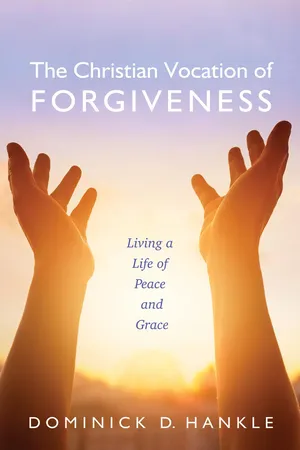
The Christian Vocation of Forgiveness
Living a Life of Peace and Grace
- 132 pages
- English
- ePUB (mobile friendly)
- Available on iOS & Android
eBook - ePub
About this book
Every soul carries within itself pain caused by the hurtful words and acts of another human being. How can you find peace and heal from these wounds? How can you live a Christian life reflective of Christ's command to be a forgiving, loving person? By integrating the work of psychologists and the deep theological truths of the Christian faith, Dr. Hankle answers these questions and more so you can live a healthy, flourishing, resilient life. He provides you with practical steps to incorporate in your daily spiritual practices so you may love and be loved as God intended.
Information
Topic
Theology & ReligionSubtopic
Christian Ministry1
Why Should Christians be Forgiving?
We receive a great many benefits from practicing virtue. Studies on gratitude, love, friendship, etc., are all areas of interest for a movement called positive psychology. This branch of psychology has built a body of evidence regarding the benefits of virtuous living. I applaud this work but caution Christians to remember there’s more to the exercise of virtue than immediate psychological and emotional benefits. The practice of virtue is about more than accommodating our personal well-being, it has to do with our vocation as Christians. While Christians should be grateful the practice of virtue benefits their personal lives, we also need to be mindful of the eternal perspective virtuous living embraces. This is especially true with forgiveness. It’s my hope this first chapter explains why forgiveness matters regardless of its effects on the quality of our lives in the here and now. We must understand forgiveness as something done in response to our calling. Let’s explore that idea a little more in the following pages.
Forgiveness, Part of the Christian Vocation
To understand why forgiveness matters we need to explore the concept of vocation. In particular, we need to understand the difference between a general vocation and a specific vocation. Let me use my life as an example to help explain these two different but related concepts. I serve the Lord through a number of particular vocations. First, I work as a psychology professor at a Christian university. That’s a particular vocation at a particular place in which I serve the Kingdom of God by educating students in the discipline of psychology. In addition to my job as a psychology professor I’m an ordained minister in a particular church body. That again is a particular vocation in which I serve a particular part of the body of Christ. Yet, within all these particular vocations there is a general vocation I exercise simply because I’m a Christian. Part of this general Christian vocation includes the idea I am an incarnational representation of forgiveness within the family and communities I live. To be Christian is to be a living sign of the forgiveness and reconciliation Christ offers the world.
For the Christian, a vocation is a response to a divine call. A vocation finds its source in God, not the individual. It’s a God given call (Thus the English word derives its meaning from the Latin word vocare which means to call) to which one must respond. The individual must respond but the response must be discerned through a number of channels, one in particular is the Christian community. The community is part of the discernment process because when we talk about particular vocations it’s within a communal context the individual serves. A particular vocation is always mediated through a faith community. Ministry is a perfect example because most Christians cannot simply proclaim themselves as pastors for a non-existent church. There’s always a community participating in the individual’s discernment regarding whether or not they are truly experiencing a call to ministry. This community might be the local church, a larger church body, or a seminary faculty. All of these are communities of people helping individuals discern whether or not what they believe their calling is comes from God or their own psychological processes.
While our particular vocations take time to process and are discerned through a number of channels, our common vocation is much more evident. By surrendering to Christ, we immediately understand we must live our lives differently than before as a response to that surrender. We may not do it perfectly, but there’s an obvious change caused by the Holy Spirit convicting us of the new life we’ve embraced and the sense this life means living differently. This common vocation requires us to love and serve God above all else and place ourselves at the service of others. Vocation in the Christian sense has ontological implications as well as functional implications. It’s a type of “being” manifested in “doing.” The Christian “takes back” his or her human dignity by choosing a life of grace instead of a natural life impacted by sin. Because we’re made in the image and likeness of God, a human life is best lived when it reflects the divine life in this fallen world. The Christian regains (Through grace) a special human dignity and lives in this dignified manner through acts of love toward God and neighbor. To live the general Christian vocation is to live as Christ demonstrates in Matthew 5:13–16:
You are the salt of the earth; but if salt has lost its taste, how can its saltiness be restored? It is no longer good for anything, but is thrown out and trampled under foot. You are the light of the world. A city built on a hill cannot be hidden. No one after lighting a lamp puts it under the bushel basket, but on the lampstand, and it gives light to all in the house. In the same way, let your light shine before others, so that they may see your good works and give glory to your Father in heaven.
This passage is a reminder God intends us to live lives incarnationally reflecting the divine life as a transforming agent making this world more perfectly reflect the coming Kingdom of God. Part of the Christian’s common vocation is to live kingdom values in the world. God intended human beings to live virtuously as benevolent caretakers of creation giving him glory and praise. In our fallen state we’re content to live creaturely instead of grace filled divinely ordered lives. We prefer living in darkness rather than in light. The virtuous life is deemed useless because it benefits others more than us. The light of kingdom values gets covered up and never gives the world the guidance it needs, the guidance we’re intended to provide as God’s caretakers of creation. People choose to be something they were never intended to be with every selfish act they perform. The Christian vocation calls us to recognize we’ve been “Fearfully and wonderfully made” (Psalm 139:14) and we are “Little less than the angels” (Hebrews 2:7). Sin has caused us to forget our true nature and embrace our creaturely, selfish, unfruitful lives instead of the grace filled lives God intended us to live.
To explore how we’ve come to such a sad condition it’s important to revisit the narrative of salvation outlined in the bible. Let’s look at that narrative now to lay a foundation for understanding why we must be agents of forgiveness if we call ourselves Christian.
The Creation and Fall of Humanity
Christianity is about relationships. It’s about the connections people make between God, one another, and the created order. This understanding of Christianity is most perfectly reflected in the concept of the Trinity. The Trinity is uniquely Christian. This triune concept of God makes Christianity different from other monotheistic religions. The Trinity describes the Godhead as one God consisting of three divine persons. God is one, but also three, reflecting not simply a lone God in the universe but a divine communion of love. Therefore, those created in his image are also created for relationships. The Christian faith knows God as a divine communion of three persons each distinct from the other yet consisting of the same divine substance. Everything begins and proceeds from the Father the creator of heaven and earth. Coexisting with God the Father is God the Son, the eternal Word from which the Father speaks creation into existence. This eternal Word became incarnate as Jesus Christ the one who perfectly reveals the Father’s will for all humanity. God the Father intensely loves God the Son and gives all of creation to the Son as an act of selfless giving and grace. The Son eternally receives the gift of creation but in a completely selfless act lovingly returns it to the Father in adoration for all the Father is and does. This continual act of receiving and giving in pure love is a type of dance; a unified process from which flows the Holy Spirit, the loving essence of the internal life of the Trinity. God within himself is distinctly three persons, the Father who creates, the Son who adores the Father, and the Holy Spirit personifying the loving action within the Godhead. The Holy Spirit is not merely a force but a divine person proceeding from the Father. These three persons are related in such a loving union they exist as one God. The mystery of the Trinity can be described as one God eternally existing as three divine persons yet never viewed as three distinct Gods. They share the same divine substance but are uniquely their own persons. It’s hard to wrap your mind around these concepts (Thus the term mystery is applied to the concept of Trinity) but it’s Christianity’s understanding of the Godhead. The early Christians discussed this connection and economic manifestation constantly. Here is an example from Tertullian, a western father of the church who wrote the following in the second century:
Thus the connection of the Father in the Son, and of the Son in the Paraclete, produces three coherent Persons, who are yet distinct One from another. These Three are one essence, not one Person, as it is said, “I and my Father are One,” in respect of unity of substance, not singularity of number.1
Understanding this relational nature of God helps us understand something about ourselves. The key question needing answered is if we’re created in the image of God existing eternally as a loving communion how is it reflected in who we are? To answer that question we need to reflect on the first few chapters of Genesis.
The first chapter of Genesis describes God creating everything we know as real. God creates the heavens, the earth, and the rest of creation as a divine craftsman ordering things perfectly. The pinnacle of his creation is the human person. God intended people, created in his image, to most perfectly reflect this image as a community, not merely as isolated individuals. The second chapter of Genesis fills in the gaps the first creation account left open by showing us the importance of the communal existence of human beings. In the second chapter of Genesis God places Adam in a Garden where he lives and cares for the created order. God created Adam to be a good steward of creation. Additionally, Adam was meant to live a life of communion with God himself. In other words, humanity was meant to participate in the life of God by reflecting his divine image upon creation caring for and nurturing what God created. Additionally, as part of creation and its keeper people have the responsibility for taking all creation has to offer and give it back to God through praise and worship in awe of his majesty and glory (sounds a little like our reflection on the internal life of the Trinity, doesn’t it?) Importantly, at this point in the narrative, God asks Adam to name all the creatures he created. While doing this Adam recognizes he’s alone. It’s as if God wants Adam to come to the realization with every creature he names “I am incomplete.” God echoes that experience when he says in Genesis chapter 2, verse 18: “It is not good that man should be alone; I will make him a helper as his partner.” Ultimately, after Adam names all of creation God creates from Adam’s side a partner that will complete him. The Genesis account reads as follows (Chapter 2 verses 21 through 25):
So the Lord God caused a deep sleep to fall upon the man, and he slept; then he took one of his ribs and closed up its place with flesh. And the rib that the Lord God had taken from the man he made into a woman and brought her to the man. Then the man said, ‘This at last is bone of my bones and flesh of my flesh; this one shall be called Woman, for out of Man this one was taken.’ Therefore a man leaves his father and his mother and clings to his wife, and they become one flesh. And the man and his wife were both naked and were not ashamed.
There’s so much to take from these passages we could get lost in the content for decades. For now let’s continue focusing on the manner in which they speak about humanity’s communal nature as a reflection of the divine. The account of Adam and Eve’s creation demonstrates human beings are not intended to live alone. People flourish best when they share their lives with others. By the time you get to the end of the first two chapters of Genesis you discover God the creator of all things takes joy in his creation. God is not distant and uninvolved with creation rather he delights in it describing it as good. To complete the goodness of creation God makes people rule over and care for his good work. God never intends people to use creation for destructive and selfish reasons. Humanity is meant to share in God’s divine life by living in communion with him and in harmony with the rest of creation. Human beings are different from the rest of the created world because they were made to reflect the divine life of God back into the created order. To do this well God created men and women to live in a loving communion in which the two become one flesh just as the three divine persons are one God.
The stage is set. If the story stopped here all would be well. However, when we look around we certainly don’t find this communion of love being expressed in the way we live today. What went wrong? Continued reflection on the narrative of Genesis provides us with the answer. Chapter three starts with a story about a serpent and the woman Eve. It’s in this part of the narrative we discover how easily we can abuse the great gift of free will God blessed us with from the start of our creation.
In the beginning of time God gave humanity one law. Don’t eat the fruit of one particular tree. The fruit of this tree poisons the human spirit taking away its innocence. Once it’s eaten the world is understood in terms of good and evil. These forces are difficult to discern from one another because by eating this fruit the human spirit becomes disordered. Evil brings confusion while good allows for order and structure. God desires human beings to exist holistically in a state of order to live in relationship with him, not confused and “disordered” blinded by evil struggling to discover what is good. The fruit of the forbidden tree distorts humanity’s ability to love. Originally human beings loved properly and in an orderly fashion; God first, then each other. After being poisoned by the fruit confusion crept into the core of humanity’s existence and twisted their ability to love. Let’s continue reflecting on the narrative.
Eve finds herself in a conversation with the serpent who asks her about this forbidden fruit God commanded them to avoid. Eve responds in Genesis chapter 3 verses 2 and 3, “We may eat of the fruit of the trees in the garden; but God said you shall not eat of the fruit of the tree that is in the middle of the garden, nor shall you touch it, or you shall die.” Evil, represented by the serpent, is a master at twisting meaning and words around developing lies that seem reasonable and truthful. That’s exactly what happens in this conversation. Evil knows how to play on the human heart drawing out selfishness, the very thing that twists love around destroying its divine characteristic and making it worldly. The serpent responds to Eve saying in verses 4 and 5, “You will not die; for God knows that when you eat of it your eyes will be opened, and you will be like God, knowing good and evil.”
A simple dialog starts the unraveling process of creation. Just a few innocent words passed between two creatures have tremendous ramifications for reality. No longer believing God desires what’s good for them, human beings want to “be God” instead of being “like God.” Disorder s...
Table of contents
- Title Page
- Chapter 1: Why Should Christians be Forgiving?
- Chapter 2: The Characteristics of Forgiveness
- Chapter 3: Forgiveness in the Early Christian Community
- Chapter 4: A Psychological and Theological Look at Forgiveness
- Chapter 5: Exercising Forgiveness and the Fruits of a Forgiving Life
- Bibliography
Trusted by 375,005 students
Access to over 1.5 million titles for a fair monthly price.
Study more efficiently using our study tools.
Frequently asked questions
Yes, you can cancel anytime from the Subscription tab in your account settings on the Perlego website. Your subscription will stay active until the end of your current billing period. Learn how to cancel your subscription
No, books cannot be downloaded as external files, such as PDFs, for use outside of Perlego. However, you can download books within the Perlego app for offline reading on mobile or tablet. Learn how to download books offline
Perlego offers two plans: Essential and Complete
- Essential is ideal for learners and professionals who enjoy exploring a wide range of subjects. Access the Essential Library with 800,000+ trusted titles and best-sellers across business, personal growth, and the humanities. Includes unlimited reading time and Standard Read Aloud voice.
- Complete: Perfect for advanced learners and researchers needing full, unrestricted access. Unlock 1.5M+ books across hundreds of subjects, including academic and specialized titles. The Complete Plan also includes advanced features like Premium Read Aloud and Research Assistant.
We are an online textbook subscription service, where you can get access to an entire online library for less than the price of a single book per month. With over 1.5 million books across 990+ topics, we’ve got you covered! Learn about our mission
Look out for the read-aloud symbol on your next book to see if you can listen to it. The read-aloud tool reads text aloud for you, highlighting the text as it is being read. You can pause it, speed it up and slow it down. Learn more about Read Aloud
Yes! You can use the Perlego app on both iOS and Android devices to read anytime, anywhere — even offline. Perfect for commutes or when you’re on the go.
Please note we cannot support devices running on iOS 13 and Android 7 or earlier. Learn more about using the app
Please note we cannot support devices running on iOS 13 and Android 7 or earlier. Learn more about using the app
Yes, you can access The Christian Vocation of Forgiveness by Dominick D. Hankle in PDF and/or ePUB format, as well as other popular books in Theology & Religion & Christian Ministry. We have over 1.5 million books available in our catalogue for you to explore.