eBook - ePub
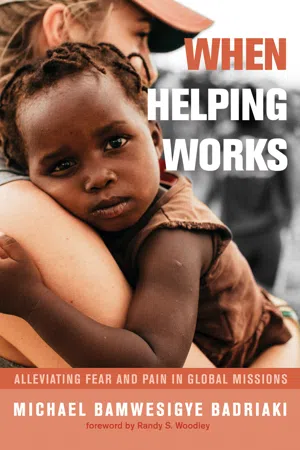
When Helping Works
Alleviating Fear and Pain in Global Missions
- 172 pages
- English
- ePUB (mobile friendly)
- Available on iOS & Android
eBook - ePub
About this book
Today, people from various parts of the world who are interested in helping fellow human beings impacted by famine, epidemics, wars, and poverty are uniquely positioned. They are interconnected due to globalization's impact, which also has implications for intercultural work and global missions. The ability to help people is a constructive asset, which calls for the need to build friendships and partnerships across the globe. Helping well depends on a number of factors, yet this book looks into the impact of stereotype threat and its effects on intercultural identities, the perceptions of others, and performance in intercultural missions. Human interactions continue to suffer due to fears, anxious reactions about confirming negative stereotypes about a person's identity, abilities, and effectiveness in global missions. Stereotype threat happens when caricatures and negative understandings about people's identities are invoked.
Information
Topic
Theology & ReligionSubtopic
Education GeneralChapter 1
To Give . . . or Not to Give . . . That Is the Question
Facts are stubborn things; and whatever may be our wishes, our inclinations, or the dictates of our passions, they cannot alter the states of facts and evidence.
John Adams1
My friend Dave is from England. Dave remembers when he realized he was very rich. He was working with a small UK Christian charity in Northern Thailand driving a pickup truck along a dusty dirt road in the stunning jungle mountains of the Thai/Myanmar border delivering rice, dried fish, oil, and chili to some of the refugee communities we were working with. The area was and still is surrounded by communities of displaced Shan people from Myanmar fleeing the long-standing persecution of ethnic groups by the military government. To avoid arrest, many families work in the fields by day for the smallest of wages and live in makeshift communities with limited access to basic provisions, health services, or education for their children. Families fear the authorities may exploit their vulnerable position by demanding bribes or may deport unregistered migrants back to the border. This is a journey back to persecution.
At one of the first communities to which Dave came, a man led him to a frail, elderly woman in her bamboo home who was very sick with belly pain and had not eaten for days. Her family was clearly very fearful and anxious. What should he do? He had a vehicle; cash in his wallet, and legitimate papers to be living and working in Thailand and was standing face to face with the woman with no vehicle, no cash in her wallet, and no legal papers to be in Thailand. She was in a lot of pain. This was in 2001.
In 1993 Dave became a Christian at the age of seventeen; he was propelled by God’s love to help other people. At the age of eighteen he went joined Youth With a Mission for Discipleship Training School, followed by the School of Frontier Missions, and became a missionary afterward. His journey to being on the Thai/Myanmar border road that day involved a myriad of learning and experiences: a three-month placement in Seville, Spain, with a Spanish church, a three-month placement in Kolhapur, India, working under an Indian pastor and his family, two years in China managing a project in a state-run orphanage, and three years of working with displaced communities in Northern Thailand. He met this lady and her family that day as he was delivering food to several of the families on the border. This meeting is not apart from a larger history because Dave was born and raised in England and she belonged to the Shan people group of Myanmar. It was Dave’s country’s government and colonialist endeavors over sixty years ago that had created the military Burman government that had ousted her family from their family lands through persecution and forced dislocation across the border into Thailand. There was a broader historical context to our meeting. Our meeting was not without the prejudices, experiences, and stereotype perceptions that had shaped both of them. Yet, he had money, a vehicle, and other resources. She did not.
What was his excuse? Should he pause to pray about it and come back another day? Should he ask “what would Jesus do?” His response on that day was unequivocal. He placed the elderly lady inside the front of the truck with her family in the back and drove to the hospital in Fang. He walked into the patient admitting area, he handed over his driver’s license, and told the hospital staff he was responsible for this family and the costs. A week later, after a successful surgery, they all drove back to her home with smiles on their faces thanking God for his loving kindness and continued waking up daily to life. Was that the right thing to do? Should he have helped? Another scenario is about Jane (that’s not her real name). She was a university student at Makerere University, the largest university in Uganda, and my colleagues and I met her while doing community outreach work. She and her family contributed to her tuition at college.
However, a time came when she wasn’t able to afford the fees she needed to graduate due to financial hardship. In Uganda, there isn’t a federal student loan program like that in United States. Jane was hopeful that God would provide for her need and she shared with a few friends about the remaining tuition she needed to graduate. One of her friends was my wife, Kristen, who was visiting in Uganda from the United States. Along with others, Kristen eagerly helped. Jane is a teacher, a mother, and is pursuing her goals in life. It’s been close to fifteen years now; Jane and Kristen are longtime friends. Should Kristen have ignored Jane’s challenge and left it up to Jane’s Ugandan friends, resisting the opportunity to help because Kristen was an “outsider”?
Let me introduce a different story, close to a decade later, in another context on the Isle of Wight in England, over five thousand miles away from Fang. In 2009, Mark Wells was walking home one night when he fell head first into a storm drain yards from his house. All through the night he shouted, “Help me, help me, please,” but neighbors were too frightened to help. Dismissed as a drunk by his neighbors, Mr. Wells was found dead in the morning as he had suffocated during the night. According to the newspaper article, the coroner did not blame residents for ignoring the thirty-two-year-old’s cries, saying it was a “sad reflection on society that people were too scared to venture out of their homes when they heard screams,” and that people are fearful and nervous about getting involved when faced with the reality of helping or not helping in a situation. Bill Fox, chairman of the conflict management training company Maybo stated that “the worst thing is to do nothing.”2
It is very pertinent that this quote comes from a professional conflict management specialist, because conflict at many levels is a real issue of our time in global missions. Many people have developed an internal soul conflict about helping. We are fearful, we are confused, and many of us have experienced great pain in the process of helping and receiving help. Why? What has happened? In 2010, Dave and I facilitated a potential donor team from a US church. We were visiting an HIV clinic for children started by the NGO we were working for. It was late in the evening, the clinic was closed, and the hosting was over when a distraught girl came out of the village toward Dave while I was meeting with another group of people in the community. She was carrying her baby sister, a sick and limp child suffering from malaria. The parents had died from HIV/AIDS. Again, we had a vehicle, cash in our wallets, and yet . . . this time he did not help. Instead, they just prayed for the child.
Why did he not help?
According to Dave, he had become afraid to get involved. He had become confused about helping. He was a prime candidate for the bystander effect. Where would he take her? The clinic was closed. It was late at night. He was responsible for a team of western donors who needed to head back to the guesthouse. Why did he just not open his wallet and give her money? What had happened to him since 2001? He found himself with questions like: Should he give her money? Can he trust this person to use the money? Shouldn’t she trust God for the money from her neighbors? Should he go and knock on the straw doors of the mud huts to corral the neighbors into giving money from local assets? I can guarantee you that if he had given the lady $20 or $50 from his wallet that within twenty-four hours that sick child would have been in the nearest best clinic in her district or in Kampala, the capital city of Uganda. (Generally, the closer a sick person can get to the larger cities, the better the health care.)
She would have used that money to find a bike, a truck ride, or a bus to get her child the care she needed. In this instance, not helping definitely hurt. He discussed this story with a psychologist recently who suggested to him that were she in this situation she would have sat down with the girl and sick baby to help her understand what her problems really were and to understand why she was poor. It is understandable that she was coming from a clinic background; however, this is a case that required resource help at that given point in time and not just psychoanalytic tactics. The family needed money immediately, not questions. When a house is on fire do you stop to think about the possible cause of the fire, or do call 911?
Dave would tell you there are many people he has met that he both has and has not helped. Indeed, it is the people he has not helped that he remembers most clearly. It is seared into his conscience, like a sinful occurrence. He would say he went against scripture (Jas 2:16; 1 John 3:17). Was helping in Fang and not helping in Uganda the right thing to do? According to Fikkert and Corbett’s viewpoint, he should have stepped back, made sure he had the right policy, researched the community extensively, mobilized local assets and been aware of the “explicit guidelines or policies as to roles and authority [in the community], including what to do if the community members don’t carry out their responsibilities.”3
This may be the view in some development and technocratic circles, but the reality is not that clear-cut or well-set in the daily experience of the non-Western resource poor and even in the biblical understanding generosity. Christians are called to a life of generosity in good times and in bad times, in season and out of season. As followers of Christ, we are called to participate in the good news.
“If you see some brother or sister in need and have the means to do something about it but turn a cold shoulder and do nothing, what happens to God’s love? It disappears. And you made it disappear.”4
In the story of the aging lady in Fang, she was terribly sick and needed help; based on Scripture, we believe the answer is a resounding and non-negotiable yes. Dave should have helped and anyone in this position ought to do the same in global missions. Today’s Christian cultural question asks “what would Jesus do?” Yet if one looked attentively to the Scriptures, it is apparent that a better reflection leads us to imagine Jesus asking, “What did I say, and based on my word, what are you going do?”5
Jesus said of the faithful and prepared servant, “For I was sick and you visited me.”6 Without debating which kind and what degree of sickness is deserving of attention and which is not, it is clear that Jesus invites his disciples and followers in the global church to respond to human deprivation. In all the Abrahamic faiths, there are practices that are dutiful for the adherents. For example, in Islam, the practice of charity to the poor is not a choice, it is obligatory. Jesus’ dialogue with the wealthy ...
Table of contents
- Title Page
- Foreword
- Acknowledgments
- Preface
- Introduction: You Should Help!
- Chapter 1: To Give . . . or Not to Give . . . That Is the Question
- Chapter 2: Unmasking Fear, Anxiety, and False Guilt in Giving
- Chapter 3: Something’s In the Air
- Chapter 4: Go to All the Nations! Ready, Steady, Go!
- Chapter 5: Fighting with the Lion
- Chapter 6: Today It’s Me; Tomorrow It’s Someone Else
- Chapter 7: Past and Collective Experiences in Global Mission
- Chapter 8: The Circle of Helping of ‘Do Gooders’
- Chapter 9: Hope Abounds
- Bibliography
Trusted by 375,005 students
Access to over 1.5 million titles for a fair monthly price.
Study more efficiently using our study tools.
Frequently asked questions
Yes, you can cancel anytime from the Subscription tab in your account settings on the Perlego website. Your subscription will stay active until the end of your current billing period. Learn how to cancel your subscription
No, books cannot be downloaded as external files, such as PDFs, for use outside of Perlego. However, you can download books within the Perlego app for offline reading on mobile or tablet. Learn how to download books offline
Perlego offers two plans: Essential and Complete
- Essential is ideal for learners and professionals who enjoy exploring a wide range of subjects. Access the Essential Library with 800,000+ trusted titles and best-sellers across business, personal growth, and the humanities. Includes unlimited reading time and Standard Read Aloud voice.
- Complete: Perfect for advanced learners and researchers needing full, unrestricted access. Unlock 1.5M+ books across hundreds of subjects, including academic and specialized titles. The Complete Plan also includes advanced features like Premium Read Aloud and Research Assistant.
We are an online textbook subscription service, where you can get access to an entire online library for less than the price of a single book per month. With over 1.5 million books across 990+ topics, we’ve got you covered! Learn about our mission
Look out for the read-aloud symbol on your next book to see if you can listen to it. The read-aloud tool reads text aloud for you, highlighting the text as it is being read. You can pause it, speed it up and slow it down. Learn more about Read Aloud
Yes! You can use the Perlego app on both iOS and Android devices to read anytime, anywhere — even offline. Perfect for commutes or when you’re on the go.
Please note we cannot support devices running on iOS 13 and Android 7 or earlier. Learn more about using the app
Please note we cannot support devices running on iOS 13 and Android 7 or earlier. Learn more about using the app
Yes, you can access When Helping Works by Michael Bamwesigye Badriaki in PDF and/or ePUB format, as well as other popular books in Theology & Religion & Education General. We have over 1.5 million books available in our catalogue for you to explore.