eBook - ePub
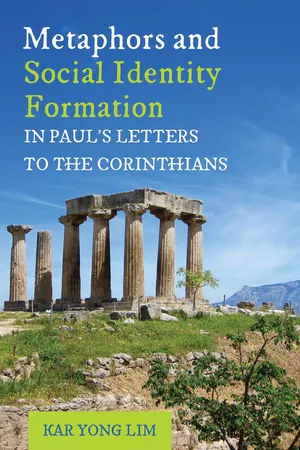
Metaphors and Social Identity Formation in Paul’s Letters to the Corinthians
- 266 pages
- English
- ePUB (mobile friendly)
- Available on iOS & Android
eBook - ePub
Metaphors and Social Identity Formation in Paul’s Letters to the Corinthians
About this book
Why did Paul frequently employ a diverse range of metaphors in his letters to the Corinthians? Was the choice of these metaphors a random act or a carefully crafted rhetorical strategy? Did the use of metaphors shape the worldview and behavior of the Christ-followers?
In this innovative work, Kar Yong Lim draws upon Conceptual Metaphor Theory and Social Identity Theory to answer these questions. Lim illustrates that Paul employs a cluster of metaphors--namely, sibling, familial, temple, and body metaphors--as cognitive tools that are central to how humans process information, construct reality, and shape group identity. Carefully chosen, these metaphors not only add colors to Paul's rhetorical strategy but also serve as a powerful tool of communication in shaping the thinking, governing the behavior, and constructing the social identity of the Corinthian Christ-followers.
Information
Topic
Theology & ReligionSubtopic
Biblical StudiesPart I
1
Paul’s Use of Metaphors in the Corinthian Letters
Introduction
In his letters to the Corinthians, Paul skillfully uses metaphors1 drawn from the social reality, cultural background, and symbolic universe of his predominantly Greco-Roman audience. He also creatively employs metaphors to instruct, rebuke, and build up these communities. Not only are metaphors central to Paul’s arguments, they are also a powerful tool of communication which enabled his audience to visualize things in new and different ways.
Referring to the recipients’ former pagan religious practices, Paul declared: “Do you not know that you are God’s temple and that God’s Spirit dwells in you? If anyone destroys God’s temple, God will destroy that person. For God’s temple is holy, and you are that temple” (1 Cor 3:16–17).
Paul also drew on architectural terminology to express his role as an apostle to those who would have been familiar with construction, having witnessed the rebuilding of the city of Corinth since 44 BCE: “For we are God’s servants, working together; you are God’s field, God’s building. According to the grace of God given to me, like a skilled master builder I laid a foundation, and someone else is building on it. Each builder must choose with care how to build on it” (1 Cor 3:9–10).
Paul also evoked the imagery of paterfamilias in addressing the Corinthians: “I am not writing this to make you ashamed, but to admonish you as my beloved children. For though you might have ten thousand guardians in Christ, you do not have many fathers. Indeed, in Christ Jesus I became your father through the gospel” (1 Cor 4:14–15).
Knowing that the Corinthians were familiar with the Isthmian Games held bi-annually near Corinth, Paul employed athlete imagery in speaking to them: “Do you not know that in a race the runners all compete, but only one receives the prize? Run in such a way that you may win it. Athletes exercise self-control in all things; they do it to receive a perishable wreath, but we an imperishable one. So I do not run aimlessly, nor do I box as though beating the air; but I punish my body and enslave it, so that after proclaiming to others I myself should not be disqualified” (1 Cor 9:24–27).
The patronage system was deeply entrenched in the Greco-Roman society, and Paul drew on the social convention of using letters of recommendation in 2 Corinthians: “Are we beginning to commend ourselves again? Surely we do not need, as some do, letters of recommendation to you or from you, do we? You yourselves are our letter, written on our hearts, to be known and read by all; and you show that you are a letter of Christ, prepared by us, written not with ink but with the Spirit of the living God, not on tablets of stone but on tablets of human hearts” (2 Cor 3:1–3).
Finally, Paul also used imagery familiar to the Greco-Roman audience when he compared the Corinthian community to the function of a human body: “Indeed, the body does not consist of one member but of many. If the foot would say, ‘Because I am not a hand, I do not belong to the body,’ that would not make it any less a part of the body. And if the ear would say, ‘Because I am not an eye, I do not belong to the body,’ that would not make it any less a part of the body. If the whole body were an eye, where would the hearing be? If the whole body were hearing, where would the sense of smell be? But as it is, God arranged the members in the body, each one of them, as he chose” (1 Cor 12:14–18).
How do we make sense of these diverse metaphors that Paul used in his correspondence to the Corinthians? Are they merely random rhetorical tools he employed to drive home a point in his argument? Or was Paul’s use of metaphors a very calculated and deliberate attempt to convey the truth of the gospel in a deeper manner? Was there a wider agenda in Paul’s theological discourse when he used these metaphors in rebuking, exhorting, and encouraging the Christ-followers in Corinth?
Until the last decade, Paul’s use of metaphors has been largely downplayed by his interpreters. This is evident when one compares the number of studies dedicated to the investigation of metaphors to those on, say, Pauline theology. Even when studies on metaphors are being carried out, they are usually from the perspective of a particular theological framework that often discounts the social reality of these metaphors. Some examples of these include election, redemption, justification, reconciliation, and adoption where Paul’s theology has been largely perceived as the springboard from which to understand these metaphors. However, without a proper understanding of Paul’s use of imagery, it is impossible to arrive at a complete understanding of his message to his audience. Ian Paul has underscored this serious lack of proper interpretation of metaphor, and this is puzzling as metaphor “is one of the most crucial areas on the whole of hermeneutics since so much of biblical theology hangs on metaphors.”2
The thesis of this study is that Paul used metaphor not only to instruct, rebuke, and present a theological argument of his understanding of the various issues that confronted the community, but that his primary reason was to employ metaphor in the task of community building and social identity formation in Christ, one that was deeply rooted in the Scripture of Israel and the social conventions of the Greco-Roman world. As such, Paul’s use of these metaphors goes beyond a theological treatise. Metaphors are used to convey Paul’s understanding of what it means to be followers of Christ as demonstrated in the Corinthians’ communal existence as the living exegesis of the gospel of Christ.
Previous Studies on Paul’s Use of Metaphors
An earlier study of Paul’s metaphors is the 1964 publication of Herbert M. Gale.3 Gale expresses surprise that little treatment has been given to the investigation of the analogies of Paul. This lack of attention is even more pronounced since a number of Paul’s analogies “have played an extremely important role in the formulation and expression of many of the most important Christian theological ideas and doctrines.”4 As such, he sets out to explore Paul’s use of metaphors in the seven undisputed letters with the aim that these analogies “can be employed justifiably as a basis for an understanding of the apostle’s theological thought.”5 The primary aim of Gale’s investigation is directed at uncovering Paul’s theological thought through metaphors and not how they function in the understanding of ...
Table of contents
- Title Page
- Permissions
- Acknowledgments
- Abbreviations
- Introduction
- Part I
- Part II
- Part III
- Bibliography
Trusted by 375,005 students
Access to over 1.5 million titles for a fair monthly price.
Study more efficiently using our study tools.
Frequently asked questions
Yes, you can cancel anytime from the Subscription tab in your account settings on the Perlego website. Your subscription will stay active until the end of your current billing period. Learn how to cancel your subscription
No, books cannot be downloaded as external files, such as PDFs, for use outside of Perlego. However, you can download books within the Perlego app for offline reading on mobile or tablet. Learn how to download books offline
Perlego offers two plans: Essential and Complete
- Essential is ideal for learners and professionals who enjoy exploring a wide range of subjects. Access the Essential Library with 800,000+ trusted titles and best-sellers across business, personal growth, and the humanities. Includes unlimited reading time and Standard Read Aloud voice.
- Complete: Perfect for advanced learners and researchers needing full, unrestricted access. Unlock 1.5M+ books across hundreds of subjects, including academic and specialized titles. The Complete Plan also includes advanced features like Premium Read Aloud and Research Assistant.
We are an online textbook subscription service, where you can get access to an entire online library for less than the price of a single book per month. With over 1.5 million books across 990+ topics, we’ve got you covered! Learn about our mission
Look out for the read-aloud symbol on your next book to see if you can listen to it. The read-aloud tool reads text aloud for you, highlighting the text as it is being read. You can pause it, speed it up and slow it down. Learn more about Read Aloud
Yes! You can use the Perlego app on both iOS and Android devices to read anytime, anywhere — even offline. Perfect for commutes or when you’re on the go.
Please note we cannot support devices running on iOS 13 and Android 7 or earlier. Learn more about using the app
Please note we cannot support devices running on iOS 13 and Android 7 or earlier. Learn more about using the app
Yes, you can access Metaphors and Social Identity Formation in Paul’s Letters to the Corinthians by Kar Yong Lim in PDF and/or ePUB format, as well as other popular books in Theology & Religion & Biblical Studies. We have over 1.5 million books available in our catalogue for you to explore.