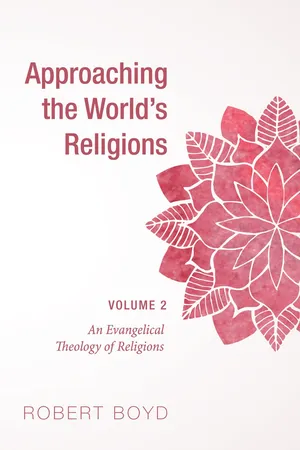
eBook - ePub
Approaching the World’s Religions, Volume 2
An Evangelical Theology of Religions
- 260 pages
- English
- ePUB (mobile friendly)
- Available on iOS & Android
eBook - ePub
About this book
Evangelical theology strives to be evangelical, conservative, and contemporary. In a world in which everyone is "Christian," evangelical theology provides a balanced position between fundamentalism and liberalism. While theological debates within the family will occur, to be evangelical is a breath of fresh air for many.
However, we do not live in such a world. We do find ourselves living in a secular, global society. It is secular because no religious organization dictates how we live our lives. It is global for at least two reasons. First, our technology brings us immediately in contact with those faraway places. Second, and of more importance, we can simply step outside our front doors and encounter our neighborhoods that reflect a global pluralism.
This raises the question, how shall we then live? The intent of An Evangelical Theology of Religions is to suggest a direction for evangelicals to think about the secular, global society in which they live in a way that is not only conservative but also evangelical and contemporary. The final essay strives to address the evangelical aspect of our tradition that places an emphasis on the Great Commission and the law of love.
Information
Topic
Theology & ReligionSubtopic
Christian TheologyPart 1
Preliminary
1
Christian Relationship with the World
Evangelicalism and World Religions1
The theology of relationships is vital, not only for those who wish to be relevant in their theology today, but for those who seek to understand the mind of God. For, if our theology does not speak of relationships in a contemporary setting, it may become irrelevant for individuals today and fail our contemporary and often impersonal society. Furthermore, we must not ignore that the God portrayed in the Scriptures is self-revealing and seeking relationships with the created. Establishing relationship and community seems to be a vital desire and activity of the Christian God. In this essay I wish to focus on the Christian relationship as it pertains to the world. As one who identifies himself as an evangelical Christian, I will address this focal point from an evangelical perspective.While there is much misunderstanding regarding evangelical theology, there seem to be three crucial aspects of the tradition. First, it is committed to the Christian Scriptures. Second, it is committed to evangelism and discipleship. And third, it exhibits a level of theological tolerance absent in other forms of conservative Protestant Christianity. Whereas in some cases evangelicalism has exhibited tolerance of other parts of the Christian tradition, it has lacked such tolerance of non-Christian faith traditions. It is this relationship, i.e., between evangelical Christians and members of other religions that I wish to direct our attention. This essay will not address those exhortations to be “in the world, but not of the world.” That aspect of the relationship between Christians and the world, which calls for some level of separation, is outside the scope of this project. Furthermore, evangelicals continue, and rightly so, to emphasize evangelism and sharing the gospel. This too is outside the scope of this paper. My purpose is to address an aspect of the Christian’s relationship to the world that is often overlooked. I will claim that evangelical Christians should embrace a position that is both agnostic and optimistic as they seek relationships with members of other faith traditions. In order to accomplish this task I will begin by briefly laying out foundational information. Then in the second section, I present five general observations pertinent to constructing an evangelical theology of Christian relationship with the world, i.e., with those outside of the Christian faith. This essay will introduce issues that will be further explored in later essays.
Foundational Information
It has been suggested that Romans 12 provides a model for Christian relationships with the world. However, this Pauline literature must be seen in its context. If we are to understand Romans 12 as a model, it must be viewed in the context of the entire book of Romans. Chapters 1 through 8 are often seen as a doctrinal dissertation, which ends with a confidence that God is able to accomplish that which God desires. This confidence in God’s ability poses an interesting dilemma for our writer. God had established a covenant with the Jewish people. This promise included that the Christ would come through that group of people (Gal 3:15–18), but the Old Testament suggests that God’s covenant also intended to bring that group of people into a final community with God.2 Yet, Paul faces the apparent reality that as a people, the Jews had rejected the Christ. He addresses this dilemma in chapters 9 through 11. Two things are significant from these three chapters for our current purpose. First, Paul is optimistic that Israel, the Jewish people, has a future in God’s plan. God will accomplish what God had promised. Notice the Christ had come and was rejected, yet Paul expects a future for his people; he expects them to experience a relationship with God. God has not replaced Israel with the church. Second, Paul does not seem to understand how God will accomplish this. Hence, Paul is both hopeful and agnostic regarding the future of Israel and its relationship with God. As a result, this concrete example connects the doctrinal chapters of Romans to its practical applications in chapters 12 through 15. It is Paul’s stance of agnosticism and optimism that lays the foundation for chapter 12 of Romans as a model for the Christian relationship in the world.
The relationship between Christians and members of other faith traditions is a critical issue within the theology of religions. Discussions in this field of theology frequently identify three basic categories: pluralism, inclusivism, and exclusivism or particularism.3 For evangelicals concerned about their relationship to the world and specifically to members of other faith traditions, these three categories are obstacles, for they oversimplify the complexity of evangelical theology and its understanding of other traditions. Regarding the agency by which God brings individuals into community, evangelicals are exclusivists. Jesus Christ is the only means by which community is possible with God. Atonement is possible only because of the Christ-event. However, regarding the recipients of salvation or those to whom God gives community, evangelical theology acknowledges that there are individuals outside of the church who are saved. (A quick glance at the “great cloud of witnesses” is provided in Hebrews 11, and the list consists of many who never knew Jesus Christ or knew of him.) The Christ of Colossians is a cosmic Christ whose impact goes far beyond the church. So in this sense, evangelicals are inclusivists. Yet when we ask, “Who may possess religious truth?” evangelicals cast the net even wider. While Christians claim a superior revelation in both the written and living Words, evangelicals must not deny that God reveals through general revelation, e.g. conscience and nature. Given the Noahic covenant and the scope of general revelation, evangelicals are pluralists regarding religious truth. As a result, any attempt to categorize evangelical theology in terms of the typical typology is doomed to fail. Having sketched the foundational position of this discussion, I will now present five general observations, as well as two critical elements, if an evangelical stance is to be developed regarding Christian relationships with the world.
General Observations
The development of an evangelical theology of religions provides a fascinating challenge. It must be faithful to those elements that may be seen as key characteristics of evangelicalism, and it must present a story of how evangelicals should understand and relate to individuals who belong to non-Christian faith traditions. These two points can create tension. The tension may exist because evangelicals, like most human beings, tend to think in terms of either/or, black/white, Christian/non-Christian, us/them, and so forth. The challenge facing evangelicals is to develop a theology that does not reject the foundational beliefs of evangelicalism but that does encourage a move beyond dualistic thinking. This is my first observation. Krister Stendahl offers sound advice, which if heeded by evangelicals may be very helpful.4 He proposes stepping back and looking at a wider panorama than is normal when developing a theology. For understandable reasons, evangelical theologians have focused on Jesus Christ and the Christian church. However, Jesus Christ and the Christian church are only part of a larger drama. Stendahl suggests that we can best see this larger drama as we look at the message and mission of Jesus Christ, which was the kingdom. Stendahl says, “my guess is that this very term expressed the continuity with the old and eternal dream of God’s for a mended creation, for a redeemed world. Kingdom is more than a King and a Lordship, and Reign. The kingdom of God, the kingdom of heaven, stands for a mended creation, with people and things, a social, economi...
Table of contents
- Title Page
- Preface
- Acknowledgments
- Introduction to Volume 2
- Part 1: Preliminary
- Part 2: Reconstruction Proposal
- Part 3: Application
- Bibliography
Trusted by 375,005 students
Access to over 1.5 million titles for a fair monthly price.
Study more efficiently using our study tools.
Frequently asked questions
Yes, you can cancel anytime from the Subscription tab in your account settings on the Perlego website. Your subscription will stay active until the end of your current billing period. Learn how to cancel your subscription
No, books cannot be downloaded as external files, such as PDFs, for use outside of Perlego. However, you can download books within the Perlego app for offline reading on mobile or tablet. Learn how to download books offline
Perlego offers two plans: Essential and Complete
- Essential is ideal for learners and professionals who enjoy exploring a wide range of subjects. Access the Essential Library with 800,000+ trusted titles and best-sellers across business, personal growth, and the humanities. Includes unlimited reading time and Standard Read Aloud voice.
- Complete: Perfect for advanced learners and researchers needing full, unrestricted access. Unlock 1.5M+ books across hundreds of subjects, including academic and specialized titles. The Complete Plan also includes advanced features like Premium Read Aloud and Research Assistant.
We are an online textbook subscription service, where you can get access to an entire online library for less than the price of a single book per month. With over 1.5 million books across 990+ topics, we’ve got you covered! Learn about our mission
Look out for the read-aloud symbol on your next book to see if you can listen to it. The read-aloud tool reads text aloud for you, highlighting the text as it is being read. You can pause it, speed it up and slow it down. Learn more about Read Aloud
Yes! You can use the Perlego app on both iOS and Android devices to read anytime, anywhere — even offline. Perfect for commutes or when you’re on the go.
Please note we cannot support devices running on iOS 13 and Android 7 or earlier. Learn more about using the app
Please note we cannot support devices running on iOS 13 and Android 7 or earlier. Learn more about using the app
Yes, you can access Approaching the World’s Religions, Volume 2 by Robert Boyd in PDF and/or ePUB format, as well as other popular books in Theology & Religion & Christian Theology. We have over 1.5 million books available in our catalogue for you to explore.