- 140 pages
- English
- ePUB (mobile friendly)
- Available on iOS & Android
eBook - ePub
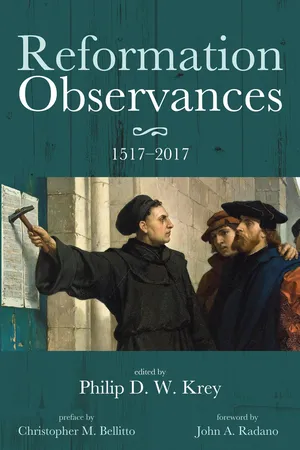
Reformation Observances: 1517–2017
About this book
The year 2017 marks the five-hundredth anniversary of the Reformation, if that event is dated from the posting of Martin Luther's Ninety-Five Theses. Admittedly, 2017 is an arbitrary and somewhat artificial milestone. Nevertheless, anniversaries can be special occasions that allow for an appreciation and evaluation of memorable persons and events. As a number of Reformation anniversaries approach, the historical significance of the Reformation merits increased attention. Employing a variety of historiographical methods from intellectual history to postcolonial theory, this volume demonstrates how four major traditions observed the Reformation: Lutheran, Anglican, Reformed, and Roman Catholic. The foreword and preface place the essays into the contemporary and broader historical contexts in the history of reform. Commemorations of the Reformation varied in different periods, often influenced by immediate historical contexts. How are those sixteenth-century events, which caused both renewal and conflict in church and society as well as divisions between those expressions, to be viewed in the twenty-first century in a setting broader than Europe?
Information
Topic
Theology & ReligionSubtopic
Christian Theology1
Martin Luther and the Lutheran Reformation—October 31, 1517–October 31, 2017
From Augustinian Monk and Doctor of the Church Attempting to Reform Catholic Theology in 1517 to doctor communis of the Church in 2017
1517 The “Posting” of the Ninety-Five Theses and Early Commemorations
We may never know whether on October 31, 1517, Martin Luther actually nailed or had a student nail ninety-five theses on the door of the Castle Church or on other Wittenberg church doors. We do know that his colleague and friend Philipp Melanchthon, who arrived in Wittenberg one year later, thought he did. In a vita about Luther in the preface to the second Wittenberg edition of Luther’s Works (1546) he noted that having been spurred on by Tetzel’s preaching and sale of indulgences Luther nailed the Ninety-Five Theses on the door of the Castle Church on October 31, 1517.1 Luther’s colleague also “held a classroom ceremony for the event out of collegial piety.”2 Martin Luther himself seems to have celebrated the event at home on November 1, 1527, as he reports in a letter to Nikolaus von Amsdorf: “Ten years after the indulgences have been destroyed; in memory of this we both drink and are comforted at this hour.”3 However, there is no mention of his having observed the event in subsequent decades.4 What we do know is that these Ninety-ive Theses intended as a proposal for reform by “an intentionally Catholic theologian” who knew himself to be a teacher of the church5 via theological discussion launched a movement when published that eventually divided the church and perhaps the late-medieval and modern worlds. Those divisions are healing after five hundred years and his reform theology is now gradually being accepted as part of the Roman Catholic tradition such that the 500th Anniversary Celebration of the Reformation will observe him more as the common doctor of the church than hero and prophet.
We know that Luther’s critique of scholastic theology and his theological concerns with indulgences began earlier than the evening and the day of All Saint’s (October 31–November 1) 1517, but this weekend has been etched into the historical imagination over the centuries that this essay will address. Scholars have proposed that Martin Luther’s reform can now be understood as the most significant in a series of medieval and late-medieval attempts at reform.6 In some sense the Roman Catholic Church had become immune to the many attempts at reform from, for example, the Mendicant movements of the thirteenth century that were received by Pope Innocent III to the failed reforms of the Conciliar movement of the fifteenth century that foundered on the reefs of nationalism and a timeless attraction for a strong leader over against a constitutional and balanced papal monarchy. In any event, in the sixteenth century the context left Luther, the Augustinian monk and young professor of theology at the University of Wittenberg, with a proposal for reform and a number of secret sympathizers but a hardened church structure that made dialog impossible.7 He was eventually declared a heretic.8
What happened on that critical day?9 The Augustinian monk and young professor at the University of Wittenberg (age 34), Dr. Martin Luther sent a letter to the Archbishop of Magdeburg–Mainz alerting him of the danger to the proclamation of the Gospel in his territory since the Dominican Friar Johann Tezel was marketing and exaggerating the sale of indulgences. To this letter Luther attached theses arguing theologically against the sale of indulgences.10 He did not expect the Prince-Bishop to respond to the theses, as the disputation was the right and duty of the university.11 Thus Luther was working on this issue for some time. The Wittenberg faculty including Andreas Karlstadt was preparing for theological debate.12 Luther had been researching the ecclesiastical, theological, and legal grounds for indulgences earlier in 1517 and was distressed by the great collection of relics that Prince Frederick had stored at the Castle Church—the list of which would be read publicly on All Saints Day, November 1. Historians agree that whether or not the Theses were posted, the events of the days lose none of their historical importance.13 To some extent Luther was surprised by the broad reception that the Theses received. That the subsequent sermon “On Indulgences and Grace” (Feb. 2, 1518) in German enjoyed at least twenty editions surprised Luther.14 What was and remains decisive is the Reformation’s proposal to the church catholic, a proclamation of the gospel that continues to challenge and influence Lutheran, Reformed, and Roman Catholic Christians to this day.15
What we also know is that as the Reformation movement developed the nailing of the Theses was not the focus of commemorations but the life events of Martin Luther himself—his birth and death dates—and the anniversaries of key Reformation events—the establishment of Lutheranism in different territories, the Diet of Augsburg, or the Book of Concord. To some extent the date and event itself was lost to history for a century and the message was overshadowed by the larger than life figure of Luther, himself and the movement that the content of the theses set in motion.
Given the context of the church and personalities involved, the movement that was launched, in particular, by the mailing of the Theses and later explanations unleashed forces that were irreversible and hurtled towards schism and not for the Wittenberg faculty’s hoped for theological discussion. Tetzel felt compelled to respond and Eck took it upon himself to challenge Luther.16 Given that Luther himself was soon considered a “prophet teacher and hero” by his followers the anniversaries of his ...
Table of contents
- Title Page
- Contributors
- Foreword
- Preface
- Acknowledgments
- Abbreviations
- Introduction
- Chapter 1: Martin Luther and the Lutheran Reformation—October 31, 1517–October 31, 2017
- Chapter 2: Martin Luther and the Episcopal Church
- Chapter 3: Celebrating the Dynamic Legacy of the Reformation
- Chapter 4: The Five-Hundredth Anniversary of the Reformation
Trusted by 375,005 students
Access to over 1.5 million titles for a fair monthly price.
Study more efficiently using our study tools.
Frequently asked questions
Yes, you can cancel anytime from the Subscription tab in your account settings on the Perlego website. Your subscription will stay active until the end of your current billing period. Learn how to cancel your subscription
No, books cannot be downloaded as external files, such as PDFs, for use outside of Perlego. However, you can download books within the Perlego app for offline reading on mobile or tablet. Learn how to download books offline
Perlego offers two plans: Essential and Complete
- Essential is ideal for learners and professionals who enjoy exploring a wide range of subjects. Access the Essential Library with 800,000+ trusted titles and best-sellers across business, personal growth, and the humanities. Includes unlimited reading time and Standard Read Aloud voice.
- Complete: Perfect for advanced learners and researchers needing full, unrestricted access. Unlock 1.5M+ books across hundreds of subjects, including academic and specialized titles. The Complete Plan also includes advanced features like Premium Read Aloud and Research Assistant.
We are an online textbook subscription service, where you can get access to an entire online library for less than the price of a single book per month. With over 1.5 million books across 990+ topics, we’ve got you covered! Learn about our mission
Look out for the read-aloud symbol on your next book to see if you can listen to it. The read-aloud tool reads text aloud for you, highlighting the text as it is being read. You can pause it, speed it up and slow it down. Learn more about Read Aloud
Yes! You can use the Perlego app on both iOS and Android devices to read anytime, anywhere — even offline. Perfect for commutes or when you’re on the go.
Please note we cannot support devices running on iOS 13 and Android 7 or earlier. Learn more about using the app
Please note we cannot support devices running on iOS 13 and Android 7 or earlier. Learn more about using the app
Yes, you can access Reformation Observances: 1517–2017 by Philip D. W. Krey, Krey in PDF and/or ePUB format, as well as other popular books in Theology & Religion & Christian Theology. We have over 1.5 million books available in our catalogue for you to explore.