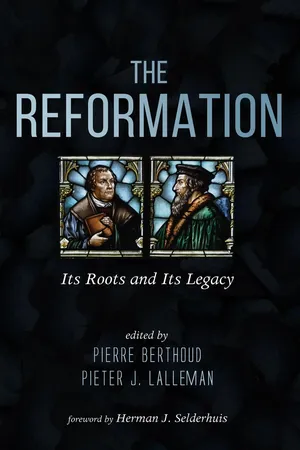
eBook - ePub
The Reformation
Its Roots and Its Legacy
- 246 pages
- English
- ePUB (mobile friendly)
- Available on iOS & Android
eBook - ePub
The Reformation
Its Roots and Its Legacy
About this book
The papers in this volume are less a commemoration of the Reformation than a discussion of its meaning in the era after 2017. What is celebrated in 2017 is not the Reformation as such, but the beginning of the Reformation. It was the dynamics of the "new" theology of Luther and Calvin that caused a radical change with global effects. Reformation is not just an historical event but an ongoing movement of renewal and change. The message of the Reformation constantly challenges us to think through positions, actions, attitudes, and programs.
This book presents contributions from eleven experts from all over Europe, who deal with their various topics on the conviction that the essence of Luther's theology does not need to be adapted to make it relevant. The papers originated at the 2016 conference of the Fellowship of European Evangelical Theologians, which was held in Lutherstadt Wittenberg.
Information
Topic
Theology & ReligionSubtopic
Christian Denominations1
The Reformation, Denominationalism, and the Unity of the Church
Why is the Church so Divided?
One Movement or Many?
It is now customary to date the beginning of the Protestant Reformation to 31 October 1517, the day on which Martin Luther nailed his Ninety-five Theses to the church door in Wittenberg, thereby challenging the authority of the pope and the legitimacy of his claim to exercise jurisdiction over souls in purgatory by the grant of indulgences. What effect Luther’s action actually had is the stuff of legend, but it is safe to say that virtually all Protestants look back to it as the dramatic gesture that signaled the birth of a new and distinct form of Christianity. There is no doubt that Luther ignited a fire that spread across Europe and could not be put out, but he was not the first person to attack the power of the pope over the church. Protest movements against the papacy and its claims had been in the air for a long time and had nothing to do with Luther or with his theological agenda. In England, John Wycliffe (1328–84) and his followers, known as Lollards, had stirred up revolt in the late fourteenth century, promoting the doctrine of Scripture alone as the source of doctrinal authority, and objecting to the idea of transubstantiation in the Eucharist.1 Jan Hus (1370?–1415) and the so-called Utraquists in Bohemia had also objected to what was then the relatively new practice of communion in one kind only, rightly claiming that it had no scriptural justification. Wycliffe and Hus were not connected to each other, but their followers made common cause and created a kind of proto-Protestantism a century before Luther’s Reformation. Earlier still, Peter Waldo (1140?–1205?) had done something similar and attracted followers in Provence (France) and parts of northern Italy. In spite of persecution, they had managed to survive in the Alpine valleys, and their descendants still worship there today. None of these “reform” movements was successful to the degree that the Lutherans would later be, but they all left their mark and remnants of them were still active in the sixteenth century. When Luther’s protest against Rome got going, they mostly identified with it, even though their origins were quite different. The Lollards, who by then were few in number and lacking any organization of their own, merged without trace into the reformed Church of England. The Waldensians survived as an independent church, though they eventually aligned themselves theologically with Calvin and the Reformed tradition, while the Czech Brethren remained a distinct group that has maintained its separate existence to the present time.
At almost exactly the same time as Luther made his initial protest against what he saw as an overbearing papacy, Huldrych Zwingli did much the same thing in Zürich. Whether Luther inspired Zwingli to speak out is debated, but even if he did, the Swiss protest took a different form from its north German counterpart.2 Zwingli focused his attention on the sacraments, which he believed had been corrupted by a false theology, and he developed an understanding of them that was alien to Luther’s mind. Luther’s primary concern was justification by faith alone, which he regarded as the foundation of a true church. When asked to rethink the so-called “real presence” of Christ in the Eucharist, he was willing to reject the Roman doctrine of transubstantiation, which in any case had been a medieval concoction, but he would not adopt the subjective, “receptionist” position advocated by the Zwinglians. Whatever happened in the consecration of the elements of bread and wine, Luther was convinced that Christ was objectively present in the Lord’s Supper, and he regarded Zwingli’s position on this point as deeply unsatisfactory. Their contrasting personalities and different doctrinal concerns also played a role in preventing them from making common cause, but as the joint statement from the Colloquy of Marburg (1529) testifies, they were not as far apart as modern observers like to think. There was still a reasonable hope that, with the right amount of discussion and reflection, a solution could be found that would permit them to unite with one another. But before that possibility could be properly explored, the emperor demanded that Luther and his followers should compose a confession of faith, which was then ratified at the Diet of Augsburg in 1530. This confession ignored the Zwinglians and defined what would henceforth be known as Protestantism according to Luther’s theological criteria. For the next hundred years and more, a Protestant would be someone who adhered to the Augsburg Confession, and anyone who did not accept it would not be recognized as belonging to what had become an alternative church. Later controversies would reveal differences of detail between the Reformers of Zürich and those of Geneva, which were eventually patched up, and there would be a schism among the followers of Luther as well, with some of them inclining more towards the Swiss and others leaning in the opposite direction. By the 1560s the Swiss of both Zürich and Geneva, along with Germans who were sympathetic to them, united under one broadly Reformed label, while the bulk of Luther’s followers declared themselves to be the “genuine” Lutherans, claiming the title by which we know their descendants today.3
But even before the Augsburg Confession was written, some of Zwingli’s followers were pushing the logic of his principles further than he himself was willing or able to go, and they renounced the practice of infant baptism. The Anabaptists, as these people were called, inspired similar movements elsewhere, and before long there were several groups that were loosely included under the Anabaptist label, though their connections with one another were few or non-existent. Some of these radicals revolted against the civil authorities, on whom both Luther and Zwingli depended for support, provoking serious unrest. Soon they were being persecuted by secular rulers, often with the consent of the mainline Reformers, and in the end only remnants of their movements survived. In some cases these survivors joined together with others of like mind, but others rejected any form of compromise and went their separate ways, creating a number of small sects that all wore the Anabaptist label.4
Of course, neither Luther nor Zwingli had any desire to split the church and both men initially hoped that their protest would lead to a general reformation of Western Christendom. They might have accepted the papacy in some kind of figurehead role if the popes had been prepared to support their theological positions, but they wanted a much more conciliar and decentralized approach to church government than the one they knew. Unfortunately neither Rome nor the Holy Roman emperor, whose co-operation would have been needed if any long-term solution was to be found, was willing to accede to the Reformers’ demands, even in principle. As time went on, the papacy recovered from the initial shock of Luther’s revolt and did what it could to restore the unity of the church by overcoming it as best it could. On the theological and diplomatic front the pope summoned what was to become the great reform Council of Trent (1545–63), and initially the Protestants were invited to attend. When they refused, the secular authorities resorted to force of arms, which was more successful in crushing their resistance that many people now realize. Eventually a truce was agreed and the German rulers were allowed to determine whether their states would be Protestant (in the Lutheran sense) or Catholic (cuius regio, eius religio). This was a political decision, not a theological one, and subjects who dissented from their rulers’ verdict were expected to move to a more congenial jurisdiction, thereby aligning church divisions even more closely to the pattern of secular government.5
This solution was unstable because it ignored the growing difference between Lutherans and the so-called “Reformed,” who either had to sign the Augsburg Confession or be excluded from the settlement. Despite some initial prevarication, most of them held their ground and as time went on their numbers increased, with the result that it was not always possible for the secular authorities to enforce a strictly Lutheran interpretation of Protestantism in their territories. It would not be until 1648 that the Reformed would achieve formal recognition, both in the United Provinces of the Netherlands and the Swiss Confederation, which were then effectively detached from the Holy Roman Empire, and also in a number of German states that remained under a revamped imperial jurisdiction which acknowledged their distinct identity for the first time. By then, of course, animosity between the two (or if we include the Anabaptists, three) main branches of Protestantism was almost as great as that between the Protestants and the Roman Catholics, making any form of pan-Protestant unity seem more utopian than ever.6
Politics versus Theology
It might be thought that the danger of persecution from Rome would drive the different Protestant groups together, and to some extent it did, but that outside pressure was never enough to counteract the internal forces that were pulling them in the opposite direction. One factor that must be borne in mind was largely cultural in origin. In its earliest phase the Reformation was almost entirely a “German” affair. Despite their theological differences, Luther and Zwingli spoke the same language and the Zwinglians generally adopted Luther’s German Bible without protest. The Czech Brethren, however, were Slavs, and anti-German feeling had played a part in the Hussite movement from the beginning. On the western side of the Holy Roman Empire, Geneva and Lausanne were French-speaking, and the Netherlands was a world of its own, a collection of seventeen autonomous provinces that spoke a Low German dialect sufficiently different from Luther’s High German to constitute a different language w...
Table of contents
- Title Page
- Contributors
- Foreword
- Introduction
- Chapter 1: The Reformation, Denominationalism, and the Unity of the Church
- Chapter 2: Reformation and Education
- Chapter 3: The Artistic Legacy of the Reformation and Protestant Artists Today
- Chapter 4: “With Psalms and Hymns”
- Chapter 5: The Reformation and Historical-Critical Research in Biblical Interpretation
- Chapter 6: Justification by Faith
- Chapter 7: The Reformation and the Questions of Authority and Truth
- Chapter 8: Guilt, Shame, and Forgiveness
- Chapter 9: The Reformation and the Jews
- Chapter 10: The Reformation and the Challenge of Islam
- Chapter 11: Theologia Crucis and the Persecuted Church
- Chapter 12: Freedom of Conscience, Reformation, and the Advent of Secularism
Trusted by 375,005 students
Access to over 1.5 million titles for a fair monthly price.
Study more efficiently using our study tools.
Frequently asked questions
Yes, you can cancel anytime from the Subscription tab in your account settings on the Perlego website. Your subscription will stay active until the end of your current billing period. Learn how to cancel your subscription
No, books cannot be downloaded as external files, such as PDFs, for use outside of Perlego. However, you can download books within the Perlego app for offline reading on mobile or tablet. Learn how to download books offline
We are an online textbook subscription service, where you can get access to an entire online library for less than the price of a single book per month. With over 1.5 million books across 990+ topics, we’ve got you covered! Learn about our mission
Look out for the read-aloud symbol on your next book to see if you can listen to it. The read-aloud tool reads text aloud for you, highlighting the text as it is being read. You can pause it, speed it up and slow it down. Learn more about Read Aloud
Yes! You can use the Perlego app on both iOS and Android devices to read anytime, anywhere — even offline. Perfect for commutes or when you’re on the go.
Please note we cannot support devices running on iOS 13 and Android 7 or earlier. Learn more about using the app
Please note we cannot support devices running on iOS 13 and Android 7 or earlier. Learn more about using the app
Yes, you can access The Reformation by Pierre Berthoud, Pieter J. Lalleman, Pierre Berthoud,Pieter J. Lalleman, Berthoud, Lalleman in PDF and/or ePUB format, as well as other popular books in Theology & Religion & Christian Denominations. We have over 1.5 million books available in our catalogue for you to explore.