- 208 pages
- English
- ePUB (mobile friendly)
- Available on iOS & Android
eBook - ePub
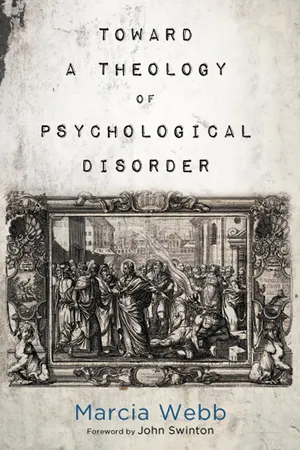
Toward a Theology of Psychological Disorder
About this book
How do Christians in the twenty-first century understand psychological disorders? What does Scripture have to teach us about these conditions? Marcia Webb examines attitudes about psychological disorder in the church today, and compares them to the scriptural testimony. She offers theological and psychological insights to help contemporary Christians integrate biblical perspectives with current scientific knowledge about mental illness.
Information
Topic
Theology & ReligionSubtopic
Mental Health in PsychologyPart I
The Current Dilemma Regarding Psychological Disorder in Christian Culture
1
Introduction to the Dilemma
I’m going to hell! I’m going to hell!”
My client is seated across from me in my office, yelling. She is pounding her fist against one thigh, as if to punctuate each sentence. She had briefly alluded to her fears about hell in previous sessions with me, when I met her a few weeks ago as a psychiatric inpatient, but now she is screaming these words, repeating the same fears again and again.
“God is going to send me to hell! I’m going to hell!”
“Wait, wait,” I say, trying to calm her. “Why is God going to send you to hell?”
She tells me of her lack of faith, of her anxiety and despair. She begins yelling and pounding her fist again. “God is going to send me to hell!”
I do not know what to say. I sit for several seconds and watch her screaming. Having only recently earned my doctoral degree, I try to remember anything I may have learned in my graduate psychology training that would help me respond to her now. Did my professors talk about clients who were terrified of God’s wrath? I want to tell her of God’s compassion, but I wonder if, in doing so, I might step outside my professional role as a psychotherapist. She begins to cry as she relates her inadequacies as a Christian; she states that if she had faith in God, she would not experience this anxiety and despair.
“Well,” I start, hesitating, “. . . uh, I don’t know what God thinks about your future, or even about my future, to be honest . . . I don’t know what I can say about that . . . But I do know something about you. I know you loathe yourself. I’ve listened to you say very cruel things about yourself in these sessions. So I bet if you were God, you would send yourself to hell.”
She stares at me, silently, for a second or two. Then she sighs, closing her eyes and lowering her head. She begins to describe her self-hatred, and her difficulty imagining that God might feel any differently about her. For that session, for that day, she stops screaming. But in sessions to come we will revisit these same issues—this intense sense of her failure as a Christian, and her fears of God’s abandonment because of her anxiety and despair.
The Dilemma
As a clinical psychologist with approximately two decades of experience, I have listened to the concerns of Christians with various psychological disorders, including depression, anxiety, trauma, dissociation, and occasionally, psychosis. Sometimes a single encounter with a client has served as a catalyst for personal reflection for years to follow. This session with my client who feared God’s wrath, occurring decades ago, impacted me this way.
Although my client was able to calm herself that day when we considered that perhaps her self-loathing had skewed her image of God, as time passed, I was not sure this explanation fully addressed all the sources of her fears. As a therapist, I have heard Christian clients over the years express similar concerns. They have described the shame they felt about their psychological struggles. “Shouldn’t a believer be protected from anxiety?” they’d ask. “Isn’t despair a sin?” At times they also described how they felt judged by church members because of their disorders.
I was also aware of similar beliefs about mental illness in the faith community. Since my conversion to Christianity as an adolescent, I had attended churches of various denominations, and over the decades, I had heard statements from both religious leaders and congregants that associated psychological disorder with sin or spiritual failure. Yet, other than these occasional, negative messages, it seemed at times that Christians had very little to say about these afflictions. If I had not known otherwise from my training and clinical experience as a psychologist, I might have wondered if mental illness in the faith community was, for the most part, nonexistent.
And yet, I did know otherwise. While data from epidemiological studies may vary, depending on the population studied and the research methods employed, psychological disorder is an increasing societal problem. In developed nations, mental disorders currently produce more disability than any other subset of medical conditions, surpassing even cardiovascular disease or cancer, with prevalence rates of approximately 25 percent of adults in the United States alone.1 The World Health Organization has reported that “lifetime prevalence rates for any kind of psychological disorder are higher than previously thought” and these rates “are increasing in recent cohorts.”2
For individuals with these disorders, mental illness can assume a central role in life experience, as they struggle to navigate through daily events with any number of cognitive, affective, behavioral, and social impairments. Yet the epidemiological information I have cited above does not include the vast numbers of people who must also confront the challenges of psychological disorder because they are the spouses, parents, siblings, children, or close friends of individuals with these diagnoses. Mental illness profoundly impacts those with disorders and their loved ones as well.
If the church is often silent about these problems, how then do believers understand mental disorder from the perspective of Christian faith? Christ called his disciples to love God with all of our hearts, souls, minds, and strength (Mark 12:29–30). How do believers understand this commission if they consider their minds to be in some way impaired?
These questions become even more perplexing when we consider the nature of those scattered messages about psychological disorder which do occasionally emerge out of the church’s general silence. While at times these messages may promote insight, compassion, and support, at other times, they contradict those received from research scientists and mental health professionals. According to research, certain forms of depression may result in part from genetic and biological influences on development. Yet Christian leaders may preach that happiness is a matter of personal choice, or that joy results from a believer’s decision. From a scientific perspective, the hallucinations and delusions evident in schizophrenia are associated with impaired brain functioning, and are often successfully treated with medication. Among some Christian groups, however, hallucinations and delusions may be viewed as evidence of demonic influence.
How do persons with mental disorders, and their loved ones, make sense of these discrepancies? When one’s conception of the Christian life contradicts with one’s conception of psychological functioning in general, and mental illness in particular, this incongruity itself can become a source of confusion and distress. Psychological disorders are confusing and distressing enough without these additional inconsistencies for believers. People with these disorders need to feel at peace with God and at peace with themselves to move toward greater psychological stability and improved, overall well-being.
I have often sensed, then, that Christians with mental disorders need more than scientific information about them. They also need a way of understanding themselves that integrates reasonably well with their personal experience, their scientific knowledge of mental health, and their Christi...
Table of contents
- Title Page
- Foreword
- Acknowledgments
- Preface
- Part I: The Current Dilemma Regarding Psychological Disorder in Christian Culture
- Part II: Toward a Theology of Psychological Disorder
- Bibliography
Trusted by 375,005 students
Access to over 1.5 million titles for a fair monthly price.
Study more efficiently using our study tools.
Frequently asked questions
Yes, you can cancel anytime from the Subscription tab in your account settings on the Perlego website. Your subscription will stay active until the end of your current billing period. Learn how to cancel your subscription
No, books cannot be downloaded as external files, such as PDFs, for use outside of Perlego. However, you can download books within the Perlego app for offline reading on mobile or tablet. Learn how to download books offline
Perlego offers two plans: Essential and Complete
- Essential is ideal for learners and professionals who enjoy exploring a wide range of subjects. Access the Essential Library with 800,000+ trusted titles and best-sellers across business, personal growth, and the humanities. Includes unlimited reading time and Standard Read Aloud voice.
- Complete: Perfect for advanced learners and researchers needing full, unrestricted access. Unlock 1.5M+ books across hundreds of subjects, including academic and specialized titles. The Complete Plan also includes advanced features like Premium Read Aloud and Research Assistant.
We are an online textbook subscription service, where you can get access to an entire online library for less than the price of a single book per month. With over 1.5 million books across 990+ topics, we’ve got you covered! Learn about our mission
Look out for the read-aloud symbol on your next book to see if you can listen to it. The read-aloud tool reads text aloud for you, highlighting the text as it is being read. You can pause it, speed it up and slow it down. Learn more about Read Aloud
Yes! You can use the Perlego app on both iOS and Android devices to read anytime, anywhere — even offline. Perfect for commutes or when you’re on the go.
Please note we cannot support devices running on iOS 13 and Android 7 or earlier. Learn more about using the app
Please note we cannot support devices running on iOS 13 and Android 7 or earlier. Learn more about using the app
Yes, you can access Toward a Theology of Psychological Disorder by Marcia Webb in PDF and/or ePUB format, as well as other popular books in Theology & Religion & Mental Health in Psychology. We have over 1.5 million books available in our catalogue for you to explore.