- 150 pages
- English
- ePUB (mobile friendly)
- Available on iOS & Android
eBook - ePub
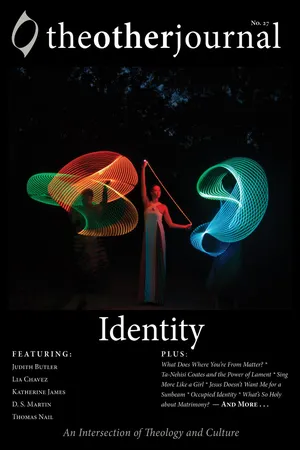
The Other Journal: Identity
About this book
FEATURING:
Judith Butler
Lia Chavez
Katherine James
D. S. Martin
Thomas Nail
PLUS:
What Does Where You're From Matter? * Ta-Nehisi Coates and the Power of Lament * Sing More Like a Girl * Jesus Doesn't Want Me for a Sunbeam * Occupied Identity * What's So Holy about Matrimony?
AND MORE . . .
"We the people . . ." So begins the familiar first line to the Preamble of the United States Constitution. But even in its initial context, in a document intended to be a manifesto of hope and freedom, the matter of who exactly was to be included in this "we" was unclear and contested. First-person pronouns (i.e., I and we) roll off the tongue-or onto parchment paper-with ease, but their common use often belies an underlying complexity. Who am I? Who are we? Who does my theology say that I am?
Identity is at the same time essential to life and yet also deeply contested, problematic, and enigmatic. The world may be becoming more one and, yet, it seems also to be becoming more different, fragmented, agonistic, and isolated. In this issue of The Other Journal, we explore the valences of identity, both individual and communal, personal and public. We take up the theme of identity in multiple ways, examining its interconnections with gender and race, the dissolution and reconstitution of borders, and, yes, even the 2016 presidential campaign.
The issue features essays by Derek Brown, Zach Czaia, Ryan Dueck, Julie M. Hamilton, Peter Herman, Zen Hess, Kimberly Humphrey, Katherine James, Russell Johnson, Sus Long, Willow Mindich, Angela Parker, Taylor Ross, and Erick Sierra; interviews by Stephanie Berbec and Zachary Thomas Settle with Judith Butler and Thomas Nail, respectively; poetry by T. M. Lawson, D. S. Martin, Oluwatomisin Oredein, and Erin Steinke; performance art by Lia Chavez; and photography by Jennifer Jane Simonton, Pilar Timpane, and Mark Wyatt.
Information
Topic
Theology & ReligionSubtopic
Christian Theology1 We were all storm chasers there
Nebraska, May 2001
If you don’t like the weather
wait twenty minutes, just like that
from sun to tornado, a wild ride—
home base to the edge of town
where the roads flatten into single-lane gravel
as the Kimball county sign flashes by
in lightning that shows we’re almost there
almost at its heart
almost got it by the throat
a funnel ready to drop from the telltale
wall cloud, all that potential pressure
and if we drive farther
just a bit faster
we may arrive
see that smoky white shard from the heart of God
stretch to scratch its message in a field—
a hieroglyph in dust and root.
Or the wind may shift
that olive green light
all those sure signs
now tricks and winks
leaving us with bones creaking
in the barometric weight of lost chance.
2 Strange, Like Pentecost: A Journey for the True Church
I woke up in the middle of the night to find I’d been sleepwalking, knocking over tables and shattering glass and spilling food across floors, leaving my apartment a wreckage of spiritual hunger. Although it happened in an instant, this coming-to had been decades in the making, for the journey has spanned a much longer distance than these late-night hours or the square footage of my small urban apartment. It has spanned decades and nearly every region of Christianity. By the time I was eighteen, I’d been a Catholic, an inner-city Latin American Pentecostal, and a suburban megachurch evangelical. Later in my twenties, I’d burrow myself in a Southern Baptist church, then in a working-class charismatic church, then in a non-denominational congregation serving an elite university. In my mid-thirties, I’d enter into leadership at a high-brow upper-Manhattan Presbyterian church. Then two summers ago, turning forty, I was received by Holy Chrismation into the Eastern Orthodox Church, anointed of the same batch of oil that graced the Apostles. And now, waking from this long somnambulance of restless seeking, I dart frantic eyes about me trying to gain my bearings: Where am I? How did I get here? What have I been looking for?
My earliest memories of this journey are in the Catholic church of my boyhood, where I served as head altar boy and attended the parish school for eight years. Here, I experienced God as the roiling of music and the shimmering of liturgy. At the end of Mass, the organist would lose himself in the closing crescendos of his musical score; having fulfilled my altar duties, I’d hurry back into the church to experience the sound amid icon, incense, candle, and glass—an immersive kaleidoscope irradiated with divine Presence.
Driving much of my desire for a heavenly Father was the absence of an earthly father. For twelve years, he had descended into a heroin addiction that shriveled his body and led, finally, to my parents’ divorce. He left home when I was ten and disappeared for three years. Then he called one day saying he was back. He had been “delivered” from drugs, he said, “by the hand of the living God.”
At first I saw this as just another one of his shenanigans to lure us back, but over time I came to feel that the immanent Presence I’d sensed as a boy had somehow broken through the veil and erupted, fierce and alive, in my father’s life. It began remaking him into this man who’d returned to us tall, radiant, ready to love and serve. My parents remarried a year later. In time, my father would go on to become executive director of the drug-rehabilitation program that he himself had completed, Teen Challenge Brooklyn, and to this day he remains the greatest Christian I know.
I fell in love with the church he was attending at the time, a Latin American Pentecostal congregation in Brooklyn. Soon, the mighty force that had seized upon him would start after me. In this environment, my concept of God would transform from ethereal Presence into the winds of disruptive force; as my new spiritual elders put it, I was now being indwelt with the Holy Spirit, lleno del Espíritu Santo.
God had given me back my father, so I would dance like David, voice throttling and hands reaching toward Spirit descending. Eventually, I would receive the gifts of the Spirit, particularly the gift of speaking in tongues. As my exercise of these gifts developed, I’d even receive, just a couple of times, a word of prophesy, an intuition concerning a stranger on the subway that would turn out to be true—but wait . . . how did you know that? how do you know that about me! To this day, these experiences are the closest I feel I’ve ever been to God’s reality.
At the time, it never occurred to me to view any of these new religious experiences as materially different from what I’d experienced earlier as an altar boy. I saw my entire journey from Catholicism to Pentecostalism as an unfolding—as if God had been wooing me from behind Catholic imagery in preparation for this new form of relating. Wasn’t the God who once filled my mouth with eucharistic grace the same one now filling it with other tongues? But no! the people at my church retorted. Catholicism was the “musical chairs” of ritual—at best a distraction, at worst a deception. But I should be thankful, they insisted, that God had led me to a “Full Gospel” church stripped of “man-made tradition” and allowing the Spirit to shine through. So I did as I was told, beating back the Catholic imaginary of my childhood and pressing on to the revelation now entrusted me.
A couple of years later, when I was a senior in high school, my family moved to the Washington DC area and I joined my father in attending a largely white suburban evangelical Bible church that had attracted his attention there. My first impression was that no one spoke in tongues. Why was the Spirit not present? Why were these people not grateful, dancing and raising their hands, exalting God for all he is and has done? I soon began to see what had drawn my dad to this church, though. There was something different at work here. These Christians had a high view of the Bible as ...
Table of contents
- Title Page
- Letter from the Editors
- 1 We were all storm chasers there
- 2 Strange, Like Pentecost: A Journey for the True Church
- 3 Autobiographical Memory and the Art of Storytelling and Narrative Identity: A Poetics of the Self
- 4 What Does Where You’re From Matter?
- 5 Tit for Tat
- 6 Being Pretty
- 7 Elena Ferrante’s Words Are Good Enough
- 8 Ta-Nehisi Coates and the Power of Lament
- 9 Sing More Like a Girl
- 10 Performativity and the Flesh: The Economy of the Icon in Lia Chavez’s Light Body
- 11 We Are Worldless Without One Another: An Interview with Judith Butler
- 12 Behind Blue Eyes: Consubstantiality and the Unthinkable
- 13 Jesus Doesn’t Want Me for a Sunbeam: Thoughts on Depression, Race, and Theology
- 14 An Unnatural Order
- 15 Kinopolitics and the Figure of the Migrant: An Interview with Thomas Nail
- 16 handiwork
- 17 Street Portraits: Anonymity as Identity
- 18 Occupied Identity: The Aesthetics of Palestinian Suicide Bombing
- 19 Can’t Stop the Feelings: Anger and Identity in Mark 6:17–29
- 20 What’s So Holy about Matrimony? A Feminist Theological Reflection
- 21 Portrait with Eyes Turned Aside
- Contributors
Trusted by 375,005 students
Access to over 1.5 million titles for a fair monthly price.
Study more efficiently using our study tools.
Frequently asked questions
Yes, you can cancel anytime from the Subscription tab in your account settings on the Perlego website. Your subscription will stay active until the end of your current billing period. Learn how to cancel your subscription
No, books cannot be downloaded as external files, such as PDFs, for use outside of Perlego. However, you can download books within the Perlego app for offline reading on mobile or tablet. Learn how to download books offline
Perlego offers two plans: Essential and Complete
- Essential is ideal for learners and professionals who enjoy exploring a wide range of subjects. Access the Essential Library with 800,000+ trusted titles and best-sellers across business, personal growth, and the humanities. Includes unlimited reading time and Standard Read Aloud voice.
- Complete: Perfect for advanced learners and researchers needing full, unrestricted access. Unlock 1.5M+ books across hundreds of subjects, including academic and specialized titles. The Complete Plan also includes advanced features like Premium Read Aloud and Research Assistant.
We are an online textbook subscription service, where you can get access to an entire online library for less than the price of a single book per month. With over 1.5 million books across 990+ topics, we’ve got you covered! Learn about our mission
Look out for the read-aloud symbol on your next book to see if you can listen to it. The read-aloud tool reads text aloud for you, highlighting the text as it is being read. You can pause it, speed it up and slow it down. Learn more about Read Aloud
Yes! You can use the Perlego app on both iOS and Android devices to read anytime, anywhere — even offline. Perfect for commutes or when you’re on the go.
Please note we cannot support devices running on iOS 13 and Android 7 or earlier. Learn more about using the app
Please note we cannot support devices running on iOS 13 and Android 7 or earlier. Learn more about using the app
Yes, you can access The Other Journal: Identity by Andrew David, Other Journal in PDF and/or ePUB format, as well as other popular books in Theology & Religion & Christian Theology. We have over 1.5 million books available in our catalogue for you to explore.