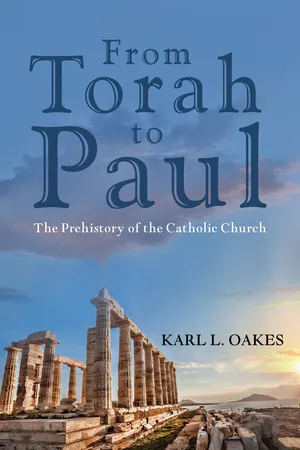
Where did the Catholic Church come from? Ask any Roman Catholic this question and, without a moment's hesitation, they will tell you they are the heirs of St. Peter. He was the first pope, leading and guiding the young Christian movement from Rome. This claim can be traced back to the first century Epistle of Clement to James. The second-century embellishment, known as the Teaching of Simon Cephus, asserts that Peter served in Rome for twenty-five years.However, there is not a single, solitary scrap of Scripture that places Peter at Rome. Not one. In the Acts of the Apostles, we read of Peter at Joppa, at Caesarea, he made a trip up to Syrian Antioch, and he played a major role in the Jerusalem Council in AD 49. When Paul wrote to the saints at Rome in AD 57, he greeted about twenty of the faithful by name--but not Peter, the supposed bishop. Paul was imprisoned in Rome from AD 60 to AD 62, and wrote at least five epistles during that period. Again, Peter is strangely missing.From Torah to Paul advances a provocative new theory of church history. Far from being the heirs of St. Peter, the Catholic Church is shown to be the offspring of the false apostles, the oldest heresy of Christendom. The evidence produced in this book proves beyond a shadow of a doubt that the conventional wisdom on Catholic origins, believed by hundreds of millions, was in fact the grand deception of the ages.
- 216 pages
- English
- ePUB (mobile friendly)
- Available on iOS & Android
eBook - ePub
About this book
Information
Topic
Theology & ReligionSubtopic
ReligionChapter One
The Background of the Schism
AD 30 to AD 60
For in Jesus Christ neither circumcision availeth any thing, nor uncircumcision; but faith which worketh by love.
—Galatians 5:6
The complete story of the first century Christian church has never been told. There is an abundance of clues sprinkled through the New Testament and the patristic literature, but they have been overshadowed by counterfeit documents designed to deceive and mislead. And mislead they have. The actual history of the period is dominated by a messy doctrinal dispute, false teachers who rejected the authority of the apostles, and a colossal deception, all culminating in an unrecorded schism. Perhaps we should not be surprised. Heresy, the tendency to mix the teachings of Jesus with the traditions of men, is one of the traits of human nature (flesh) mentioned on Paul’s list.1
The young Christian movement had to contend with two distinct forms of heresy before the close of the apostolic age. The first to apostatize was a small faction of believing Pharisees. These men had grown up revering the Law of Moses; they stood in awe of its divine origin and believed it was God’s will for all men and all time. They simply could not accept the decision of the apostles regarding Gentile believers. The second set of false teachers were the Gnostics. They went to the other extreme, utterly denying the God of Abraham and the covenant He had made with Moses. After detaching the gospel of Jesus Christ from its Jewish base, they combined it with elements of Greek philosophy.
The religious tradition that has dominated the western world grew out of a dispute over the Law. God had revealed the Torah, the glory of Israel, to Moses amid the thundering and lightning on Mount Sinai. They were promised wonderful natural blessings and temporal advantages if they lived within its borders.
If ye walk in my statutes, and keep my commandments, and do them; then I will give you rain in due season, and the land shall yield her increase, and the trees of the field shall yield their fruit. And your threshing shall reach unto the vintage, and the vintage shall reach unto the sowing time: and ye shall eat your bread to the full, and dwell in your land safely. And I will give peace in the land, and ye shall lie down, and none shall make you afraid: and I will rid evil beasts out of the land, neither shall the sword go through your land.
—Leviticus 26:3–6
This covenant, though, was subject to some limitations. The blessings of Torah were given to a specific people (the Jews), who inhabited a certain land (Israel), and they were restricted to natural life. Eternal life was never part of the bargain and one influential sect, the Sadducees, did not even believe in life after death.2 Beginning with Moses, the Hebrew prophets wrote with increasing clarity about a Messiah who would usher in an everlasting kingdom of righteousness.
When Christ came, he directed his ministry toward the lost sheep of the house of Israel.3 Later, of course, he sent them out to the whole world, but the apostles and first disciples were all Jewish. They continued to keep the commandments of Torah and attend synagogue along with their unbelieving neighbors.4 After the resurrection, however, they withdrew from the synagogues, and the apostles laid the foundation for a Christ-centered fellowship. They established separate gatherings for worship, instituted the breaking of bread to commemorate the risen Savior, and designated Sunday, the day of the resurrection, as the Christian day of fellowship.5 We are not told when this happened but, according to Acts 2:42, it could not have been too long after the resurrection. “And they continued steadfastly in the apostle’s doctrine and fellowship, and in breaking of bread, and in prayers.”
The fledgling church grew by leaps and bounds the first few years. Three thousand souls were added on the day of Pentecost, five thousand men on another occasion, and a “multitude” of seekers came to Christ after Ananias was struck dead. The light of the glorious Gospel even penetrated into the temple. “The number of disciples multiplied in Jerusalem greatly, and a great company of the priests were obedient to the faith.”6 This was all happening within the walls of the Holy City, in full view of all Israel.
The apostles had their hands full in those early years. The first Christians broke bread in private homes, and if each one held twenty-five or thirty people, there would have been hundreds of such gatherings in Jerusalem alone. To put this into perspective, Jerusalem, a city of approximately 90,000 inhabitants, had 480 synagogues.7 The Sadduccean establishment initially reacted to the threat of mass apostasy with threats and intimidation. But after several public confrontations in the temple, they stepped it up to beatings and imprisonment. A flashpoint was reached with the trial and stoning of Stephen. Leaving the leadership behind in Jerusalem, many of the disciples fled north up the Mediterranean coastline from Samaria to Syria.
This was when the door of salvation begins to open to the Gentiles. Although they had been given a mandate to “go and teach all nations,” the Christ...
Table of contents
- Title Page
- Preface
- Abbreviations
- Chapter 1: The Background of the Schism
- Chapter 2: The Founding Charter
- Chapter 3: The Teaching Develops and Spreads
- Chapter 4: Church Polity and the Rites of Worship
- Chapter 5: The Fathers of Uncleanness
- Chapter 6: The Primitive Eucharistic Meal
- Chapter 7: The Dawning of the Pauline Day
- Chapter 8: The Evolution of the Canon
- Chapter 9: The Meaning of the Eucharist
- Chapter 10: The Roman Reformation
- Chapter 11: The Great Feast: Easter
- Chapter 12: Chronology and Mythology
- Chapter 13: Peter and Rome
- Placing the New Testament Writings in History
- The Earliest Patristic Witnesses to the New Testament Books
- Dating the Patristic Literature
- Epistle of Peter to James
- Epistle of Clement to James
- The Didache
- Bibliography
Trusted by 375,005 students
Access to over 1.5 million titles for a fair monthly price.
Study more efficiently using our study tools.
Frequently asked questions
Yes, you can cancel anytime from the Subscription tab in your account settings on the Perlego website. Your subscription will stay active until the end of your current billing period. Learn how to cancel your subscription
No, books cannot be downloaded as external files, such as PDFs, for use outside of Perlego. However, you can download books within the Perlego app for offline reading on mobile or tablet. Learn how to download books offline
We are an online textbook subscription service, where you can get access to an entire online library for less than the price of a single book per month. With over 1.5 million books across 990+ topics, we’ve got you covered! Learn about our mission
Look out for the read-aloud symbol on your next book to see if you can listen to it. The read-aloud tool reads text aloud for you, highlighting the text as it is being read. You can pause it, speed it up and slow it down. Learn more about Read Aloud
Yes! You can use the Perlego app on both iOS and Android devices to read anytime, anywhere — even offline. Perfect for commutes or when you’re on the go.
Please note we cannot support devices running on iOS 13 and Android 7 or earlier. Learn more about using the app
Please note we cannot support devices running on iOS 13 and Android 7 or earlier. Learn more about using the app
Yes, you can access From Torah to Paul by Oakes in PDF and/or ePUB format, as well as other popular books in Theology & Religion & Religion. We have over 1.5 million books available in our catalogue for you to explore.